
IB Results Day: when your stomach drops
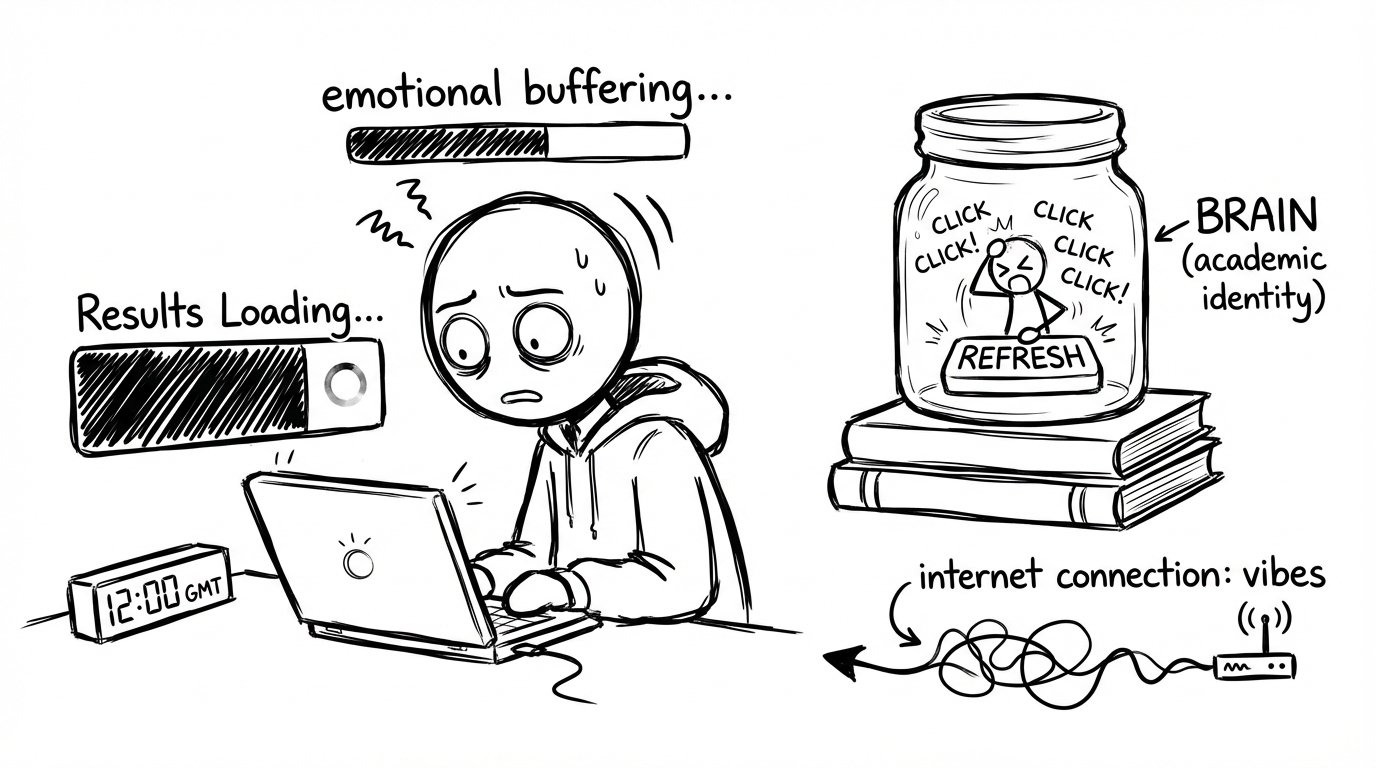
The screen loads. Your heart does that strange thing where it feels both too fast and too quiet. You tell yourself it's just numbers, just an outcome, just a system.
Then the IB result appears, and your brain immediately starts writing a story you didn't agree to.
Maybe it's lower than your predicted. Maybe one subject slid from a safe 6 to a shaky 4. Maybe the diploma status line is not what you expected. Or maybe you can't even log in and you're already convinced the universe has chosen chaos.
If you're an IB student preparing for exams, it's easy to imagine results day as a single moment of truth. But real life doesn't work like that. Results day is a junction, not a verdict. And even if everything goes wrong, there are moves you can make that are calm, strategic, and surprisingly effective.
The quick IB results day checklist (save this)
If your IB results feel like a disaster, don't freestyle. Run a checklist.
- Confirm you're reading the right things: total points, subject grades, core points, diploma status.
- Take a screenshot or write the results down (calmly, accurately).
- Pause for 10 minutes before texting anyone.
- Contact your IB coordinator: ask about component marks, boundaries, and your options.
- If university offers are involved: prepare a short email today.
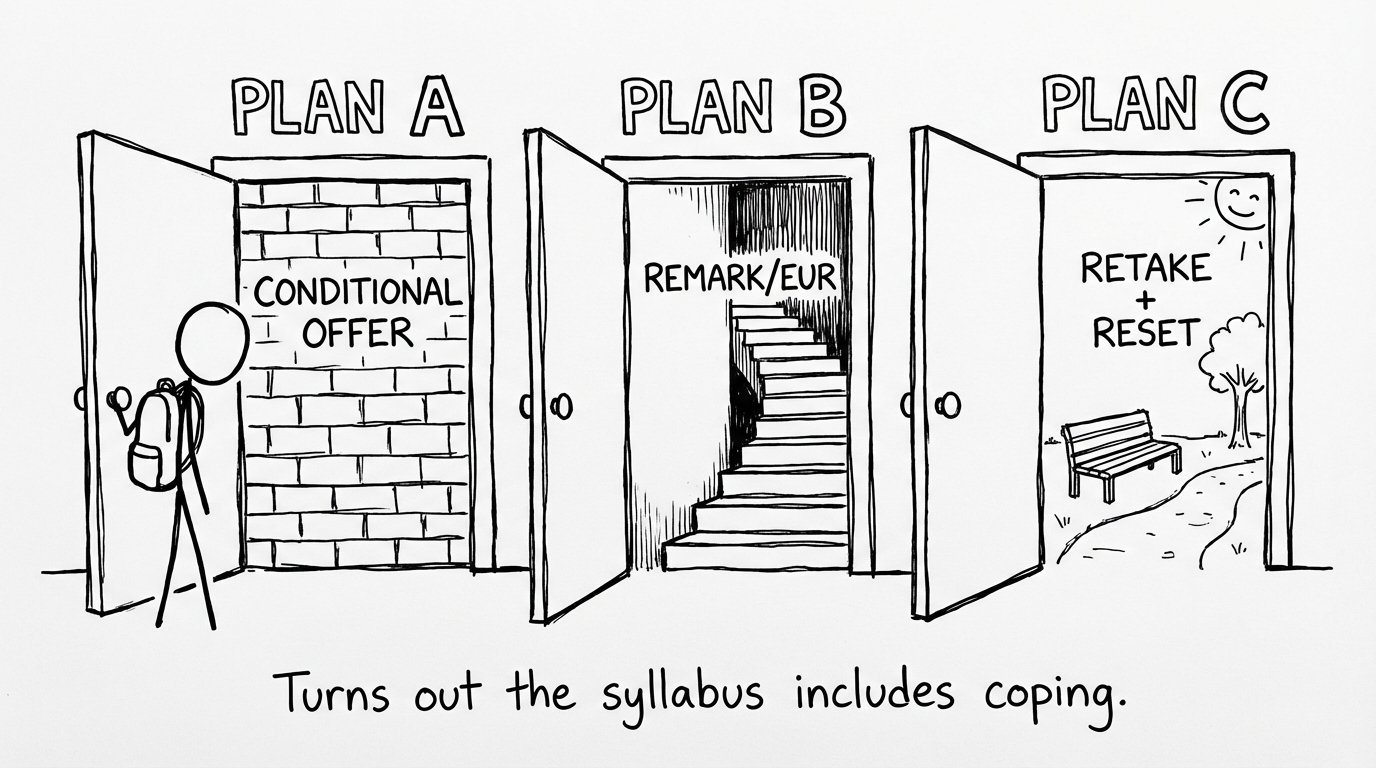
- Decide whether you're exploring a remark (EUR), retake, or alternative pathway.
- Build a 2-week plan so your next action isn't emotional.
For logistics like dates, access, and what to expect, keep this open: IB Results Day: What to Expect and What to Do Next.
First: define what "everything goes wrong" actually means in IB
In IB, panic loves vagueness. The words "I failed" or "it's over" feel final because they're blurry. Clarity is the fastest way to get your agency back.
Here are the most common "everything went wrong" scenarios:
You missed your university condition
That's painful, but it's not instantly terminal. Some universities flex, some offer alternatives, and some just want a quick, professional explanation and your plan.
You're 1--2 points away from the diploma or a key subject grade
This is where a remark (Enquiry Upon Results, often shortened to EUR) can matter. Not always, but sometimes.
One subject collapsed
That can change your total and your options, but it also gives you a single target. Retakes are psychologically hard, but academically straightforward.
You did "fine," but it still feels wrong
A 30 can feel like failure if you were expecting 38. That gap is real. But it's also a sign you're measuring your worth with the wrong ruler.
If you want the timeline and timing details (and to avoid refreshing at the wrong hour), this helps: IB Results Day 2025: Exact Date, Key Timings, and What to Expect.
The two things to do in the first hour (even if you're shaking)
Make the situation legible
Write down:
- Total points
- Each subject grade
- TOK/EE grades and core points
- Whether diploma requirements were met
This isn't busywork. In IB, your next steps depend on which specific requirement broke.
Borrow calm from someone who knows the system
Contact your IB coordinator. Don't ask "What do I do with my life?" Ask:
- Can you share my component marks?
- How close am I to the next boundary in each subject?
- What are the deadlines for an EUR?
- If I retake, what does registration look like?
The system is bureaucratic. That's good news. Bureaucracy means there are procedures.
IB remarks (EUR): when a recheck is rational, not desperate
A remark is not a magic spell. But in IB, it can be a reasonable move if:
- You are very close to a grade boundary.
- The subject is essay-heavy (where examiner judgment has more room).
- Your university offer depends on that specific change.
What a strong EUR decision looks like:
- You choose 1--2 subjects max (usually the ones that change the outcome).
- You check how many marks you need to move up.
- You accept the emotional reality: a grade can go up, stay the same, or go down.
If you need a practical overview of results access and the immediate options, this guide is useful: What Should I Do on the IB Results Day? (Survival Guide).
IB retakes: the quiet power of a clean second attempt
Retakes sound like shame because we attach stories to timelines. But the IB is not judging your character. It's measuring performance in a specific format under specific constraints.
A retake can be a smart move when:
- The change you need is too large for an EUR.
- You missed the diploma requirement.
- You're reapplying or your program needs a higher score.
The best mental reframe is simple:
You're not "doing IB again." You're doing one subject (or two) correctly, with evidence.
If you decide to retake, build your plan around the most exam-shaped loop possible:
- Use Study Notes to rebuild the core concepts without rewriting your life.
- Use Flashcards to keep daily recall alive.
- Use a Questionbank to drill weak topics by type and difficulty.
- Use AI Chat to fix misconceptions fast.
- Use Mock Exams and Predicted Papers to make timing feel normal.
RevisionDojo is designed for exactly that loop. If you want to see how the pieces fit, start here: RevisionDojo App: The Smarter Way to Prep for IB Exams.
The university email: how to sound like a person, not a panic attack
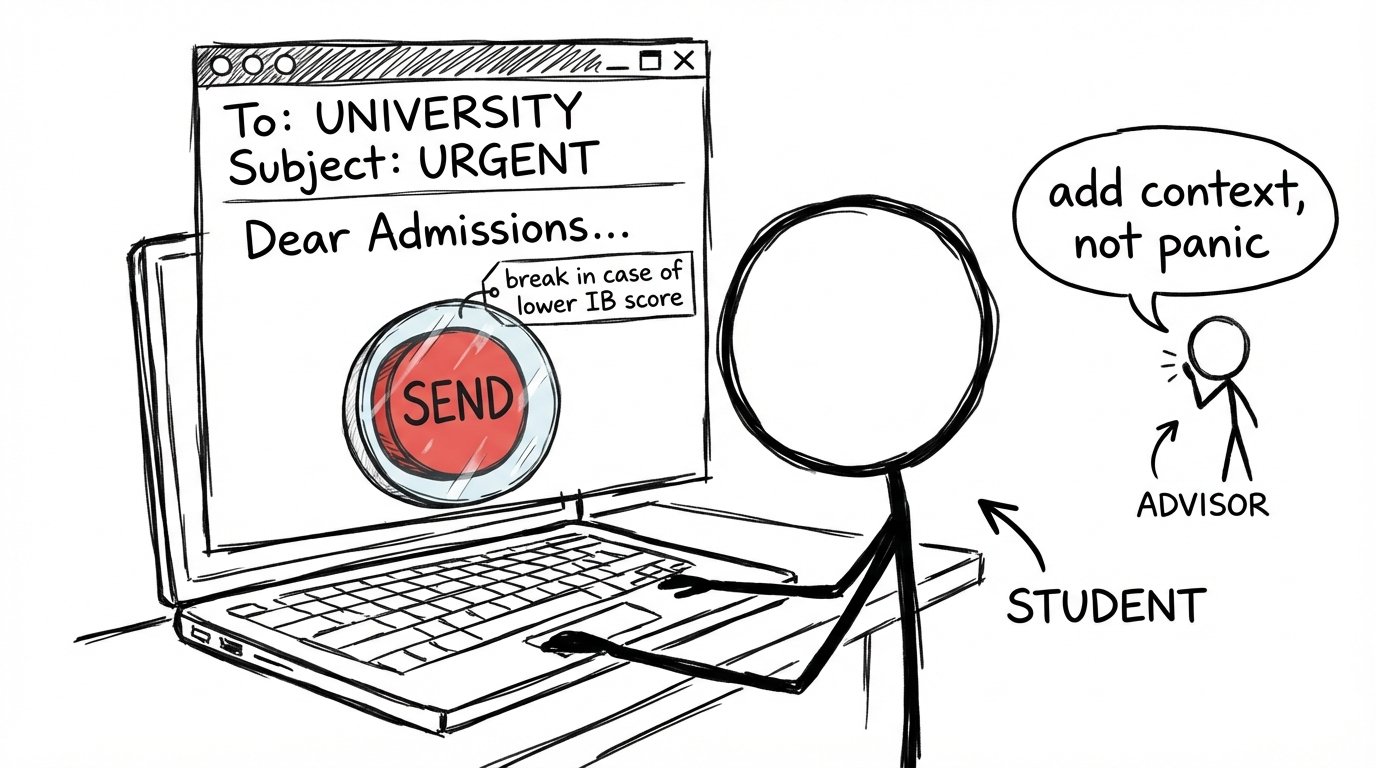
When your IB score threatens a conditional offer, speed matters, but clarity matters more. Universities don't need drama. They need context and a plan.
A good email includes:
- Your name, applicant ID, program
- The result (briefly)
- A one-sentence acknowledgement (no excuses)
- Your next steps (EUR request, retake registration, updated documentation)
- A polite question: what options are available?
Write it, then let someone read it (coordinator, parent, teacher). If you need help structuring your next days so you're not improvising, this pairs well: How to Study for IB Exams: Step-by-Step Guide.
The social media trap: the fastest way to make IB hurt more
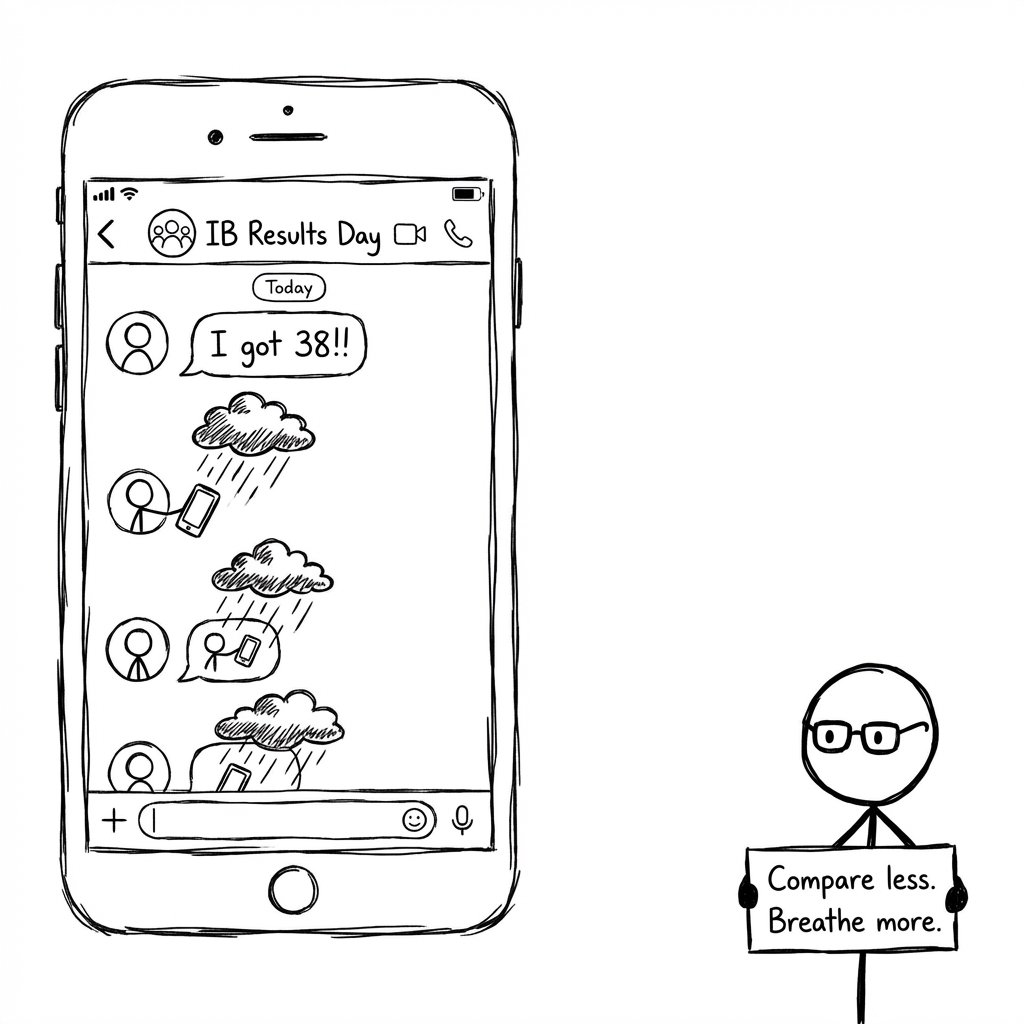
Results day isn't just you and a number. It's you and other people's numbers.
Someone will post a 44. Someone will post a "I barely revised" 7. Someone will post a crying selfie with a caption about gratitude. None of this is designed to help you.
If your IB results disappoint you, protect your nervous system:
- Mute group chats for 24 hours.
- Don't compare totals unless you're also comparing contexts (you never are).
- Choose one person who can hear the whole story.
How RevisionDojo helps after IB results day (not just before)
A lot of platforms only make sense when you're "on track." The real test is whether they help when you're not.
Here's how RevisionDojo supports the post-results reality:
- Questionbank: rebuild confidence with targeted practice by topic and paper style, not random revision.
- Study Notes: fast clarity on the exact concepts that cost you marks.
- Flashcards: a small daily habit that stops memory from leaking away.
- AI Chat: ask the questions you're embarrassed to ask, then practice immediately.
- Grading tools: tighten written work and exam responses with feedback that's specific.
- Mock Exams: train timing and stamina so the next sitting feels familiar.
- Predicted Papers: build realism and reduce surprise.
- Coursework Library: see what strong work looks like when you don't trust your own judgment.
- Tutors: when you need a human plan and a calm voice.
If you want a single place to start, the main hub is here: RevisionDojo for IB.
A calmer plan for the next 7 days (if your IB results went badly)
You don't need a life plan in one day. You need a week that creates options.
Day 1: stabilize
- Tell one trusted person.
- Write down your numbers.
- Sleep.
Day 2: get the facts
- Ask your coordinator for component marks and boundary proximity.
- Decide whether an EUR is rational.
Day 3: communicate
- Email your university (if relevant).
- Ask what documentation they need.
Day 4--5: build a retake decision
- If retaking, pick the smallest set of subjects that changes the outcome.
- Draft a study loop you can repeat.
A good loop looks like: notes (small) -> questions (targeted) -> feedback (honest) -> flashcards (daily) -> one timed session weekly. This is the same structure in: IB: How to Study in the Last 24 Hours (No Panic).
Day 6--7: do one proof session
If you're retaking or rebuilding, do one session that produces evidence.
- 25--40 minutes on the Questionbank
- Review mistakes
- 10 minutes of Flashcards
Evidence doesn't erase disappointment. It does replace helplessness.
FAQ
What if my IB results mean I didn't get the diploma?
First, treat this as an administrative outcome, not a personal identity statement. In the IB, missing the diploma can happen for different reasons: total points, specific subject minimums, or core requirements. That means the solution depends on which requirement was missed, so your first step is to get precise information from your IB coordinator, including component marks and where the shortfall occurred. Once you know the exact failure point, you can decide whether an EUR is worth attempting, especially if you are close to a boundary in a key subject. If the gap is larger, a retake can be the cleanest path, because it replaces uncertainty with a controllable target. Many students find retakes emotionally heavy, but academically simpler than the full two-year experience, because you're focusing on fewer papers with clearer feedback. Tools like RevisionDojo help here because you can build a repeatable loop with Study Notes, Questionbank practice, Flashcards, AI Chat support, and timed Mock Exams to train the exact skills the IB rewards.
Should I request an IB remark (EUR) if I'm disappointed?
Disappointment alone isn't a strong reason, because the IB remark process is about mark changes, not emotional closure. A better question is: "How many marks do I need to move up, and would that change my outcome?" If you are 1--2 marks from a higher grade boundary in a subject that affects your diploma status or a university condition, an EUR can be rational. You should also consider the nature of the subject, because some assessments have more examiner judgment than others, which can slightly increase the likelihood of movement. Talk to your coordinator about deadlines, fees, and the possibility of a grade decreasing, so you're making a fully informed decision. If the gap is larger, you may be better off putting your energy into a retake plan that is predictable and within your control. For retake prep, RevisionDojo's Questionbank, Mock Exams, and Grading tools can help you translate effort into marks in a way that feels measurable for the IB.
How do I cope with seeing other people's IB scores on results day?
In the IB, comparison is uniquely toxic because it disguises itself as motivation while quietly draining your ability to think clearly. You're not comparing equal things: different subjects, different HL choices, different teachers, different stress loads, different unseen circumstances. When you scroll through other people's results, your brain naturally turns their highlight reel into a verdict on your future, which is both unfair and inaccurate. The healthiest move is to set boundaries for 24 hours: mute chats, avoid social media, and choose one person to talk to who won't reduce you to a number. Then focus on actions that create options: coordinator conversation, university email, EUR decision, or retake plan. If you need to rebuild confidence, do it through evidence, not vibes: one short Questionbank set, one mistake review, one Flashcards session. That is how you start feeling like an IB student with choices again, not a person trapped in a scoreboard.
Closing: if everything went wrong, you still have moves
The hardest part of IB results day is how quickly it tries to turn into a story about who you are. But you are not a total score. You are a person who can take the next step.
If your IB results went badly, your job is not to pretend you're fine. Your job is to get precise, choose the best lever (EUR, retake, university conversation, alternate route), and build a small routine that produces evidence.
RevisionDojo exists for that moment: when you need your next action to be clear. Use the Questionbank to find the exact gaps, Study Notes to fix them without drowning, Flashcards to keep recall alive, AI Chat to get unstuck, Grading tools to sharpen your writing, and Mock Exams plus Predicted Papers to make pressure familiar. Add the Coursework Library when you need examples, and Tutors when you need a human plan.
The IB can be brutal. But it's also learnable. And the next version of this story can be calmer than the first.