
In the middle of IB exam season, the most dangerous lie is also the most flattering one: you could be doing more.
It shows up quietly. You finish a study block and feel... nothing. No satisfaction. No proof. Just a new itch to open another tab, rewrite your notes again, or plan a schedule so detailed it becomes a hobby.
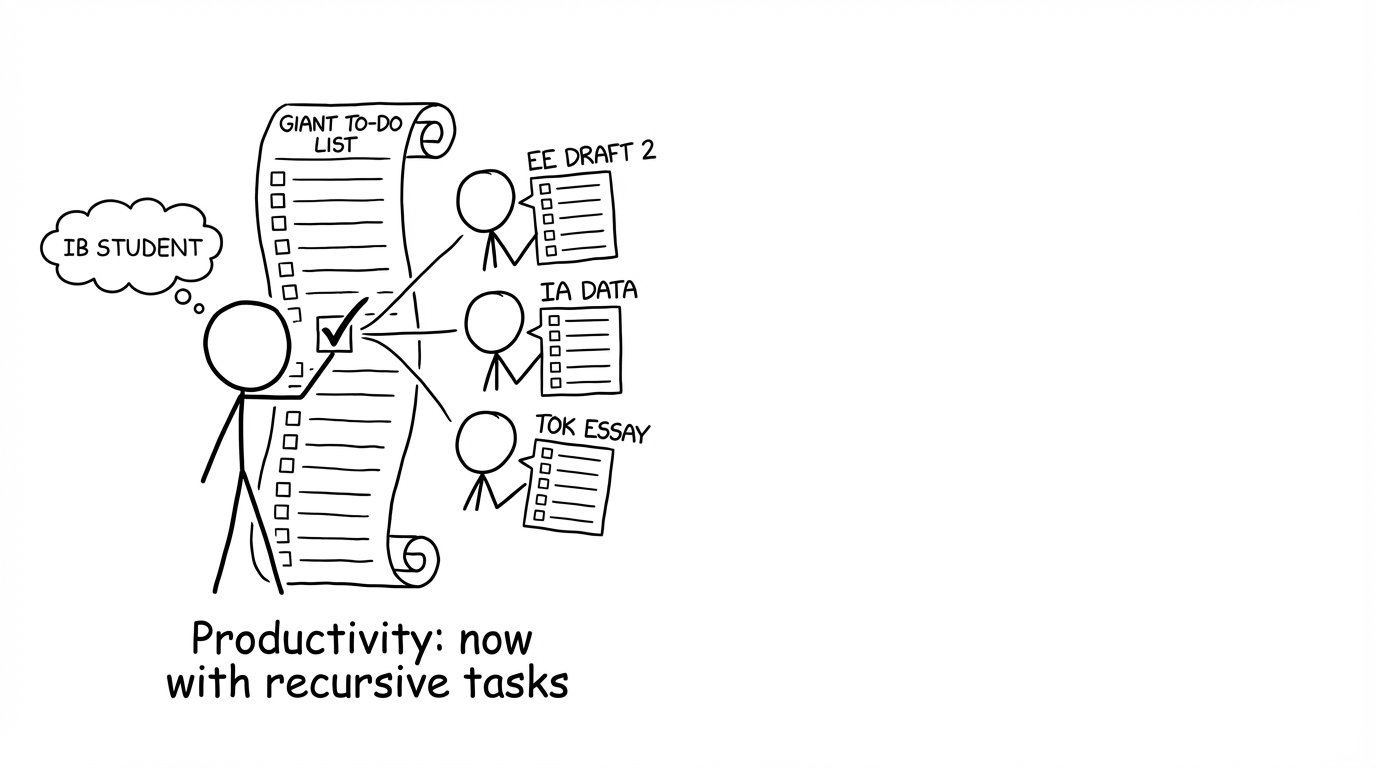
That is the myth of "always being productive." It sounds like discipline. It feels like ambition. But for IB students preparing for exams, it often becomes a loop of constant motion with surprisingly little progress.
And if you have ever stared at your desk at 10:30 p.m. thinking, "I worked all day, so why do I still feel behind?" you have already met the myth.
The IB productivity myth (and why it feels so convincing)
The IB rewards a certain kind of person: conscientious, organized, willing to try hard even when things are unclear. Those traits are real strengths. But they also make you vulnerable to a specific trap: confusing effort with improvement.
"Always being productive" usually means:
- You measure your day by hours worked, not skills trained
- You treat rest like a moral failure
- You keep expanding your plan instead of finishing it
- You do lots of preparation to study (clean notes, folders, resources) and less studying
Here is why the myth feels convincing: it reduces anxiety in the moment. When you are doing something, you feel safe. When you choose to rest or narrow your scope, you feel exposed.
But the IB does not grade your anxiety management. It grades your output under constraints.
A quick checklist: productive for IB (not productive-looking)
When you are tired and your brain wants "more," use this as a fast filter. A task is probably IB-productive if it does at least one of the following:
- Builds recall (Flashcards, closed-book retrieval)
- Trains exam technique (command terms, structure, timing)
- Produces feedback (marked questions, rubric-aligned comments)
- Shrinks a weakness (targeted topic practice, error log)
- Protects energy (sleep, real breaks, pacing)
If it only makes you feel organized, it may be comfort disguised as productivity.
A helpful place to anchor your overall system is this guide: How to Study for IB Exams: Step-by-Step Guide.
Why "always productive" breaks IB students right before it helps
There is a moment many IB students hit: the workload becomes technically possible but emotionally impossible.
You can still do the tasks, but the cost rises. Starting feels heavier. Concentration feels expensive. You stop trusting that effort will translate into marks.
That is not laziness. It is often the early shape of burnout: your mind protecting itself from a system with no recovery.
If this feels familiar, read: What Happens When You Burn Out in the IB (Real Advice) and IB Burnout Psychology: Why It Happens and How to Recover.
The uncomfortable truth is that "always being productive" can reduce your final IB performance because it pushes you toward:
- Too much passive review (rereading, highlighting)
- Too little timed practice (fear of seeing gaps)
- Too little sleep (memory and attention collapse)
- Too much switching (decision fatigue)
The myth is not that productivity is bad. It is that productivity is the same as progress.
The calmer alternative: the IB practice loop
The most reliable IB students are not the ones who "study the most." They are the ones who repeat a simple loop so often it becomes boring.
Here is the loop:
- Clarify (Study Notes)
- Recall (Flashcards)
- Apply (Questionbank)
- Review (mistake log + one rule)
- Simulate (timed sets, Mock Exams)
This is exactly how RevisionDojo is designed to work as an all-in-one IB control panel: Study Notes, Flashcards, Questionbank, AI Chat, Grading tools, Predicted Papers, Mock Exams, a Coursework Library, and Tutors.
To see how the ecosystem fits together, keep this open: RevisionDojo App: The Smarter Way to Prep for IB Exams.
The difference between "busy" and "trained" (a small story)
Think of two students a month before IB exams.
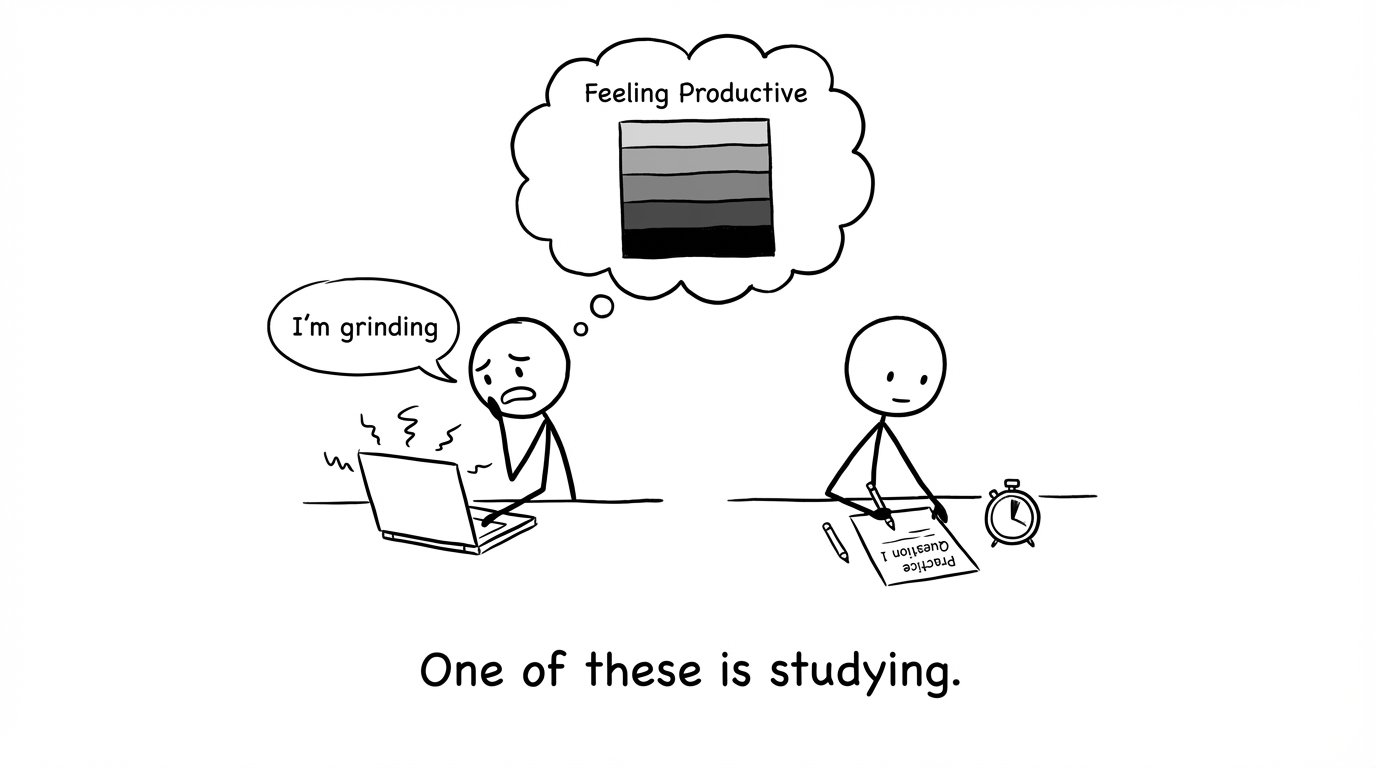
Student A studies for four hours. They rewrite notes, make a perfect schedule, watch summary videos, and end the day feeling both exhausted and unsure.
Student B studies for two hours. They do 25 exam-style questions, review mistakes, turn the repeat errors into flashcards, and do one timed mini-section.
Student B did less. But they trained.
How to be "productive enough" in IB (without breaking yourself)
"Always productive" is infinite. "Productive enough" is specific.
Below are four principles that work across every IB subject.
Use Questionbank practice to turn stress into data
Stress stays loud when it is vague. The IB feels scary when you cannot tell what matters.
Doing practice questions turns fear into a number, a pattern, a topic list.
Use RevisionDojo Questionbank to:
- Filter by topic and difficulty
- Practice exam-style prompts repeatedly
- Get fast feedback so you are not guessing
When you get something wrong, do not "study harder." Do the next right fix: a small note, a flashcard, then another question.
Stop worshipping long sessions (choose repeatable sessions)
The IB is a two-year project with a short, intense finishing window. That means consistency beats heroics.
A good template:
- 10--15 minutes: Study Notes (one subtopic)
- 15--30 minutes: Questionbank set (same subtopic)
- 10 minutes: review + 3 mistake rules
- 5--10 minutes: Flashcards
If you need a lighter, sustainable approach when pressure rises, this article pairs well: How to Stay Sane During IB Exam Season.
Use AI Chat as an "unstuck button," not a replacement brain
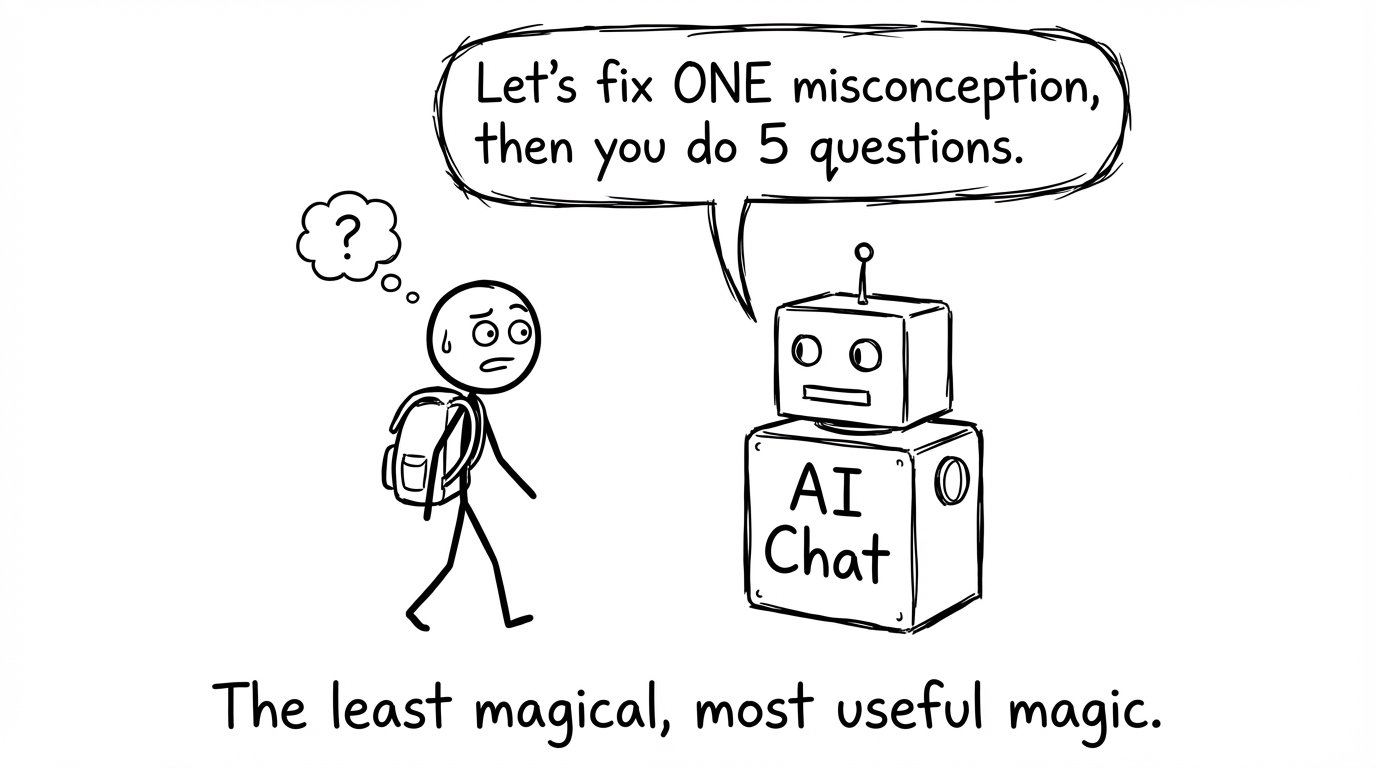
The best AI use in IB exam prep is the boring kind: quick clarification that keeps momentum alive.
That is why RevisionDojo's AI Chat works best when you ask:
- "What misconception explains this mistake?"
- "Why does the mark scheme require this step?"
- "Give me 5 quick questions on this concept, then mark me."
Not: "Write my work."
Treat rest as part of the IB strategy, not the reward
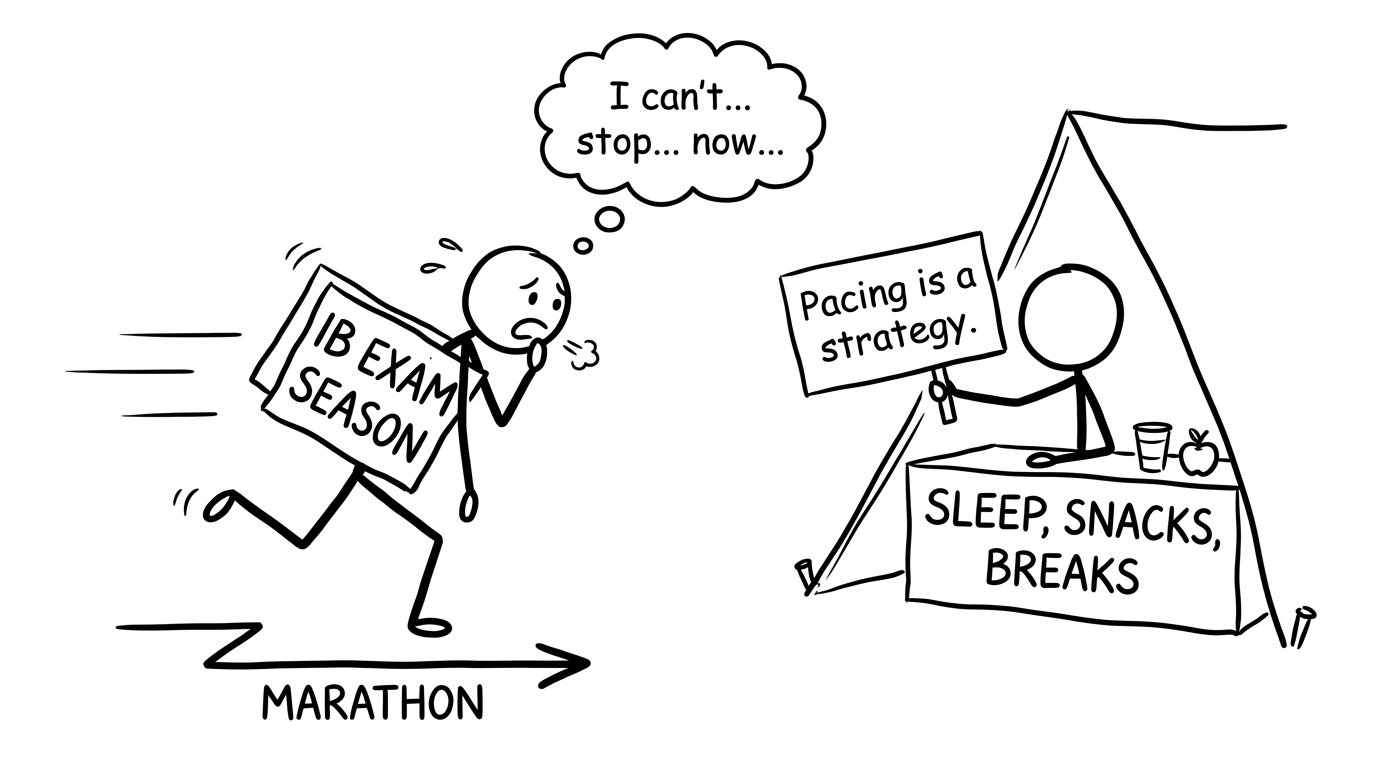
Rest is not what you earn after finishing everything. In IB, you never finish everything.
Rest is how you keep the machine working.
If you need a direct reframe, read: Why Rest Is Productive in IB Exam Season.
And remember the deeper point: sleep is not "self-care." It is memory consolidation, attention control, and emotional regulation. Those are exam skills.
Where RevisionDojo fits when productivity starts to wobble
When the productivity myth takes over, students usually add tools. More apps, more resources, more planners.
The better move is fewer tools, tighter loops.
RevisionDojo helps IB students run one loop in one place:
- Study Notes for clarity without rewriting marathons
- Flashcards for daily recall that compounds
- Questionbank for high-volume practice with feedback
- AI Chat to unblock confusion fast
- Grading tools to reduce coursework uncertainty
- Predicted Papers and Mock Exams for realistic exam pressure training
- Coursework Library to see what good looks like without guessing
- Tutors when you need a human to triage your plan
If you want a fast starting point, this overview is useful: Notes + Flashcards + Question Bank (Free).
And if productivity problems are really stress problems, keep this nearby: IB Stress: Stay Motivated Without Burning Out.
FAQ
Why do I feel guilty resting during IB exam prep?
Guilt often shows up in IB because the workload is open-ended, so your brain never gets a clean "done" signal. When there is no finish line, rest can feel like cheating, even if you have already worked for hours. The guilt is not proof you should study more; it is proof you care and your mind is trying to reduce uncertainty. The most effective response is to make your rest deliberate and bounded: decide the stop time, decide the restart time, and then actually disengage. This is important because half-rest creates the worst of both worlds: you do not recover, and you still feel behind. If guilt keeps returning, add more feedback loops (Questionbank scores, mistake logs, timed mini-sets) so your brain can see evidence that you are improving. In IB, evidence quiets guilt better than willpower.
What does "productive" actually mean for IB students?
For IB students, productive means your time creates skills that match exam marking: recall, application, structure, timing, and accuracy. It does not mean you were busy, organized, or studying all day. A productive session usually ends with something measurable: a score, a corrected response, a list of repeat mistakes, or a clearer method for a question type. That is why practice questions and review are so powerful: they turn effort into feedback you can act on tomorrow. Productive also means sustainable, because the IB is a marathon and your brain is the main asset you are protecting. If your routine destroys sleep and attention, it is not productive even if it looks intense. A good rule is that productive IB work should make you calmer over time, not more frantic.
How do I stop procrastinating disguised as productivity?
Start by naming the common disguises: rewriting notes, reorganizing files, searching for the "best" resource, and making plans that avoid doing questions. These tasks feel safe because they avoid the risk of being wrong, which is exactly what the IB exam will force you to face. The solution is not more motivation; it is a smaller entry point. Commit to a 10-minute start: one subtopic in Study Notes, then two exam-style questions, then stop if you truly need to. Most of the time, starting breaks the spell and you continue. Use RevisionDojo's Flashcards for an even lower-friction start on hard days, then transition into the Questionbank once your brain is "awake." If you get stuck conceptually, use AI Chat to fix one misconception and immediately return to practice. Over time, you train a new identity in IB: someone who starts with action, not preparation.
How can RevisionDojo help me study less but score higher in IB?
RevisionDojo helps you reduce wasted time by keeping the IB loop tight: understand, recall, apply, review, then repeat. The Study Notes are syllabus-aligned and designed for exam application, so you spend less time rewriting textbooks. Flashcards make daily recall small enough to do even when your day is busy, which keeps forgetting from stealing your progress. The Questionbank gives you high-quality practice plus feedback, so you are not guessing whether you improved. AI Chat keeps momentum when you are confused, so you do not lose 40 minutes to random videos and tabs. When you need realism, Mock Exams and Predicted Papers help you train timing and calm under pressure, and Grading tools plus the Coursework Library reduce uncertainty on written work. If you need a human layer, Tutors can triage priorities fast, which is often the quickest way to regain control.
Closing: the real flex in IB is sustainable focus
The myth says the best IB student is the one who is always productive.
The reality is quieter: the best IB student is the one who can return tomorrow.
Not because they have infinite discipline, but because they built a system that produces feedback, protects energy, and turns confusion into the next small step.
If you want that system in one place, use RevisionDojo as your routine: Study Notes for clarity, Flashcards for recall, Questionbank for practice, AI Chat for quick unblocking, Grading tools for coursework, and Mock Exams plus Predicted Papers for exam realism. Then let rest do its job.
Your goal is not to be endlessly productive.
Your goal is to be steadily dangerous on exam day -- in IB terms, calm, accurate, and trained.