
IB Command Terms Explained: IB Exams 2026
There's a quiet kind of frustration that only an IB student understands.
You revise the chapter. You know the definitions. You can even teach the topic to a friend. Then the exam arrives, and the markscheme acts like you never showed up.
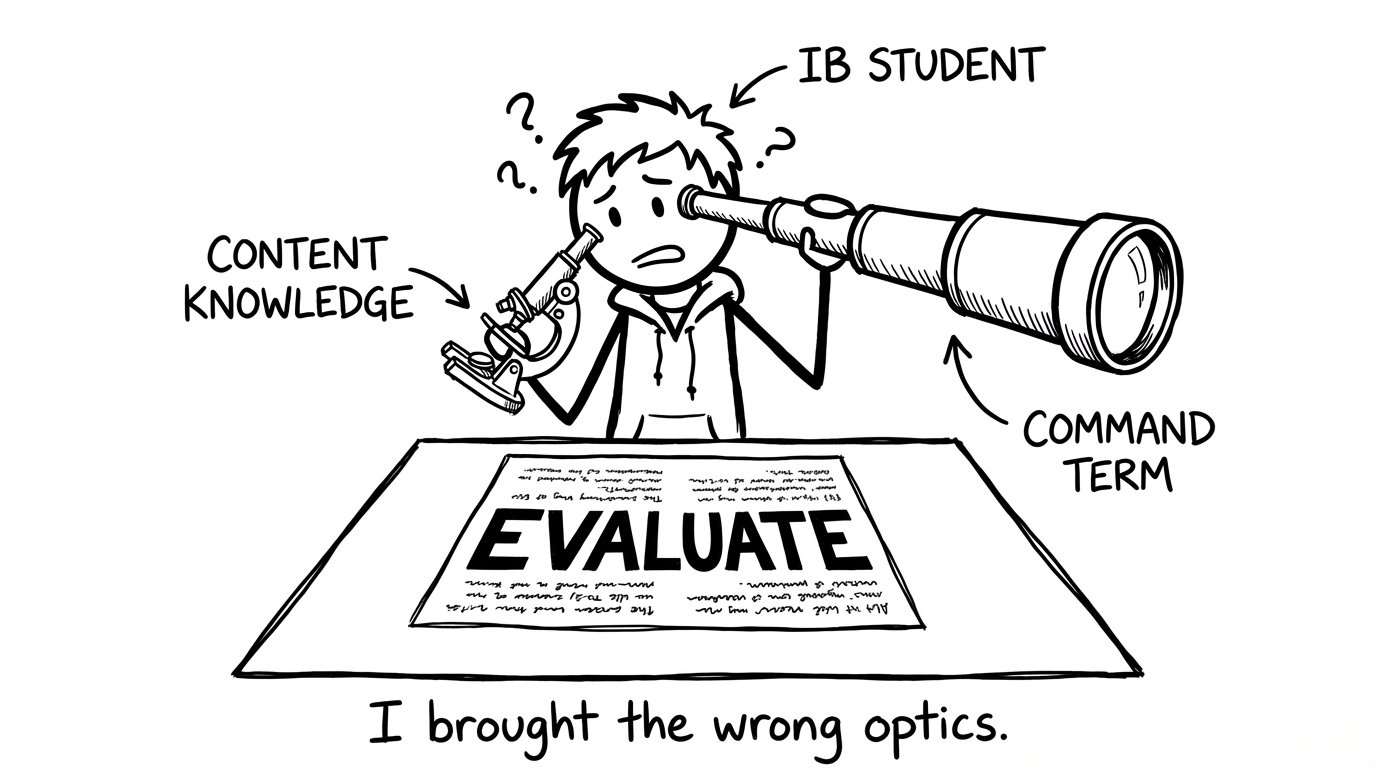
Most of the time, it's not because you "didn't know the content." It's because you answered the wrong task.
In IB Exams 2026, command terms are still the hidden steering wheel. They tell you what kind of thinking the examiner wants and how your marks will be unlocked. When you treat them like decoration, your answer becomes a beautifully written detour.
This guide explains IB command terms in a way you can use today: what they really mean, what they usually look like in high-scoring responses, and how to practise them until they feel automatic.
IB command terms: the fast checklist
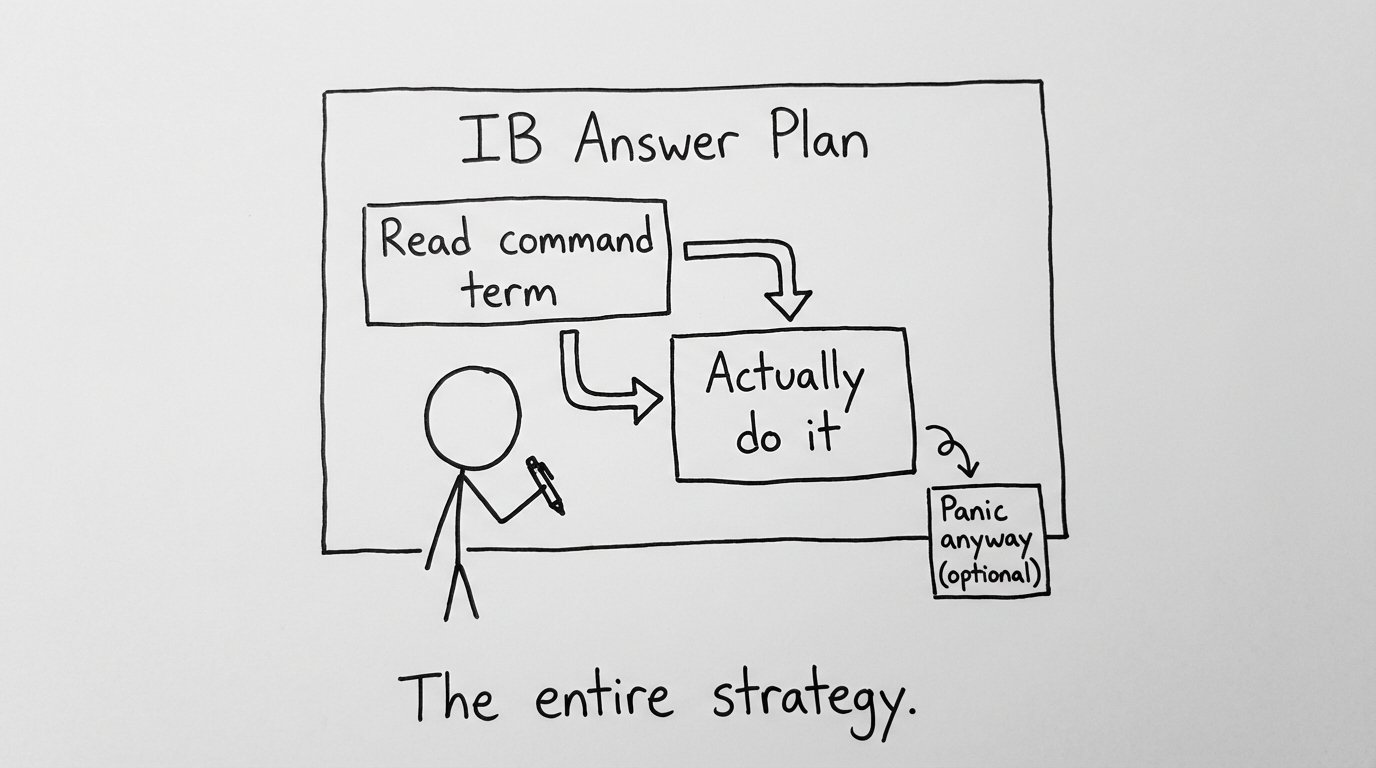
Use this quick checklist before you write anything in an IB paper:
- Circle the command term (the verb).
- Translate it into an output: "What must be on the page?"
- Match your structure to marks: more marks usually means more layers (points, evidence, explanation, judgment).
- Don't over-answer: "define" is not an essay.
- Don't under-answer: "evaluate" is not a description.
- Leave 10 seconds at the end to confirm you actually did the command term.
If you want a dedicated place to drill this skill, RevisionDojo has an IB-specific quiz hub where you can practise by command term across subjects: IB Command Terms Drill Hub.
Why IB command terms decide your grade (more than you think)
Think of an IB exam like a lock. Content knowledge is the key shape, but command terms are the direction you turn.
Two students can write about the same concept and score very differently. One answers what the question is about. The other answers what the question is asking them to do.
This matters across the whole diploma:
- In sciences, it's the difference between describing a process and explaining the mechanism.
- In humanities, it's the difference between comparing two perspectives and evaluating which is more convincing.
- In math, it's the difference between determine (get a correct value) and justify (prove your method and reasoning).
If you want an examiner-friendly breakdown of how this plays out in real responses, keep this open as a companion: How to Use Command Terms Effectively in IB Exams.
The three levels of IB command terms (and what your brain should do)
Most IB command terms cluster into three useful groups. This isn't a perfect official classification, but it's a practical mental model for IB Exams 2026.
Recall command terms (short, precise, no drama)
These command terms reward accuracy and speed.
Common examples: define, state, identify, list.
What to do:
- Write the minimum that is fully correct.
- Use subject vocabulary.
- Avoid examples unless asked.
A common IB trap is turning recall into explanation. That can actually waste time and sometimes introduces errors.
Understanding command terms (show the mechanism)
These command terms want meaning, relationships, causes, or processes.
Common examples: describe, outline, explain.
What to do:
- Use a clear sequence.
- Include "because" (explicit causality) for explain.
- For describe, focus on what happens, not why.
Higher-order command terms (marks live here)
These command terms demand structure and judgment.
Common examples: analyze, examine, compare, contrast, discuss, evaluate, to what extent, justify.
What to do:
- Build an argument or a breakdown.
- Use criteria (what are you judging by?).
- Make a conclusion that follows from evidence.
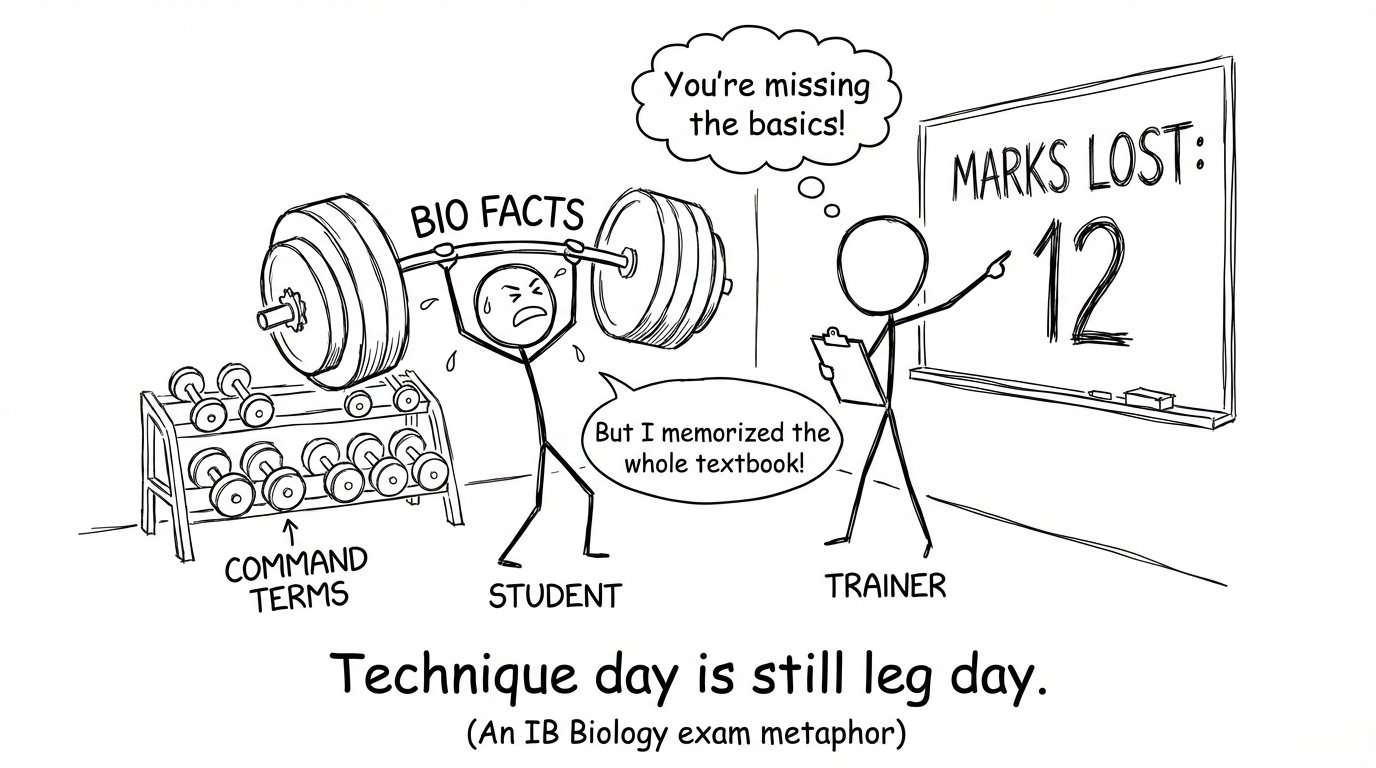
When IB students say, "I run out of time," it often means they are doing higher-order verbs with recall-level structure.
IB command terms explained (the ones that cost the most marks)
Below are the command terms that most often create avoidable mark loss in IB papers, especially in IB Exams 2026 where exam pressure is high and students default to comfort writing.
Define vs Describe vs Explain (the "depth" ladder)
- Define: a precise meaning. One sentence is often enough.
- Describe: what happens, what it looks like, the key features.
- Explain: why it happens, using reasons/causes/mechanisms.
A useful self-check in IB:
- If you wrote "because," you are probably explaining.
- If you never wrote "because," you are probably describing.
- If you could replace your answer with a dictionary entry, you are defining.
Compare vs Contrast vs Compare and contrast (the "two-column" problem)
- Compare: similarities (and sometimes differences, depending on subject conventions).
- Contrast: differences.
- Compare and contrast: both similarities and differences.
IB students often write two separate mini-essays, one for each item, and hope the examiner connects the dots. Don't.
High-scoring IB answers usually pair points directly:
- Point about A
- Matching point about B
- Explicit similarity/difference
- (Optional) implication
That pairing is what the command term is asking for.
Analyze vs Examine (the "break it down" distinction)
- Analyze: break into parts and show relationships.
- Examine: investigate with evidence; often a structured inspection that may include multiple angles.
In practice, analysis tends to look like:
- component 1, component 2, component 3
- how they interact
- what that interaction implies
If you want more of these official-style definitions embedded into real coursework criteria language, RevisionDojo's glossary is a helpful reference: Command term glossary (Chemistry IA guide).
Discuss vs Evaluate (the "judgment" requirement)
- Discuss: balanced argument, multiple perspectives, strengths and limitations.
- Evaluate: a judgment that weighs evidence against criteria and reaches a reasoned conclusion.
A reliable IB pattern:
- Discuss = "on one hand / on the other hand" + reasoned synthesis.
- Evaluate = "based on criteria X and evidence Y, the most convincing conclusion is…"
If your evaluate answer has no clear conclusion, it usually caps your marks.
To what extent (the "percentage in words")
"To what extent" is evaluate in disguise.
It asks for a nuanced conclusion:
- not "yes/no,"
- but "mostly, because… although… therefore…"
The IB reward here is control: you decide the extent and justify it.
Justify (the "prove it" command term)
Justify is not "explain again, longer."
Justify means:
- choose an answer,
- then defend it with evidence or reasoning.
In math and sciences, that can mean showing steps, assumptions, and why an approach is valid. In humanities, it often means linking claims to examples and explaining why those examples support the claim.
How to practise IB command terms (without memorizing a list)
Memorizing definitions is comforting, but it's not training.
Training looks like repetition under realistic conditions, with feedback. That's why the fastest way to improve IB command terms is to practise them in actual question formats.
Here's a simple system you can run inside RevisionDojo.
Build a command-term workout (20 minutes)
1) Choose one command term for the day (example: "evaluate").
2) Open the RevisionDojo Questionbank and filter by that command term.
3) Do 3--6 questions timed.
4) Mark and rewrite one answer to match the command term better.
RevisionDojo's platform workflow is designed for exactly this loop: Study Notes to clarify, Flashcards to retain language, Questionbank to apply, and AI Chat to fix misunderstandings quickly.
Useful starting points:
- RevisionDojo for IB
- RevisionDojo App: The Smarter Way to Prep for IB Exams
- Notes + Flashcards + Question Bank (Free)
- Flashcards feature
Convert feedback into flashcards (the compounding move)
After you practise, don't just note what was wrong. Extract an "answer rule."
Examples:
- "Evaluate needs criteria + judgment, not just pros/cons."
- "Compare and contrast must be paired, not separate paragraphs."
- "Explain must include mechanism language, not definition language."
Turn those into a Flashcards deck. In IB, small phrasing rules compound faster than another hour of rereading.
Use AI Chat like a markscheme translator
IB students often ask AI for "explanations," but the higher-value move is asking for "markscheme alignment."
In RevisionDojo's AI Chat, paste your answer and ask:
- "Did I actually do the command term? Show me where I did and didn't."
- "Rewrite my plan (not my final answer) to match the command term."
- "Give me a checklist for this command term in this subject."
Then test immediately in the Questionbank again. That loop is what turns advice into skill.
Add realism with Mock Exams and Predicted Papers
Command terms fall apart when you're tired. That's why realistic practice matters.
Use Mock Exams to train stamina and pacing, and Predicted Papers to practise under pressure with current-style prompts. After each timed session, tag which command term caused the biggest drift.
If you want a clear overall schedule for this stage of IB Exams 2026 prep, pair this article with:
- How to Study for IB Exams: Step-by-Step Guide
- IB: The Last 2 Weeks Before Exams (What Matters)
- IB: How to Study in the Last 24 Hours (No Panic)
A mini "translation guide" you can use in any IB subject
When you see these verbs in IB Exams 2026, translate them into outputs:
- Define/State/Identify: one correct line.
- Outline: brief structure, key steps, no deep detail.
- Describe: features and sequence, more detail than outline.
- Explain: reasons/causes/mechanism.
- Analyze: break down + relationships.
- Compare and contrast: paired similarities and differences.
- Discuss: balanced perspectives + synthesis.
- Evaluate/To what extent: criteria + weighing + clear judgment.
- Justify: defend choice with evidence/reasoning.
FAQ: IB command terms for IB Exams 2026
Do IB command terms change for IB Exams 2026?
IB command terms are designed to be consistent across subjects and sessions, so the verbs themselves usually don't "change" year to year in a dramatic way. What changes is how well students can apply them under the pressure of newer syllabus styles, newer question formats, and tighter timing. In IB Exams 2026, the practical issue is not whether the word "evaluate" has a new definition, but whether you consistently produce evaluation under timed conditions. Many students understand command terms conceptually but lose marks because their answers drift back into safe description when stressed. The best preparation is to practise command terms in real questions until the structure becomes automatic. That's why a tool-driven loop (Questionbank practice, feedback, rewrite, repeat) is more effective than just memorizing a glossary.
How do I know how much to write for an IB command term?
In IB exams, the mark allocation is your best hint for depth, but the command term tells you the shape of the response. A 2-mark "define" should not become a paragraph, even if you can write one. A 10-mark "discuss" cannot be a list, even if your points are correct. Train yourself to combine both signals: command term = thinking type, marks = how many layers of development. If you regularly overwrite, you will run out of time and lose marks elsewhere, which is a common IB pattern. If you regularly underwrite, you will cap your score because you never reach the criteria that reward analysis and judgment. Use timed practice and review to calibrate length, then store your best structures as templates in your own notes or Flashcards.
What's the fastest way to improve IB command terms in a month?
The fastest improvement comes from targeted repetition, not broad revision. Pick the 3--5 command terms that appear most in your subjects (often explain, analyze, compare and contrast, discuss, evaluate) and practise them deliberately. Build short sets in a Questionbank filtered by command term, do them timed, and review your answers for "task alignment," not just content accuracy. Then rewrite one response immediately, because rewriting is where the command term becomes physical rather than theoretical. Use AI Chat to identify where your answer stopped meeting the verb's demands, and turn that feedback into one-line "rules" you can rehearse through Flashcards. Once per week, add a longer timed session using Mock Exams or Predicted Papers to make sure your command term skill survives fatigue.
Can RevisionDojo help with command terms across all IB subjects?
Yes, because command terms are a cross-subject language in IB, even though the content changes. RevisionDojo's strength is that it connects the tools you need to make this language automatic: Study Notes for quick clarity, Flashcards for repeated phrasing and definitions, and a Questionbank where you can practise in exam style. When you add AI Chat, you get fast feedback on whether your response actually matched the command term, which is often what teachers don't have time to do in detail every day. The Grading tools and Coursework Library also help when command terms show up indirectly in written tasks, reflections, and structured criteria language. And if you need a human to pressure-test your approach, Tutors can help you correct habits like describing when you should be evaluating. In other words, RevisionDojo supports not just learning command term definitions, but building the habit of answering them correctly under pressure.
Closing: make IB command terms your unfair advantage
In IB Exams 2026, the students who feel calm aren't the ones who "covered everything." They're the ones who can walk into any paper and translate the question into a plan.
Command terms are that translation layer.
If you want to turn IB command terms into a dependable skill, build a simple loop you can repeat: practise by verb in the Questionbank, lock in patterns with Flashcards, get unstuck with AI Chat, and pressure-test it weekly with Mock Exams and Predicted Papers. Add the Grading tools and Coursework Library when coursework and writing need faster feedback, and use Tutors when you want a human to raise the standard.
Start with the IB Command Terms Drill Hub, and make command terms the part of IB that finally feels predictable.