The night you stop “spotting techniques” is the night you start scoring
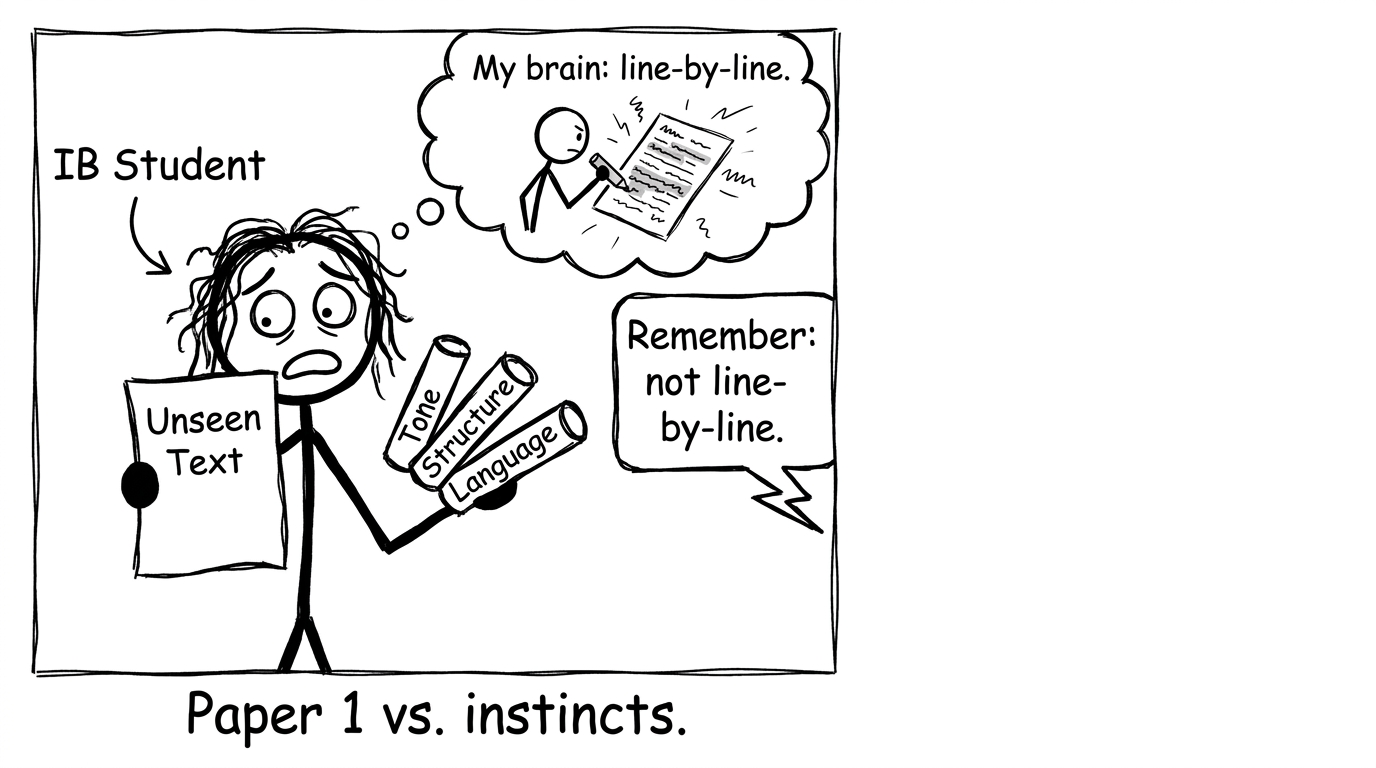
There’s a specific kind of panic that hits in IB English Paper 1: you read an unseen poem or prose extract, notice ten interesting things, and then realize you have no idea what to do with them. Your pen hovers. Your brain starts narrating line-by-line. And suddenly the clock feels louder than the text.
The calm students aren’t calmer because they’re smarter. They’re calmer because they have a repeatable method. In IB English, a literary commentary is not a memory test. It’s a decision-making test: choose an argument, choose evidence, and explain how the writer’s choices create meaning.
Paper 1 vs instincts
Quick checklist: what a strong IB English commentary must do
Use this checklist before you write a single paragraph in IB English Paper 1:
Identify what the text is doing (central tension, idea, or emotional movement)
Track how it develops (shifts in tone, perspective, setting, or pacing)
Analyze language + structure + style together (not as separate buckets)
Use short, precise quotations and micro-analysis
Keep paragraphs thesis-driven and clearly signposted
Write with controlled academic language (accurate terms, clean syntax)
What a literary commentary is in IB English Paper 1
In IB English A (Literature and Language & Literature), Paper 1 asks you to write an analytical commentary on an unseen text (or two texts at HL in some routes). You’re explaining how the writer uses authorial choices to shape meaning and effect.
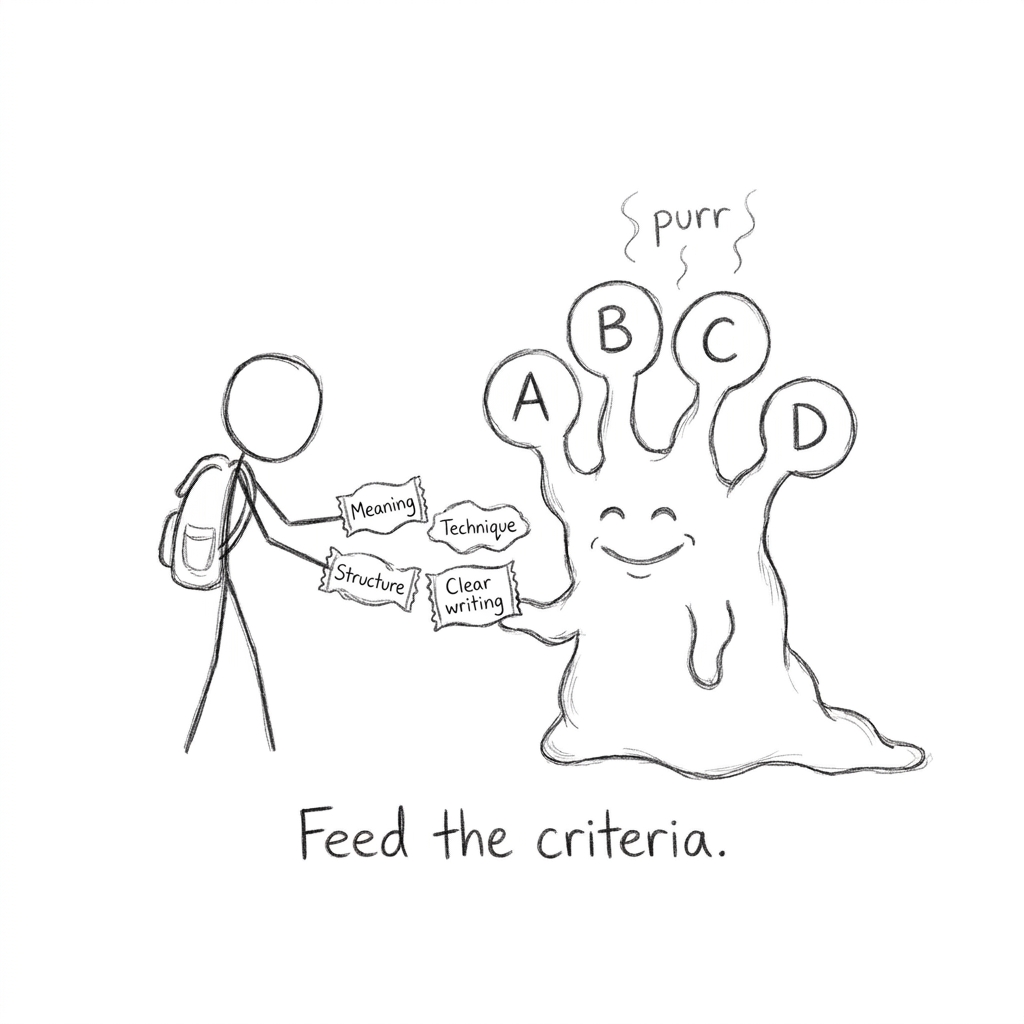
Most IB English Paper 1 marking can be translated into four questions:
Criterion A (Understanding): Do you interpret the text’s meaning, tone, and purpose convincingly?
Criterion B (Analysis): Do you explain how techniques create effects and why they matter?
Criterion C (Organization): Does your argument develop logically with clear paragraphing?
Criterion D (Language): Is your writing fluent, precise, and appropriately formal?
Your commentary should read like a guided tour, not a shopping list of devices. If you want a quick reminder of what examiners reward and what they punish, read Common Mistakes to Avoid in IB English A Essay Writing.
Feed the criteria
A step-by-step method for a Paper 1 literary commentary
Read like a detective (5--7 minutes)
In IB English, your first read is for direction, not detail. Find the “spine” of the text:
What mood dominates at the start?
Where does it shift (tone, perspective, intensity, pace)?
What feels deliberately repeated or contrasted?
Then annotate selectively: 3--5 moments you can build paragraphs around. If you want a faster annotation routine, use the approach in Close Reading Techniques for Prose and Poetry.
Build a thesis that connects technique to meaning
A top-band IB English thesis does two things:
States an interpretation (what the text suggests)
Names the main methods (how the writing achieves it)
Simple thesis formula:
Through (two to three key choices), the writer presents (central idea/tension) to (effect on reader).
Example (generic):
“Through shifting perspective, compressed imagery, and fractured syntax, the writer presents memory as unstable, forcing the reader to experience loss as disruption rather than reflection.”
Choose an organization that matches the text
Most IB English Paper 1 essays work best with one of these:
Progression structure: opening -> development -> turn -> ending (great for narratives/poems)
How long should an IB English Paper 1 literary commentary be?
In IB English, most successful Paper 1 commentaries land in the 800--1,000 word range, but length is not the scoring lever. What matters more is whether each paragraph earns marks by linking authorial choices to meaning and effect. If you write 1,000 words that summarize, you will still plateau. If you write 850 words with clear claims, precise evidence, and deliberate organization, you can reach the top bands. Practically, aim for an introduction, three focused body paragraphs, and a conclusion. Build in time to proofread so Criterion D doesn’t drop for avoidable errors.
What should I write about if I “can’t find techniques” in the text?
In IB English, techniques are not rare objects you discover; they are choices the writer made, and every line contains choices. Start with what you can always observe: tone, pace, voice, sentence length, and contrast. Then zoom in on patterns: repeated words, shifts in imagery, changes in perspective, or a turn in structure. If you truly feel stuck, pick two moments that feel emotionally different and ask what changes between them. Often, that difference is your structure paragraph and your argument. With practice, your eye learns to see techniques as clusters, not isolated labels.
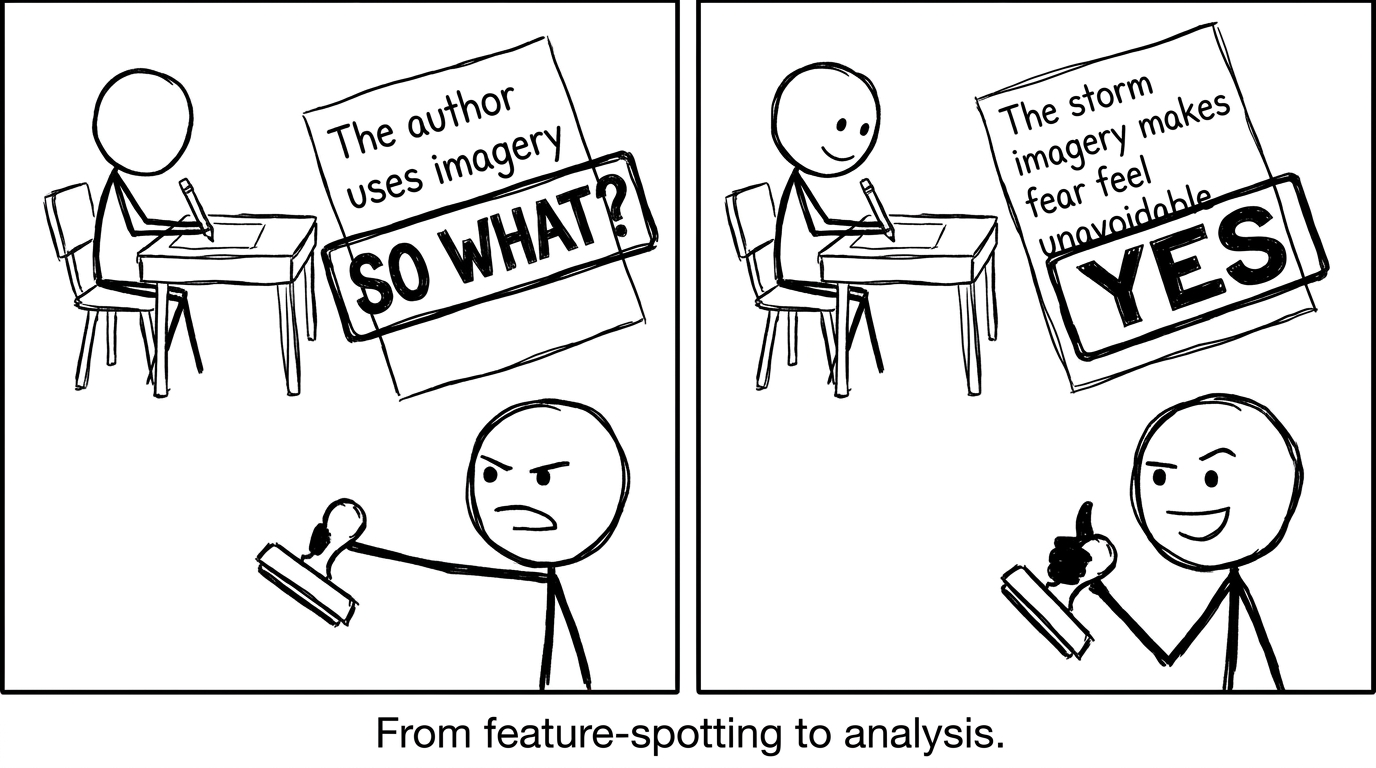
How do I improve my analysis so it stops sounding generic?
Generic analysis in IB English usually comes from stopping one step too early. Students name a feature (“imagery”) and describe it (“nature”) but don’t translate it into effect and meaning. Force yourself to answer two questions after every quote: “What does this make the reader feel or notice?” and “How does that support my thesis?” Keep your quotations short so you can micro-analyze specific words, sounds, or syntax. Vary your verbs: “suggests,” “undercuts,” “intensifies,” “compresses,” “frames,” “distorts.” Finally, rewrite one paragraph each week using feedback from a teacher or the RevisionDojo grader, because revision is where your voice becomes precise.
Closing: make IB English Paper 1 predictable
The best part of IB English Paper 1 is also the hardest part: it’s always new. But your method doesn’t have to be. If you train a consistent routine for close reading, thesis-building, and paragraph logic, the unseen text stops feeling like a trap and starts feeling like a puzzle you know how to solve.
If you want one place to practice, get feedback, and steadily raise your commentary level, RevisionDojo brings it together with its Questionbank, Study Notes, Flashcards, AI Chat, Grading tools, Mock Exams, Predicted Papers, Coursework Library, and Tutors. Start with a single timed drill today, then improve one paragraph at a time--that’s how IB English skills actually compound.
· 7 min read
IB English Paper 2: Comparative Essay Step-by-Step
IB English Paper 2 made simple: a step-by-step guide to planning, structuring, and writing comparative literary essays with confidence and speed.