
When you walk out of an IB exam, you don't remember every detail. You remember a feeling.
Maybe it's the moment you realized you wrote two pages… and still didn't answer the question.
Maybe it's the tiny panic when you saw "Evaluate" and your brain offered "Describe, but longer."
Here's the calm truth most IB students only learn after results day: you're not being marked for effort, intelligence, or how much you know. You're being marked for how closely your answer matches a system.
And systems can be learned.
This guide breaks down how IB exams are marked, what examiners actually do with your paper, and how to use that knowledge to pick up marks you're currently leaving behind.
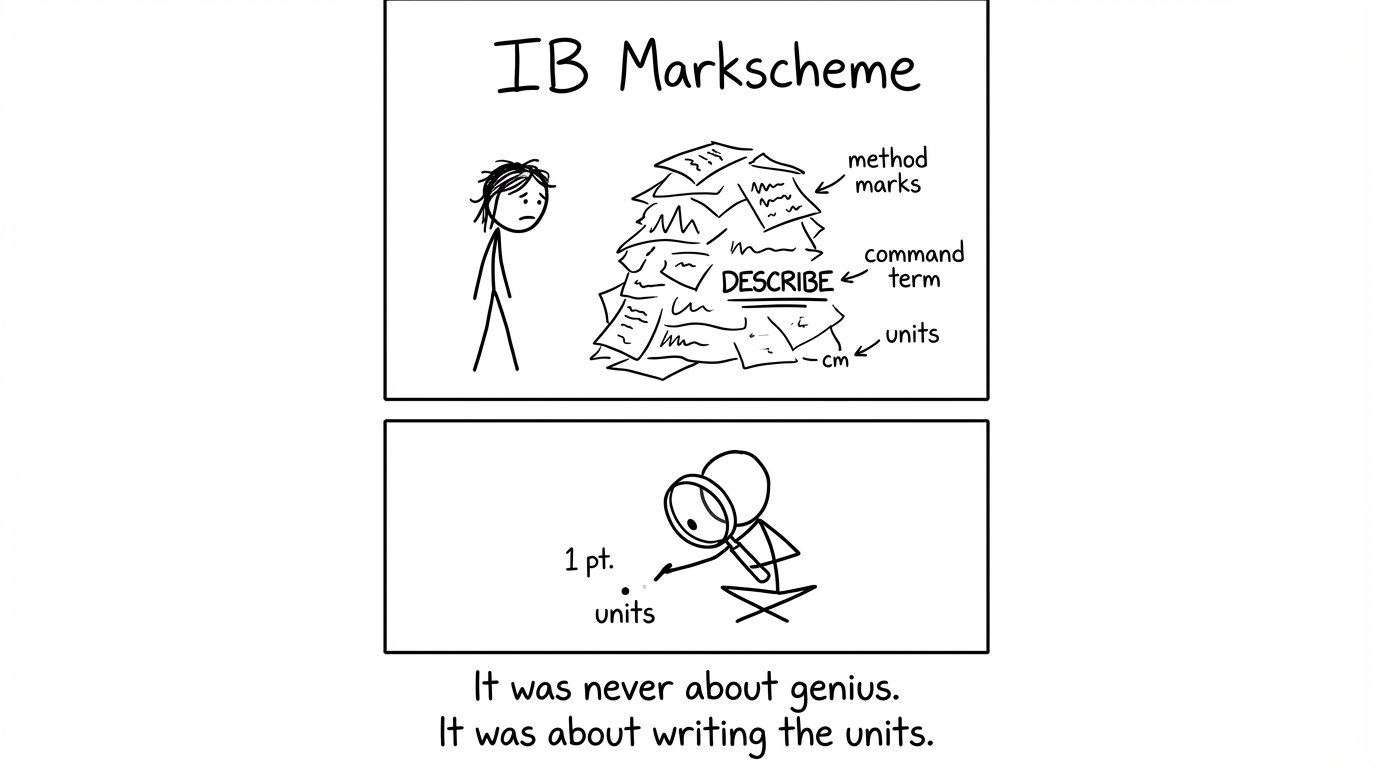
The IB marking system (quick checklist)
Use this as your mental model for every IB subject:
- Markschemes reward specific things: steps, keywords, comparisons, justified conclusions.
- Command terms decide the shape of your answer (not the topic).
- Method marks exist: in many subjects, working matters as much as the final answer.
- Criteria-based marking exists: coursework and some written tasks are judged by rubrics.
- Moderation and standardization protect consistency across schools and examiners.
- Grade boundaries are set after marking, and they shift by session.
To see how boundaries translate marks into grades, use the IB Grade Boundaries tool and keep a small buffer target.
What an IB examiner is really doing
Most students picture marking like this: an examiner reads your response and "decides" how good it is.
In the IB, it's usually closer to accounting.
An examiner is trained to look for marking points. Depending on the paper and subject, these might be:
- a correct step in a method
- a required definition
- a correct use of subject terminology
- a linked explanation (claim -> evidence -> reasoning)
- an evaluation that uses criteria
- a conclusion consistent with the data
The examiner isn't asking, "Is this impressive?"
They're asking, "Where are the marks in this response?"
That's why IB success often looks boring. It's consistent, structured, and easy to award marks to.
If you want practice that trains this directly, RevisionDojo's Questionbank is built around markscheme-aligned feedback, so you learn what earns marks and what doesn't.
Markschemes: the part of IB students underestimate
In many IB subjects, the markscheme is not an "answer." It's a map of credit.
There are different kinds of marks
Across the IB, marks tend to fall into patterns:
- Independent points (often in humanities short answers): each correct point = 1 mark.
- Linked marks (common in sciences): you only get the second mark if the first is established.
- Method marks (math/sciences): you can be wrong at the end but still earn serious credit.
- Quality bands (essays): you're placed into a level based on descriptors.
Your advantage comes from targeting the marks that are easiest to secure even on a bad day.
For example:
- units and significant figures
- clearly stated assumptions
- defining terms before applying them
- writing one sentence that explicitly links back to the question
The exam doesn't reward "nearly." It rewards "evident." Make it evident.
Command terms: the quiet scoring engine
Command terms are the IB's way of telling you what kind of thinking to show.
Many students revise content and ignore verbs. Examiners do the opposite.
A practical translation table
- State/Identify: short, precise, no story.
- Outline: key features, not detail.
- Explain: cause -> mechanism -> consequence.
- Analyse: break into parts and show relationships.
- Compare/Contrast: similarity + difference, both sides.
- Evaluate/Discuss: balanced judgement using criteria, then a reasoned conclusion.
A strong IB trick: write the command term in your own words at the top of the question in 3 seconds.
"Evaluate" becomes: "Use criteria, show pros/cons, then decide."
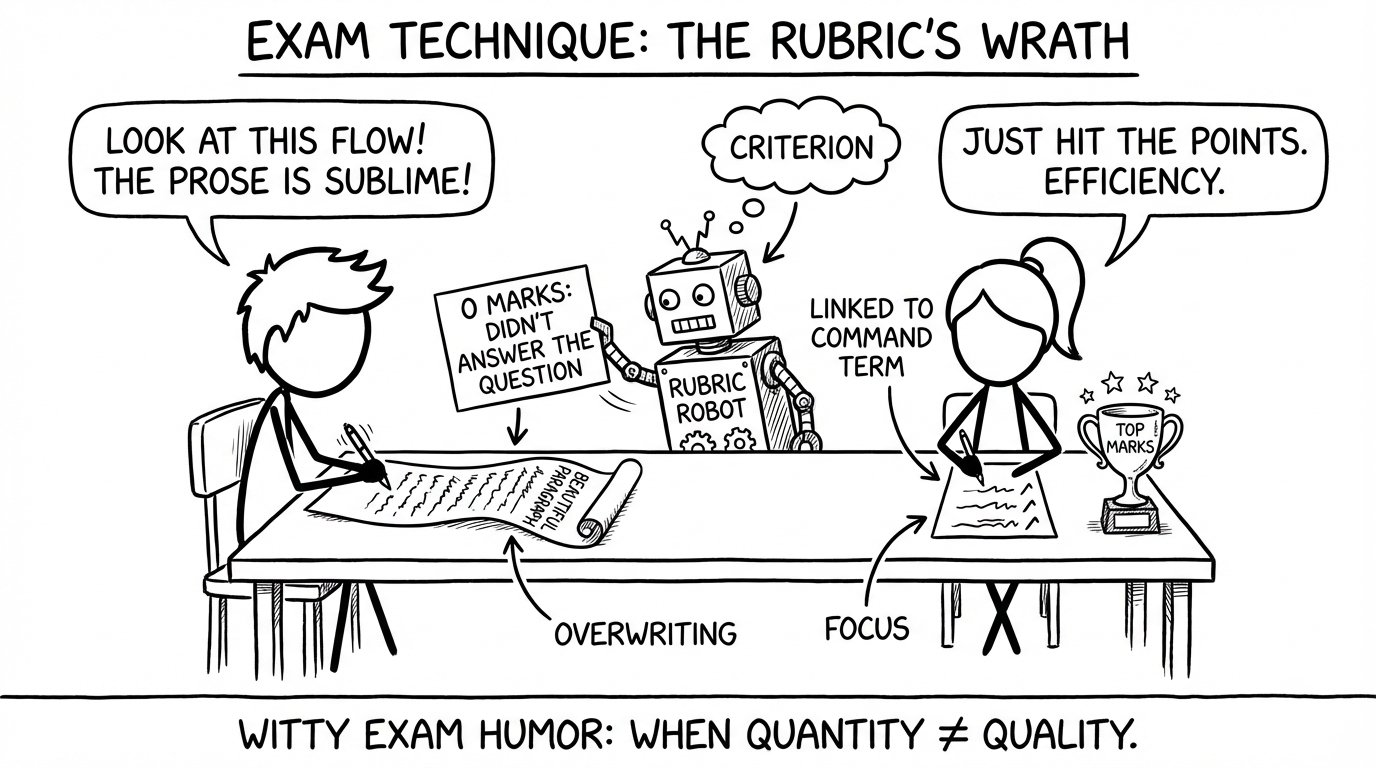
That tiny move saves you from writing a beautiful answer to the wrong question.
To build this habit, do short drills from the IB Questions: Official Exam Practice guide and tag mistakes by command term, not only by topic.
Why moderation exists (and why it matters to you)
Moderation is the IB's way of keeping grading fair across thousands of schools.
Coursework and internal components are often marked by teachers first, then moderated to align standards. This is why a school's "easy 7" myth rarely holds for long.
What matters for you:
- Your work must match the published criteria, not your teacher's personal style.
- A draft that "sounds good" can still lose marks if it doesn't hit the rubric language.
RevisionDojo's Coursework Grader helps you see your work through criterion-level feedback, and the Coursework Library gives you models to compare structure, evidence, and clarity.
If you're doing an IA and want a concrete rubric view, try a subject rubric tool like the IB Biology IA Grader.
Grade boundaries: not a curve, but still useful
Grade boundaries in the IB are set after marking. They can shift by subject, level, and session.
Two mindset shifts help:
- boundaries are not a personal judgement
- boundaries are a conversion tool from marks to grades
Read Why IB Grade Boundaries Change Every Year if you want the deeper logic.
How to use grade boundaries to your advantage
Instead of chasing a perfect percentage, build a "buffer plan."
- Take a timed paper or section.
- Convert the mark using boundaries (or typical recent ones).
- Aim for +3 to +7 raw marks above the boundary you want.
- Identify where those marks will come from (often technique).
For a practical walk-through, use IB Grade Boundaries: How They Affect Your Final Score.
The highest-leverage way to gain marks: stop donating them
Most IB students don't lose marks because they don't know anything.
They lose marks in small, repeatable ways.
Common "donated marks" list
Across subjects, these show up constantly:
- not answering the full question
- missing the "because" (no justification)
- writing a conclusion that doesn't match the evidence
- forgetting units, labels, or clear working
- giving examples without linking them to an argument
- spending too long on early questions and rushing the last ones
This is why practice has to be marked, not just completed.
RevisionDojo makes the loop faster:
- Study Notes for quick clarity
- Flashcards for daily recall
- Questionbank for exam-style reps
- AI Chat to explain your specific mistake in your wording
- Grading tools for rubric-based improvements
If you want the full workflow, RevisionDojo App: The Smarter Way to Prep for IB Exams lays it out cleanly.
How to train like the marking system (a 7-day mini plan)
You don't need a new personality. You need a new feedback loop.
Day 1: Build a "mark loss log"
Do a short timed set and record mistakes in categories:
- command term
- missing step
- unclear explanation
- time management
- factual gap
Day 2: Fix one category, not the whole subject
Use notes and targeted questions.
A good starting structure is in How to Study for IB Exams: Step-by-Step Guide.
Day 3: Drill for method and structure
Use topic filters and repeat the same question type until it feels predictable.
Day 4: A timed section
Simulate pressure. Mark it quickly. Look for patterns.
If you want a real process, use How to Run Timed IB Mock Exams in RevisionDojo.
Day 5: Patch the smallest leaks
Pick 2--3 "donated marks" habits and eliminate them.
Examples:
- always write units
- always write a one-sentence link back to the question
- always include a counterpoint in evaluation
Day 6: One full paper rehearsal
Not to prove you're ready. To find what breaks.
Day 7: Review and retake
Retake a set on the same skills. That's how the improvement becomes real.
FAQ: How IB exams are marked
Are IB exams marked "strictly," or do examiners reward general understanding?
The IB rewards demonstrated understanding, but it has to be visible in the format the markscheme can credit. That's why students sometimes feel "I understood it" and still lose marks. Your understanding might be real, but if it isn't expressed through the required steps, keywords, or reasoning links, it can't be awarded reliably. Examiners are trained to mark consistently across thousands of scripts, which means they can't guess what you meant. In practice, this pushes you toward clarity: define, apply, justify, conclude. If you want to make understanding visible, practice with markscheme-aligned feedback, because it trains you to show your thinking in the way the IB can actually reward. This is where tools like RevisionDojo's Questionbank and AI Chat help: they highlight the gap between what you thought you said and what the markscheme can credit.
What's the difference between markschemes and rubrics in the IB?
A markscheme usually breaks marks into specific points or steps, which is common in structured questions, calculations, and short responses. A rubric is more common in essays and coursework, where quality is judged across levels or criteria descriptors. In an IB essay, you often aren't collecting isolated points one by one; you're being placed into a band based on how well the response matches descriptors like focus, analysis, and evaluation. That's why "more writing" doesn't automatically mean more marks. A rubric rewards controlled structure: answering the question, selecting relevant evidence, and sustaining a line of argument. Students improve fastest when they stop asking "How long should it be?" and start asking "What would the top descriptor require me to demonstrate?" RevisionDojo's Grading tools and Coursework Grader are built around this rubric logic, so you can practice matching criteria language rather than guessing.
Do grade boundaries mean the IB curves results each year?
Grade boundaries in the IB are set after marking, and they can change between sessions, but that doesn't mean a simple curve where a fixed percentage must get each grade. Instead, boundaries are part of standard-setting: keeping a 6 or 7 meaningful across different exam sessions even when paper difficulty shifts. This is why the same raw percentage can map to different grades in different years or subjects. For students, the useful move is not predicting the exact boundary, but building a buffer so small shifts don't matter. That buffer comes from consistent technique marks: command terms, method steps, clear justification, and time control. If you want to see how boundaries behave in your subjects, use RevisionDojo's grade boundaries pages and compare multiple sessions. Then set practice targets a few marks above the boundary zone you want, so your IB performance is stable even when the conversion shifts.
How can I use IB marking to improve quickly if exams are close?
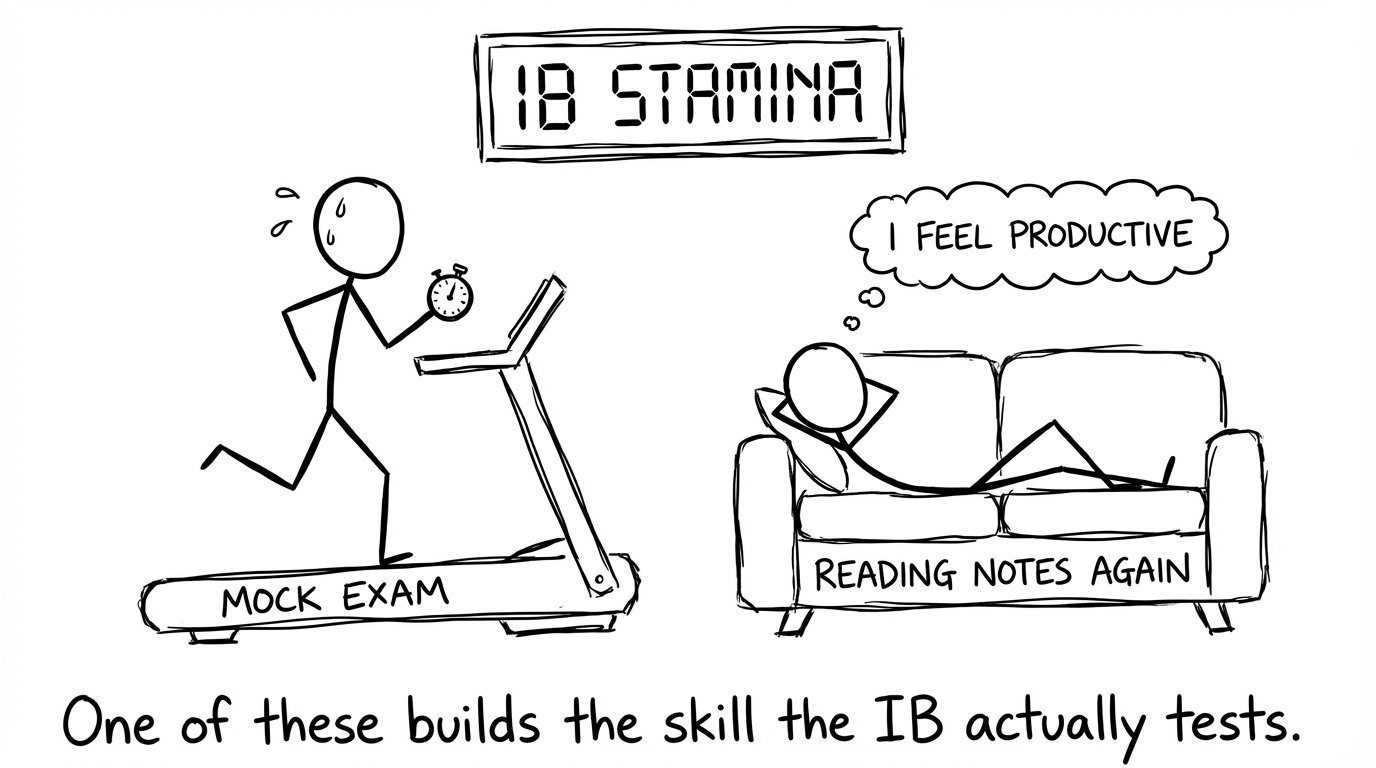
Close to exams, the fastest IB improvement usually comes from tightening how you present answers, not relearning the entire syllabus. Start by doing a timed section and identifying repeatable mark losses: missing units, skipping steps, vague evaluation, or drifting away from the command term. Then build short practice loops around one weakness at a time, because speed comes from specificity. Use Study Notes only to patch the exact gap, then immediately apply it with targeted questions so the skill becomes exam-ready. Add at least one timed session per week to build stamina and pacing, because many students know content but run out of time before they show it. RevisionDojo is designed for that last-mile loop: Questionbank for volume, Mock Exams and Predicted Papers for realism, AI Chat for quick clarification, and grading tools to show what the marking system will actually reward. When your practice looks like marking, your results start to follow.
Closing: make the IB marking system work for you
The IB is demanding, but it isn't mysterious. It rewards what it can measure: clear thinking, correctly shaped answers, and evidence that you did what the question asked.
If you learn how IB exams are marked, you stop treating revision like a guessing game. You start treating it like training.
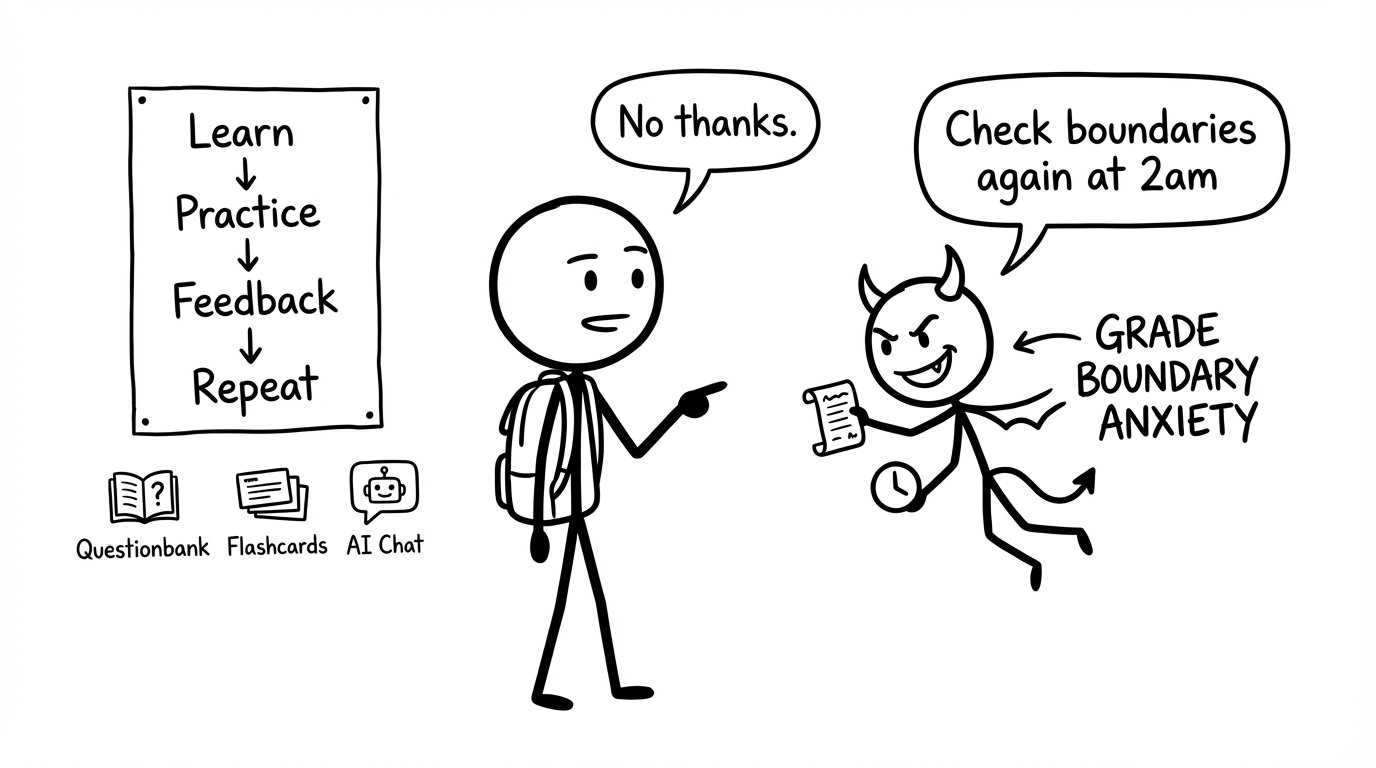
Build your loop:
- learn with Study Notes
- practice with the Questionbank
- reinforce with Flashcards
- clarify with AI Chat
- simulate pressure with Mock Exams and Predicted Papers
- tighten coursework with grading tools and the Coursework Library
- get human help with Tutors when you need it
That's what RevisionDojo is built to do: turn the IB into a system you can understand, and then outperform.