
If you've ever stared at an IB syllabus the night before a mock and thought, I could become a new person in 12 hours, you're not alone.
Cramming is a very human response to a very IB-sized problem: too much content, too many formats, too many deadlines, and one calendar that doesn't care how stressed you are.
So can you cram IB exams?
Yes and no.
You can cram some IB performance: definitions, core methods, familiar question types, and the exam rhythm that turns panic into points. But you can't cram what the IB quietly demands most: accurate thinking under time pressure. That part is trained, not wished for.
This article is a realistic guide to what IB cramming can and can't do, and how to turn "I have no time" into a tight plan using RevisionDojo's Questionbank, Study Notes, Flashcards, AI Chat, Grading tools, Predicted Papers, Mock Exams, Coursework Library, and Tutors.
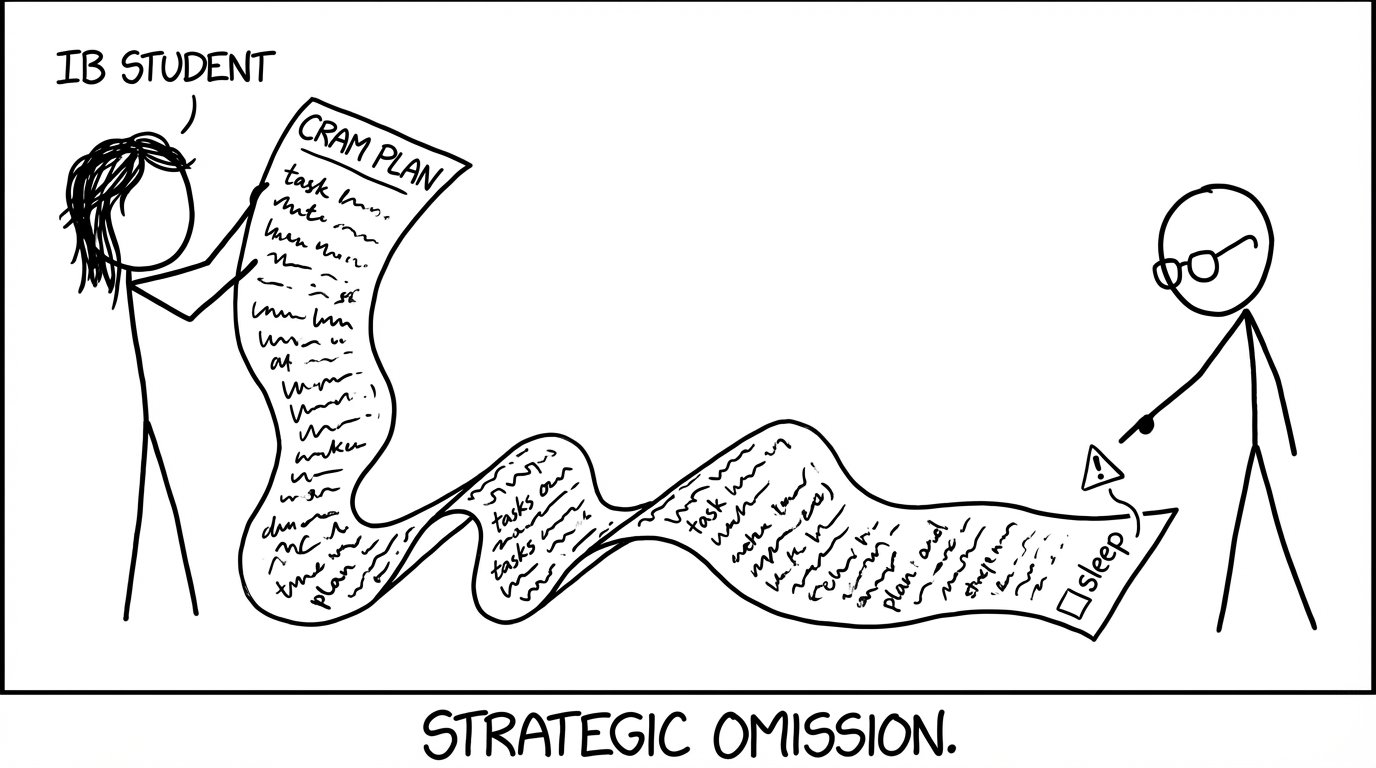
The IB cramming truth (and why it feels like it should work)
IB cramming feels tempting because the brain confuses exposure with ownership.
Reading notes at speed creates a warm sense of familiarity. Highlighting creates motion. Rewriting creates the illusion of building something.
But the IB doesn't grade familiarity. The IB grades output: correct steps, correct structure, correct command terms, correct timing.
Cramming can still help if you accept this trade:
- You are not "learning everything."
- You are building the highest-yield exam behavior you can, fast.
That means your IB cramming strategy is less about "covering topics" and more about "winning marks in the format you'll face."
If you want the all-in-one workflow this article relies on, start with RevisionDojo for IB.
A quick IB cramming checklist (the minimum that actually moves marks)
Use this checklist as your guardrails. If your "cram plan" doesn't include these, it's mostly stress theatre.
- Pick the paper you're training for (not the whole subject)
- Identify 3 high-yield topics + 2 weak topics
- Do exam-style questions first, then patch gaps
- Use timed blocks daily (even short ones)
- Track mistakes and retake them 24--48 hours later
- Sleep enough to retrieve what you practiced
For a more complete exam-prep structure, see How to Study for IB Exams: Step-by-Step Guide.
What you can cram for IB (and what you can't)
What IB cramming can do well
Cramming works best for things with clear edges: facts, definitions, formulas, and repeatable methods.
Examples:
- Key definitions (especially in sciences, business, economics)
- Common calculations and procedures (math, physics, chemistry)
- Essay frameworks and paragraph structures (humanities, English)
- Command-term reflexes (knowing what "evaluate" demands vs "describe")
This is where short, targeted Study Notes plus Flashcards plus Questionbank practice can create fast gains.
- Use Study Notes to patch understanding quickly.
- Drill with Questionbank to convert knowledge into exam behavior.
What IB cramming cannot do reliably
Cramming fails when marks require depth plus flexibility.
Examples:
- Unfamiliar data-response or extended-response problems
- Essay nuance you haven't practiced under time pressure
- Paper-specific timing and strategy (knowing when to move on)
- Higher-order thinking that depends on strong foundations
This is why students often "know the content" but still underperform in IB: they didn't train the conditions.
Why IB students cram the wrong way (and how to fix it)
There's a specific tragedy that happens in the final week: students invest in tasks that feel responsible but don't cash out in marks.
The usual suspects:
- rewriting notes
- making beautiful summaries
- watching explanation videos without testing
- doing a few questions, then switching topics before reviewing mistakes
The fix is not more intensity. It's more honesty.
You need a feedback loop: attempt, mark, diagnose, retake.
That's the design behind RevisionDojo's ecosystem: practice questions with instant feedback, AI Chat to clarify confusion mid-session, Flashcards to lock in facts, and timed Mock Exams and Predicted Papers to build exam stamina.
If you want a deeper look at why structured practice matters, read Comprehensive IB Question Bank: Thousands of Practice Questions.
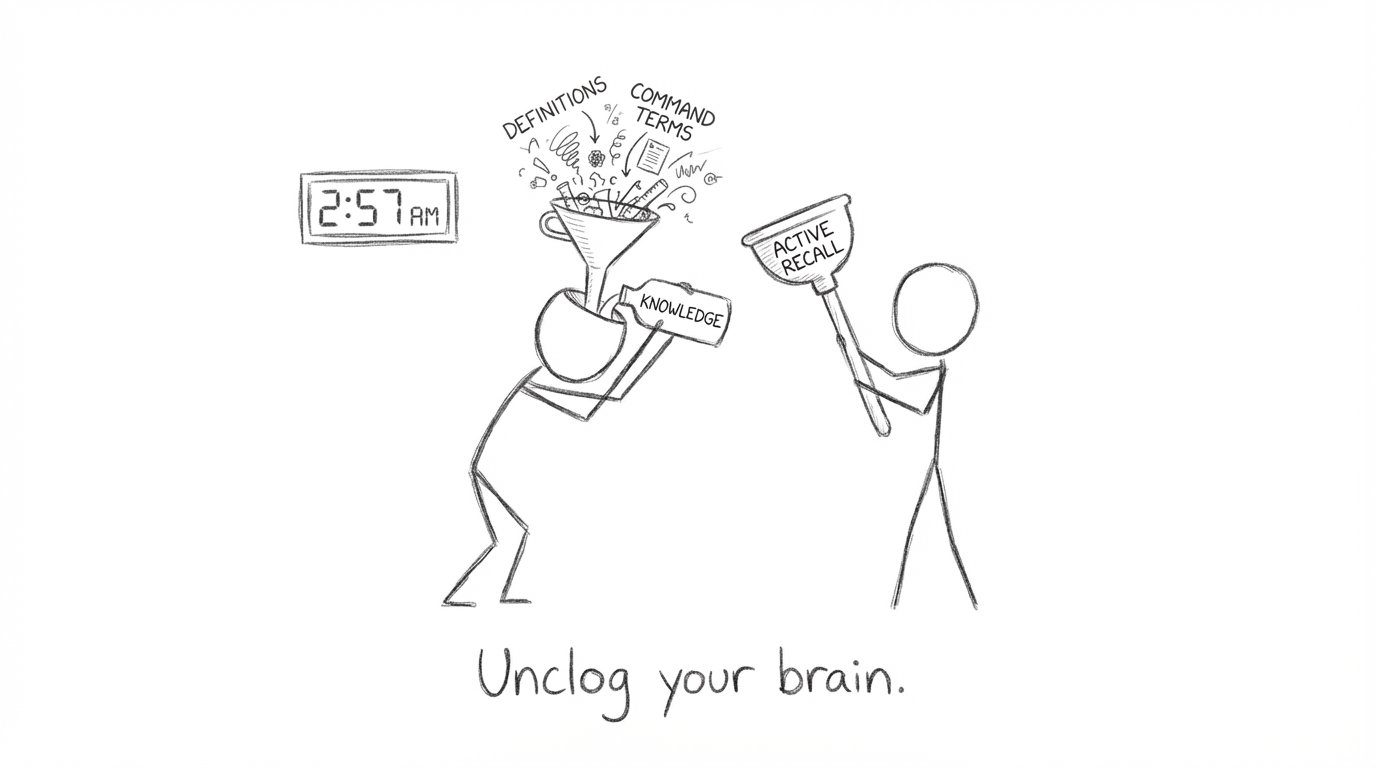
A realistic 7-day IB cramming plan (that doesn't collapse on day 3)
This is built for the scenario most students won't admit out loud: you have about a week, you're behind, and you need a plan that produces marks.
Day 1: Diagnose your IB reality (stop guessing)
Your first job is to find out what's actually broken.
- Do a 30--45 minute timed set using the Questionbank (topic-mixed)
- Mark it, and write a "mistake list" of patterns (not just questions)
- Pick 3 target topics based on mistakes and frequency
Use IB Question Search Engine: Find Questions by Keyword when you know the topic name but can't find the right practice fast.
Day 2: Build the "patch + prove" loop
For each target topic:
- 15 min: Study Notes (only the part you'll use)
- 35 min: Questionbank set on that topic
- 10 min: turn mistakes into Flashcards (or review an existing deck)
This is the core IB cramming rhythm: patch, then prove.
If you want a notes-first workflow without wasting time, skim Digital IB Study Notes: Access Anywhere, Anytime.
Day 3: Add timing (because IB marks include speed)
Do one timed section (not necessarily a full paper). Your goal is to practice calm thinking while the clock is moving.
- Sit the section in silence
- Mark it and categorize mistakes: content vs interpretation vs time
- Ask Jojo AI Chat one specific question per mistake category
This is where RevisionDojo's AI Chat shines: it lets you fix confusion without turning your session into a two-hour spiral.
For more strategy around timed practice, see IB Exams Without Pausing Your Life.
Day 4: Push into the uncomfortable topic
Cramming works when you stop revising what you already like.
Pick the topic you're avoiding.
- 20 min Study Notes
- 40 min Questionbank (mixed difficulty)
- 20 min review + Flashcards
If you're still lost, that's not a moral failing. That's a signal to use support. This is where RevisionDojo Tutors are a smart last-week investment: one focused session can replace ten hours of stuckness.
Day 5: Do a full timed Mock Exam (or the closest version)
Today is your stamina day.
- Run a realistic timed sitting with Mock Exams
- Review like an analyst: where did marks leak?
- Build a "tomorrow set" of only your weak question types
RevisionDojo is built to make this smoother with Exam-style grading and feedback loops. If you want the exact mechanics, use RevisionDojo App: The Smarter Way to Prep for IB Exams.
Day 6: Predicted Papers day (simulation, not superstition)
A good predicted set is not a prophecy. It's a simulation that trains your pattern recognition.
Pick one predicted paper set for your subject and sit it under timed conditions.
Examples you can use depending on your subjects:
Then do the most important part: review the same day while the memory is fresh.
Day 7: Taper, consolidate, and protect retrieval
The final day is not for heroics. It's for reliability.
- 30--40 min: Flashcards only (definitions, processes, command terms)
- 30--40 min: short Questionbank set on your top 2 weak areas
- 20 min: plan your exam morning routine (materials, timing, food)
You're not trying to become brilliant. You're trying to become consistent.
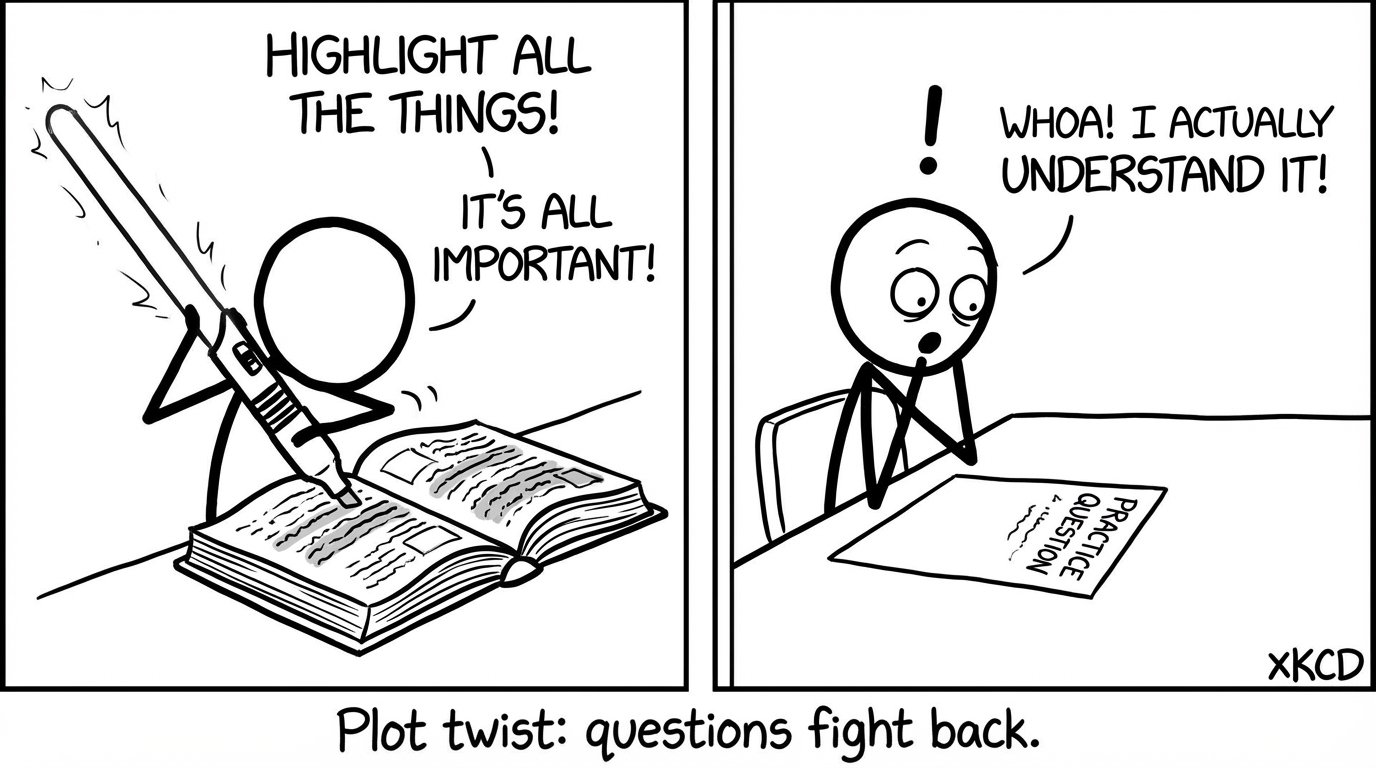
How to cram for IB without sabotaging your coursework
A hidden reason IB cramming feels impossible is that coursework doesn't stop being real just because exams are close.
Here's a simple rule: coursework gets time boxes, not open-ended days.
- If you must work on an IA/EE/TOK draft, set a 60--90 minute block
- Use Grading tools for fast rubric-aligned feedback
- Make the top fixes, then stop
RevisionDojo's Coursework Library gives you examples of what "good" actually looks like, and the Grading tools help you avoid endless polishing that doesn't move criteria.
FAQ
Is it actually possible to cram IB exams in a few days?
It's possible to improve your IB performance in a few days, but it depends on what kind of improvement you need. If you already have partial understanding, IB cramming can tighten your recall, fix common mistakes, and build timing through targeted practice. The key is that your cramming must be active: questions, feedback, retakes, and timed blocks. If your cramming is mostly rereading or rewriting, you'll feel busy and still freeze in the exam. You also need to accept that the IB rewards consistent technique, not last-minute inspiration. The most realistic goal is to convert existing knowledge into reliable exam output, not to learn entire units from zero. RevisionDojo helps here because you can move quickly from Study Notes into Questionbank practice and get instant feedback, which is exactly what a short timeline requires.
What's the fastest way to gain marks in IB when you're behind?
The fastest marks in IB usually come from fixing predictable losses: misreading command terms, skipping steps, weak structure, and poor timing. Start by doing a timed set and diagnosing patterns, because "I'm bad at this subject" is not a useful diagnosis. Often you'll find two or three repeating issues that cost marks across many topics, like not defining terms precisely or not linking back to the question. Then build a tight loop: Study Notes for the specific gap, Questionbank for the exact question type, and immediate correction using feedback. Add Flashcards only for what you repeatedly forget, not for everything you could possibly memorize. Include at least one timed Mock Exam or predicted simulation so your improvements survive under pressure. This is also where AI Chat can be useful: ask one narrow question that removes friction and lets you keep practicing. RevisionDojo is designed for this mark-focused loop, which is why it tends to outperform "general studying" when you're short on time.
How many hours should I study per day if I'm cramming for IB?
The honest answer is: fewer than you think, but with higher quality. Most students can sustain 4--6 high-focus hours in a day if they protect breaks and sleep, and those hours should be built around active recall and timed practice. If you push to 10--12 hours, the later hours often become low-quality: rereading, scrolling, and panic-highlighting. IB exams punish that because tired brains retrieve less and misread more. A better approach is to use 3--5 focused blocks, each with a clear output: a set number of questions, a timed section, or a flashcard review goal. End each block with a short mistake review so learning actually sticks. If you have many subjects, rotate them to avoid fatigue and keep recall fresh. RevisionDojo helps you keep sessions bounded because Questionbank sets, Exam Mode, and Flashcards naturally create "start and stop" points that prevent endless studying.
Should I use predicted papers when cramming for IB?
Yes, if you treat predicted papers as training, not fortune-telling. The value is that predicted sets mimic IB formatting and force you to practice under realistic constraints: timing, mark allocation, and switching between question types. When you're cramming, that realism matters because your goal is to reduce surprises on exam day. But the predicted paper itself isn't the magic; the review is. You should sit it timed, mark it carefully, then immediately turn mistakes into targeted Questionbank practice and Flashcards for weak recall points. If you do a predicted paper and move on without analysis, you've mostly just measured stress. RevisionDojo's Predicted Papers plus instant feedback and follow-up drills make the "sit--review--fix" cycle much faster. That speed is exactly what you need when your calendar is tight.
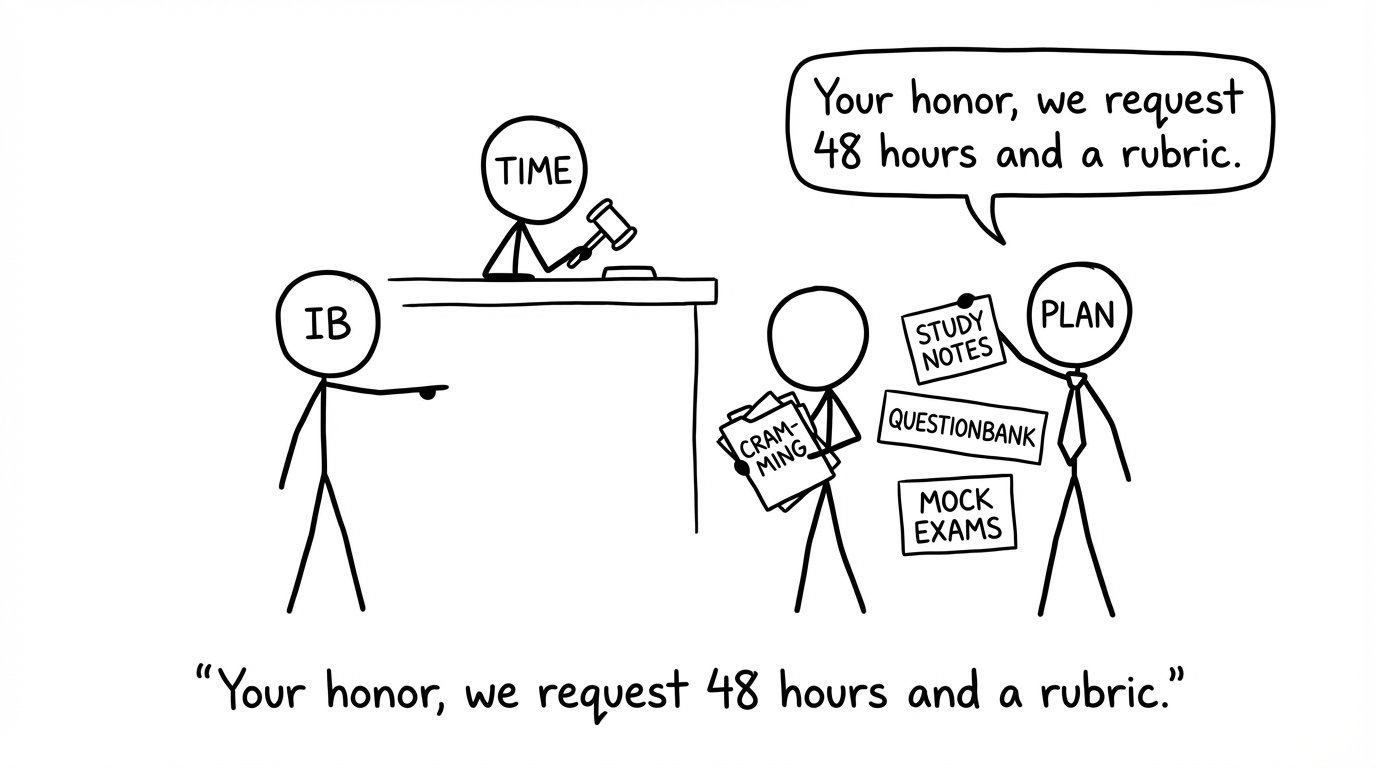
Closing: you can cram IB, but you can't bluff it
IB cramming isn't about being heroic. It's about being specific.
When time is short, the winning move is to stop trying to "revise everything" and start training the smallest set of skills that produce marks: clear recall, clean method, correct structure, and calm timing.
If you want that to feel doable, build your last-week system inside RevisionDojo: use Study Notes to patch gaps, Flashcards to retain what matters, the Questionbank to practice exam-style questions, AI Chat to get unstuck, Grading tools and the Coursework Library to keep coursework contained, and Predicted Papers plus Mock Exams to make the real exam feel familiar.
The goal isn't to feel ready.
The goal is to prove readiness with reps.
Start here: RevisionDojo for IB.