Practice AHL 3.15—Adjacency matrices and tables with authentic IB Mathematics Applications & Interpretation (AI) exam questions for both SL and HL students. This question bank mirrors Paper 1, 2, 3 structure, covering key topics like core principles, advanced applications, and practical problem-solving. Get instant solutions, detailed explanations, and build exam confidence with questions in the style of IB examiners.
Paper
Level
Question 1
HLPaper 2
A transport network has hubs , and , with directed edges representing one-way routes. The adjacency matrix includes self-loops (hubs retaining cargo):
1.[2]
Draw the directed graph, including self-loops.
2.[3]
Find the number of walks of length 5 from to .
3.[4]
A cargo starts at . Determine which hubs are reached after exactly 4 steps.
4.[3]
A new hub is added, sending to and , and receiving from . Update the adjacency matrix and graph.
5.[4]
In the updated network, find the number of walks of length 3 from to , and interpret in the context of cargo transport.
Question 2
HLPaper 1
A city's metro system has stations , with weighted edges representing distances (in km). The adjacency matrix is:
1.[2]
Construct the adjacency table for the network.
2.[5]
Use Kruskal's algorithm to find the MST, listing edges in order of selection.
3.[4]
A tourist starts at and visits all stations, returning to . Use the nearest neighbor algorithm to find an upper bound for the distance.
4.[3]
Find a lower bound using the MST from part (b).
5.[4]
If a new station is added with edges , and , update the MST and calculate its new total weight.
Question 3
HLPaper 2
A neural network has nodes , and , with directed edges representing signal propagation. The adjacency matrix is given by:
1.[2]
Draw the directed graph representing this neural network.
2.[3]
Find the number of walks of length 6 from to .
3.[3]
List all trails of length 4 from to .
4.[3]
A new node is added. It sends signals to and , and receives signals from . Update the adjacency matrix and draw the updated graph.
5.[4]
In the updated network, find the number of nodes reachable from in exactly 3 steps.
Question 4
HLPaper 1
A museum has exhibits , and , connected by pathways with weights representing viewing times (in minutes). The adjacency matrix for the museum is given by:
1.[2]
Construct the adjacency table for the pathways and their respective viewing times.
2.[5]
Use Kruskal's algorithm to find the minimum spanning tree (MST) for the network, listing the edges in the order they are selected.
3.[4]
A visitor wants to view all exhibits, starting and ending at . Find an upper bound for the total travel time using the nearest neighbor algorithm.
4.[4]
Find a lower bound for the travel time by deleting vertex and using the MST found in part 2.
5.[4]
If a new exhibit is added with pathways , and , update the MST and calculate its total weight.
Question 5
HLPaper 2
Based on the graph:
1.[3]
Create the complete weighted adjacency matrix (including the shortest weighted connection between every two vertices).
2.[3]
Find the upper bound for the travelling salesman problem using vertex A.
Question 6
HLPaper 2
Based on this graph:
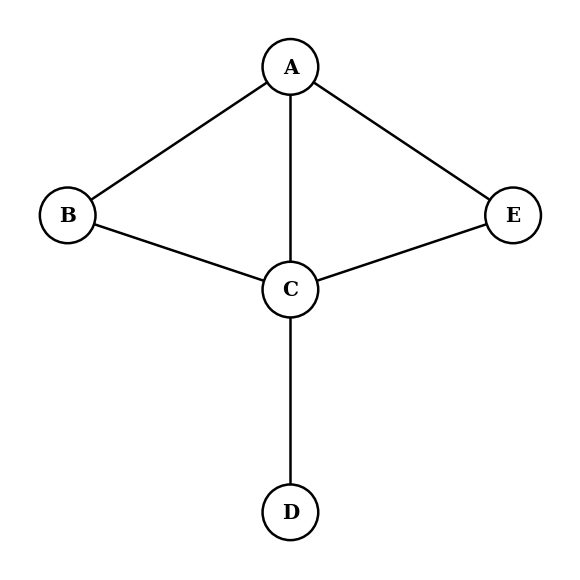
1.[2]
Write down the adjacency matrix for this graph.
2.[1]
Find a Hamiltonian path in this graph.
3.[1]
State the change that would be needed for a Hamiltonian cycle to be present.
Question 7
HLPaper 2
Based on the graph:
1.[2]
Create an unweighted adjacency matrix for the graph.
2.[1]
Hence, identify the odd vertices.
3.[4]
Hence, find the solution to the Chinese Postman Problem.
Question 8
HLPaper 2
Based on the graph:
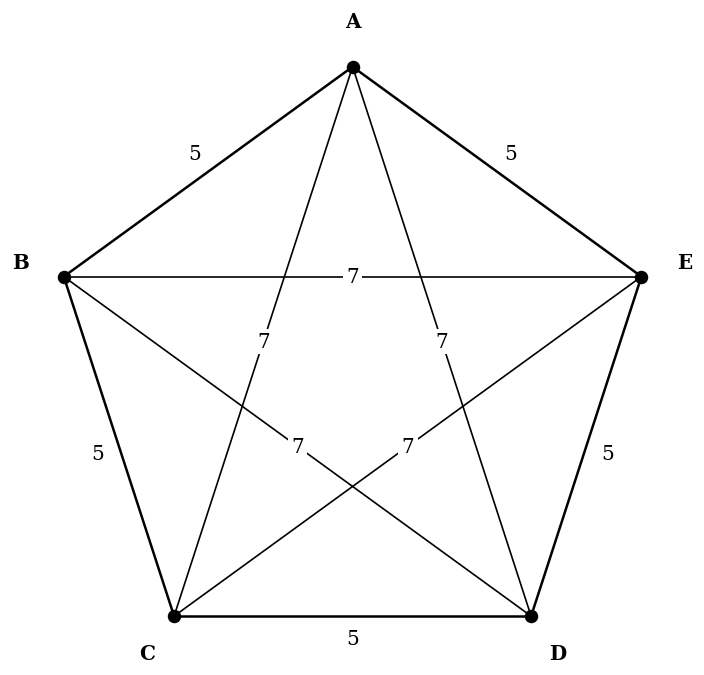
1.[2]
Create the weighted adjacency matrix showing all shortest connections.
2.[4]
Use the deleted vertex theorem with each vertex to find the best lower bound.
3.[2]
Use the nearest neighbour algorithm to find the upper bound.
4.[2]
Hence or otherwise, solve the travelling salesman problem.
Question 9
HLPaper 2
A robot navigates a grid of six rooms, , and . The possible movements between rooms are represented by a directed graph. Some paths are marked with sensors (indicated by dashed edges); these paths have twice the probability of being chosen compared to normal paths from the same room.
The movements are shown in the following graph:
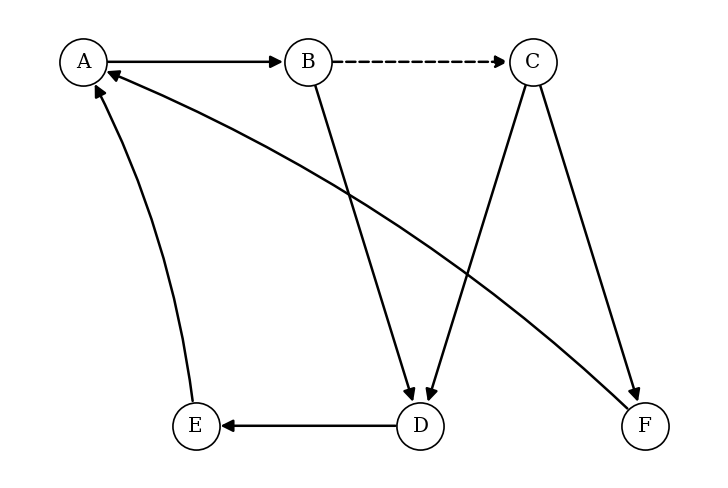
Note: For vertex , the path to is a sensor path, while the path to is a normal path. For vertex , both paths to and are normal paths. All other vertices have a single outgoing normal path as shown.
1.[3]
Determine the transition matrix, , for the robot's movement.
2.[3]
Using a graphic display calculator, estimate the percentage of time the robot spends at room if it moves indefinitely.
3.[2]
Comment on one limitation of this probabilistic model in representing a real robot's movement.
4.[3]
A new room is added to the system. The path from is changed to a normal path to , and a new sensor path is added from to . Update the transition matrix to represent this new 7-room system.
Question 10
HLPaper 2
Based on this graph:
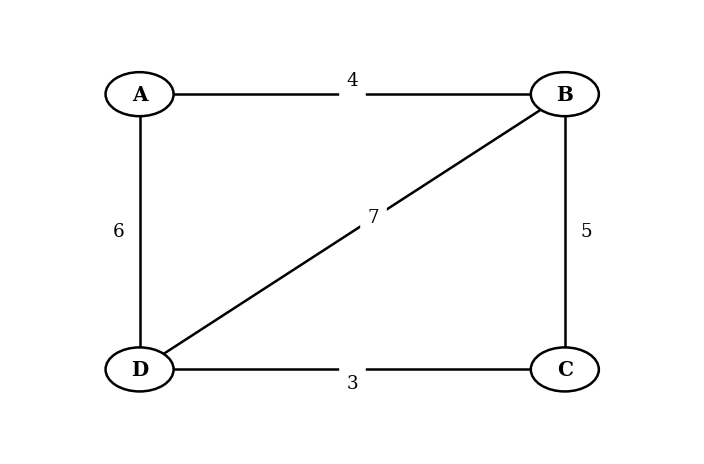
1.[2]
Create a weighted adjacency matrix for the graph, with vertices listed in alphabetical order (A, B, C, D).
2.[3]
Use Kruskal's algorithm to find the minimum spanning tree, stating the order in which edges are added and the total weight of the tree.