Practice SL 3.5—Unit circle definitions of sin, cos, tan. Exact trig ratios, ambiguous case of sine rule with authentic IB Mathematics Analysis and Approaches (AA) exam questions for both SL and HL students. This question bank mirrors Paper 1, 2, 3 structure, covering key topics like functions and equations, calculus, complex numbers, sequences and series, and probability and statistics. Get instant solutions, detailed explanations, and build exam confidence with questions in the style of IB examiners.
Paper
Level
Question 1
SLPaper 1
Consider the function .
1.[1]
Find the amplitude of .
2.[3]
Determine the possible values of such that has a period of .
3.[6]
Given that , find the -coordinates of the maximum and minimum points of in the domain .
Question 2
SLPaper 1
Let .
1.[1]
Find the derivative of the function .
2.[3]
Find the equation of the tangent line to the graph of at .
3.[4]
Hence, or otherwise, show that at the function attains its maximum.
Question 3
SLPaper 1
The first two terms of an infinite geometric sequence are and , where , and .
1.[2]
Find an expression for in terms of .
2.[6]
Find the values of which give the greatest value of the sum.
Question 4
SL & HLPaper 1
Consider a geometric sequence where the first term and the second term , where .
1.[4]
Find the common ratio of this geometric sequence in terms of and .
2.[5]
Given that , explain why the sum to infinity exists and find it for , giving your answer in the form .
Question 5
SLPaper 1
Prove the identity
for all values of for which both sides are defined.
1.[3]
Start from the left-hand side and express everything in terms of and .
2.[3]
Hence, or otherwise, show that
3.[4]
If , find the exact values of and .
Question 6
SLPaper 1
Let and (so that ). By observing the unit circle, express the following in terms of and/or .
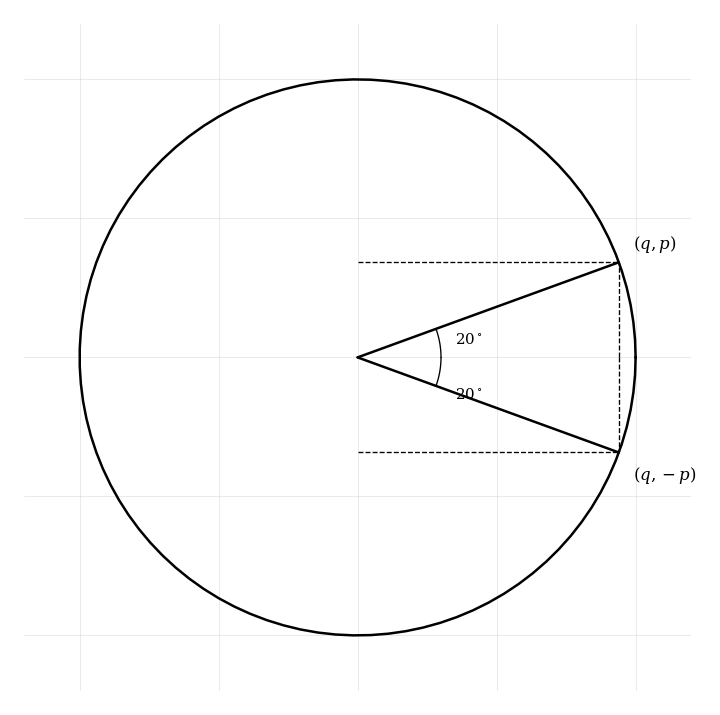
1.
[1]
2.
[1]
3.
[1]
4.
[1]
5.
[1]
6.
[1]
Question 7
SLPaper 1
A point moves around the unit circle centered at the origin with coordinates .
At a certain instant, the -coordinate of is .
1.[2]
Find all possible values of .
2.[4]
If lies in the third quadrant, find the exact values of , , and .
3.[2]
Verify that the identity holds for your values.
4.[3]
A quantity measured at is defined by . Determine the maximum and minimum possible values of , giving exact values.
5.[3]
Hence find the range of (in radians, ) for which the quantity is greater than .
Question 8
SLPaper 1
A point moves around the unit circle centered at the origin with coordinates .
At a certain instant, the -coordinate of is .
1.[2]
Find all possible values of .
2.[4]
If lies in the fourth quadrant, find the exact values of , , and .
3.[2]
Verify that the identity holds for your values.
4.[3]
A rotating light beam at has intensity given by the equation .
Determine the maximum and minimum possible intensities, giving exact values.
5.[3]
Hence find the range of (in radians, ) for which the intensity is less than .
Question 9
SLPaper 1
A point moves around the unit circle centered at the origin with coordinates .
At a certain instant, the -coordinate of is .
1.[2]
Find all possible values of .
2.[4]
If lies in the first quadrant, find the exact values of , , and .
3.[2]
Verify that the identity holds for your values.
4.[3]
A quantity defined at a general point on the circle is given by .
Determine the maximum and minimum possible values of , giving exact values.
5.[3]
Hence find the range of (in radians, ) for which the quantity is greater than .
Question 10
SLPaper 1
A point moves around the unit circle centered at the origin with coordinates .
At a certain instant, the -coordinate of is .
1.[2]
Find all possible values of .
2.[4]
If lies in the fourth quadrant, find the exact values of , , and .
3.[2]
Verify that the identity holds for your values.
4.[4]
A rotating beacon at the point emits a light beam of intensity given by . As increases from to , determine the maximum and minimum possible intensities, giving exact values.
5.[3]
Hence find the range of (in radians, ) for which the intensity exceeds 1.5.