Practice SL 3.4—Circle, radians, arcs, sectors with authentic IB Mathematics Analysis and Approaches (AA) exam questions for both SL and HL students. This question bank mirrors Paper 1, 2, 3 structure, covering key topics like functions and equations, calculus, complex numbers, sequences and series, and probability and statistics. Get instant solutions, detailed explanations, and build exam confidence with questions in the style of IB examiners.
Paper
Level
Question 1
SLPaper 2
A research drone is tethered by two cables, and , attached to points and on level ground. The points and are 80 m apart. The drone is directly above the point on the ground. In the horizontal triangle , the angle at between the lines and is .
At a certain instant, the angle of elevation of the drone from is and from is .
1.[2]
Draw a fully-labelled 3-D diagram showing and all known angles.
2.[2]
Let the horizontal distances m and m. Show that
3.[2]
Using the cosine rule in triangle , show that
4.[3]
Use your results from part 2 and 3 to find the height of the drone above the ground. Give your answer to the nearest metre.
5.[3]
The drone then moves horizontally so that its projection traces out a circular path of radius 80 m centred at . Calculate the angle swept by in radians and the length of the arc of this path when the bearing of from changes from to .
6.[3]
The tension in each cable is proportional to its length. If the tension in is and in is , find the ratio at this instant.
Question 2
SLPaper 2
A city planner is designing a circular flower bed in a public park. A sector of this circular flower bed will be planted with seasonal flowers, while the rest will have perennial plants. The area of the sector planted with seasonal flowers is with a central angle of radians.
1.[3]
Calculate the radius of the circular flower bed.
2.[3]
Determine the perimeter of the sector that will be used for seasonal flowers.
Question 3
SLPaper 2
A rescue helicopter hovers above a mountain valley. It is connected by two winch cables to huts and on level ground. The distance between the huts is . The helicopter is vertically above point , and in the horizontal triangle , .
The angle of elevation of the helicopter is from and from .
1.[2]
Sketch a fully-labelled 3-D diagram showing and all given angles.
2.[2]
Let m and m. Show that
3.[2]
Using the cosine rule in triangle , write down an equation relating and .
4.[2]
Use your results to find the height of the helicopter above the ground, correct to the nearest metre.
5.[3]
The point later moves horizontally around a circular path of radius centred at . Find the length of the arc, in metres and radians, when its bearing from changes from to .
6.[3]
If tensions are and , find .
Question 4
SLPaper 2
A hot-air balloon is anchored by two ropes to points and on level ground. The distance is 75 m. The balloon is vertically above , and in the horizontal triangle .
The angles of elevation of the balloon are from and from .
1.[2]
Draw a fully-labelled 3-D diagram showing and all the given angles.
2.[2]
Let m and m. Show that
3.[2]
Using the cosine rule in triangle , write an equation relating and .
4.[2]
Find the height of the balloon, to the nearest metre.
5.[3]
The projection moves horizontally on a circle of radius centered at . Find the angle subtended by the arc in radians and the length of the arc in metres when the bearing of from changes from to .
6.[3]
If and , find .
Question 5
SLPaper 1
1.[3]
Express the following angles in radians, giving your answers in terms of . a. b. c.
2.[3]
Express the following angles in degrees. a. b. c.
Question 6
SLPaper 1
For the given diagram, point A represents the angle of on the unit circle.
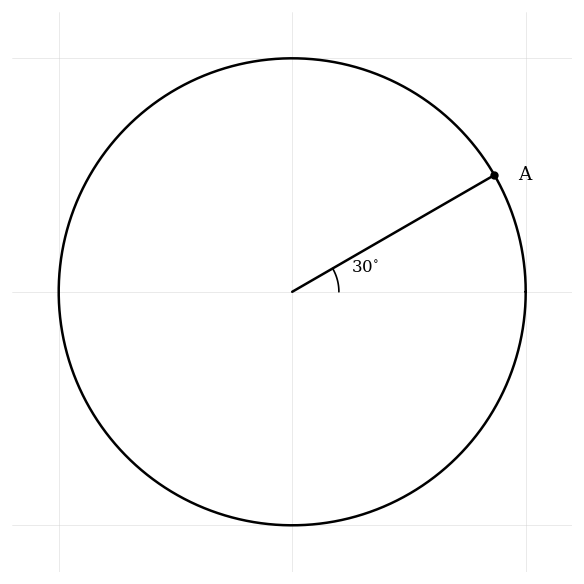
Determine the values of the angle at point A within the following intervals in degrees and in radians:
1.[1]
or
2.[1]
or
3.[1]
or
4.[1]
or
Question 7
SLPaper 2
Consider a circle with center and radius . The size of angle is radians.
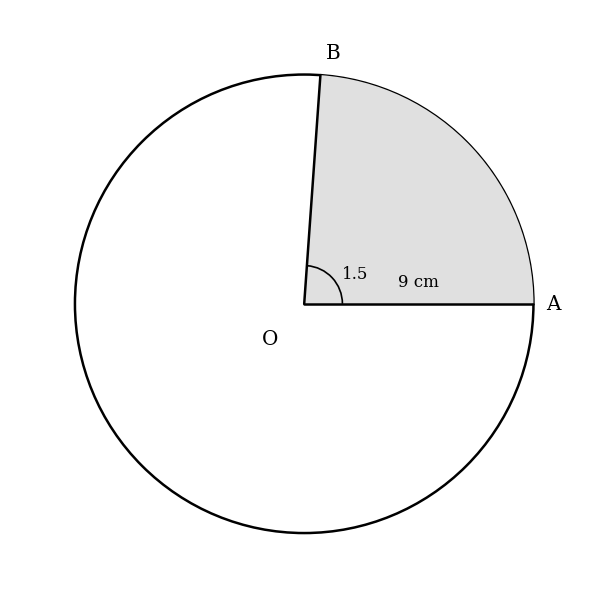
The minor sector is shaded.
1.[2]
Find the length of the minor arc and the length of the major arc .
2.[2]
Find the area of the minor sector and the area of the major sector.
3.[2]
Find the perimeter of the minor sector and the perimeter of the major sector.
Question 8
SLPaper 2
Convert the following angles from degrees to radians, giving each answer to three significant figures.
1.[2]
Convert to radians.
2.[2]
Convert to radians.
3.[2]
Convert to radians.
Question 9
SLPaper 2
A satellite dish is positioned vertically above a point on the ground. Two control posts, and , are 40 m apart. The bearing of from is . The bearing of the dish from is . At a certain instant, the angle of elevation of the dish from is and from is .
1.[2]
Draw a fully-labelled 3D diagram showing and all known angles.
2.[2]
Let the horizontal distances m and m. Show that
3.[3]
Using the cosine rule in triangle , express in terms of and known constants.
4.[3]
Combine your results from parts 2 and 3 to find the height of the dish. Give your answer to the nearest tenth of a metre.
5.[3]
The dish's projection describes a circular path of radius m. The path subtends an angle of radians. Calculate the arc length in metres.
6.[3]
Find the ratio of the horizontal distance from to the 3D distance at this instant.
Question 10
SLPaper 2
In the given figure, the sector of a circle is shown having radius and angle at the centre. The perimeter of the sector is .
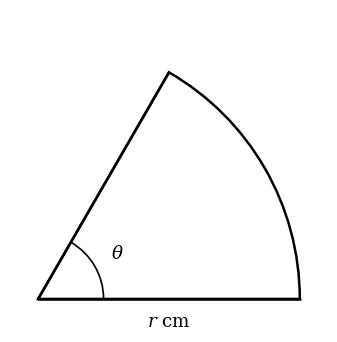
1.[3]
Show that the angle is
2.[3]
The area of the sector is . Find the value of .