Practice AHL 4.13—Non-linear regression with authentic IB Mathematics Applications & Interpretation (AI) exam questions for both SL and HL students. This question bank mirrors Paper 1, 2, 3 structure, covering key topics like core principles, advanced applications, and practical problem-solving. Get instant solutions, detailed explanations, and build exam confidence with questions in the style of IB examiners.
Paper
Level
Question 1
HLPaper 1
Elena is modeling the decay of a radioactive substance. The mass, (in grams), remaining after days is given by:
| 0 | 5 | 10 | 15 | |
|---|---|---|---|---|
| 100 | 60.7 | 36.8 | 22.3 |
She proposes a model of the form , where and are positive constants.
1.[2]
Show that the model satisfies the differential equation .
2.[3]
Find the values of and using a logarithmic transformation and least squares regression.
3.[2]
Estimate the mass remaining after 20 days.
4.[2]
Calculate the sum of squared residuals for the model at the given data points.
Question 2
HLPaper 1
An engineer models the vibration amplitude, (in mm), of a machine as a function of its operating frequency, (in Hz). The data suggests a polynomial relationship:
| 10 | 20 | 30 | 40 | |
|---|---|---|---|---|
| 2.5 | 5.0 | 6.0 | 5.5 |
The engineer proposes a cubic model of the form , where , and are constants.
1.[3]
Find the equation of the least squares cubic regression curve.
2.[1]
Write down the coefficient of determination, , for this model.
3.[3]
Find the frequency at which the amplitude is maximized, using the cubic model.
4.[2]
Calculate the sum of squared residuals for the model at the given points.
5.[1]
Suggest one reason why a cubic model might not be appropriate for frequencies far beyond 40 Hz .
Question 3
HLPaper 1
A physicist investigates the cooling of a metal rod after being removed from a furnace. The temperature, (in ), of the rod at time (in minutes) is recorded as:
| 0 | 5 | 10 | 15 | |
|---|---|---|---|---|
| 200 | 150 | 120 | 100 |
The physicist proposes a modified exponential model of the form , where , and are constants, and represents the ambient temperature (assumed to be ).
1.[2]
Show that follows an exponential decay model.
2.[3]
Find the values of and using least squares regression, given .
3.[2]
Calculate the sum of squared residuals for the model.
4.[2]
Predict the temperature after 20 minutes.
Question 4
HLPaper 2
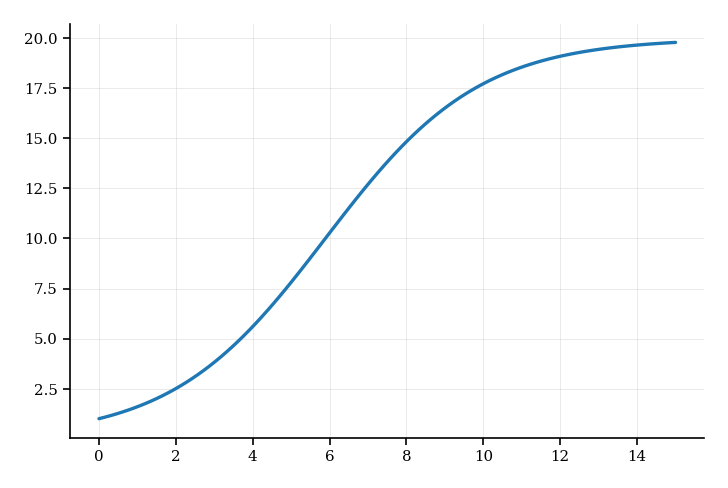
A biologist is studying the growth of a bacterial colony. The number of bacteria, (in thousands), after hours is recorded as follows:
| 0 | 2 | 4 | 6 | |
|---|---|---|---|---|
| 1.0 | 2.5 | 5.6 | 10.3 |
The biologist models the growth using a logistic function of the form , where , and are positive constants. Based on preliminary observations, the carrying capacity is estimated to be 20 thousand.
1.[1]
Explain why a logistic model is appropriate for this data.
[1 mark]
2.[2]
Transform the logistic model into a linear form to estimate parameters using regression.
[2 marks]
3.[3]
Using and the linear form from Part 2, estimate the values of and using the data provided.
[3 marks]
4.[2]
Predict the number of bacteria after 8 hours.
[2 marks]
5.[1]
Discuss one limitation of using this logistic model for long-term predictions.
[1 mark]
Question 5
HLPaper 2
A researcher is studying the relationship between the number of hours spent studying, , and the scores obtained in a test, . The data collected is as follows: .
1.[2]
Using the data provided, find the quadratic regression equation of the curve of best fit.
2.[2]
Using the quadratic regression equation found in part 1, predict the test score for a student who studies for 6 hours.
Question 6
HLPaper 2
A researcher is studying the relationship between the amount of fertilizer used (in kg) and the yield of a particular crop (in tons). The data collected is as follows: (2.3, 4.5), (3.1, 5.2), (4.7, 6.8), (5.5, 7.1), (6.2, 8.0), (7.4, 9.3). The researcher believes that a non-linear model would best describe the relationship between these variables.
1.[2]
Using the data provided, fit an exponential regression model of the form to the data. Determine the values of and .
2.[1]
Calculate the coefficient of determination () for the exponential regression model.
3.[1]
Describe what this means about the fit of the model.
Question 7
HLPaper 1
A marine biologist models the oxygen concentration, (in ), in a coral reef as a function of time, (in hours), over a 24-hour period. The data suggests a sinusoidal pattern:
| (hours) | 0 | 6 | 12 | 18 | 24 |
|---|---|---|---|---|---|
| () | 6.0 | 7.5 | 6.0 | 4.5 | 6.0 |
The biologist proposes a model of the form , where , and are constants.
1.[2]
Show that the period of the proposed model is .
2.[2]
Given the data suggests a 24-hour period, find the value of .
3.[3]
Find the values of and using least squares regression.
4.[2]
Calculate the sum of squared residuals for the model at the given points.
5.[1]
Discuss one limitation of this model for predicting oxygen levels beyond 24 hours.
Question 8
HLPaper 2
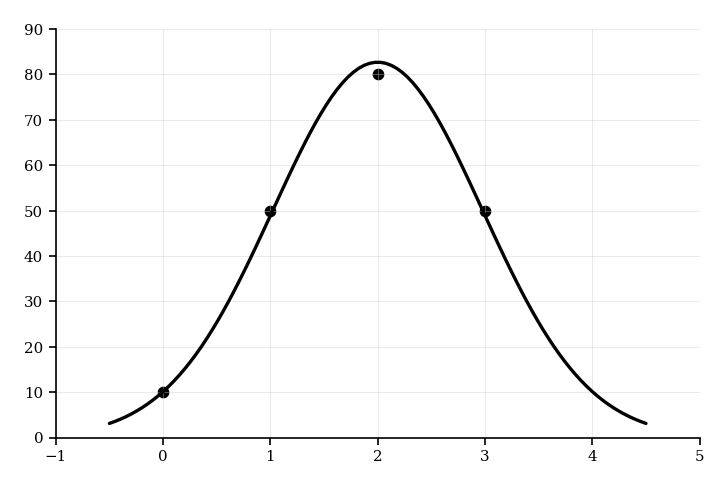
An ecologist models the population density of a species, (in individuals per ), as a function of distance, (in km), from a pollution source. The data suggests a Gaussian distribution:
| 0 | 1 | 2 | 3 | |
|---|---|---|---|---|
| 10 | 50 | 80 | 50 |
The ecologist proposes a model of the form , where , and are constants.
1.[2]
Transform the model into a linear form for regression.
2.[3]
Estimate , and using least squares regression.
3.[2]
Calculate the coefficient of determination, , for the model.
4.[2]
Predict the population density at .
5.[2]
Discuss one limitation of this model for predicting density at large distances.
Question 9
HLPaper 2
A research team is evaluating two models to estimate the growth of a bacterial culture over time in hours.
1.[1]
Model X is defined by the linear equation .
Determine the value of the coefficient of determination, , for Model X.
2.[1]
State the equation for Model X.
3.[1]
Use Model X to predict the growth at hours.
Question 10
HLPaper 1
A researcher studies the intensity of light, (in lumens), emitted by a bioluminescent organism as a function of time, (in hours), after exposure to a stimulus. The data is recorded as follows:
| (hours) | 0 | 1 | 2 | 3 |
|---|---|---|---|---|
| (lumens) | 50.0 | 41.2 | 35.0 | 30.6 |
The researcher proposes a model of the form , where , and are positive constants, and represents the baseline intensity.
1.[2]
Show that follows an exponential decay model.
2.[3]
Given , find the values of and using least squares regression on the transformed data .
3.[2]
Calculate the sum of squared residuals (SSR) for the model with respect to the given data.
4.[2]
Estimate the light intensity after 4 hours using the model found in part 2.