Practice SL 4.6—Combined, mutually exclusive, conditional, independence, prob diagrams with authentic IB Mathematics Analysis and Approaches (AA) exam questions for both SL and HL students. This question bank mirrors Paper 1, 2, 3 structure, covering key topics like functions and equations, calculus, complex numbers, sequences and series, and probability and statistics. Get instant solutions, detailed explanations, and build exam confidence with questions in the style of IB examiners.
Paper
Level
Question 1
SLPaper 1
Let and be two events
1.[2]
Let and . Find .
2.[1]
Find .
3.[1]
Show that for any two events and where , the conditional probabilities and are equal.
Question 2
SLPaper 2
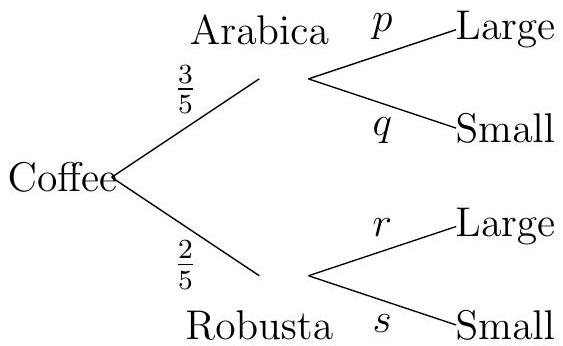
A store sells two types of coffee: Arabica and Robusta. The probability that a customer buys Arabica is . If a customer buys Arabica, the probability they purchase a large size is . If they buy Robusta, the probability they purchase a large size is . The following tree diagram represents these events.
1.[2]
Complete the tree diagram by finding the values of , and .
2.[3]
Find the probability that a customer buys a large coffee.
3.[3]
Given that a customer buys a large coffee, find the probability they purchased Arabica.
Question 3
HLPaper 2
Events and are such that , and .
1.[2]
Find .
2.[2]
Find .
3.[2]
Hence show that events and are independent.
Question 4
SLPaper 1
In a game show, a contestant chooses one of three doors at random. The probability that a prize is behind door A is , behind door B is , and behind door C is . The host, who knows where the prize is, opens one of the other doors which does not contain the prize. The contestant can then either stay with their choice or switch to the remaining closed door.
1.[3]
Calculate the probability that the contestant wins if they stay with their initial choice.
2.[3]
Determine whether the events "choosing door A" and "winning by switching" are independent.
Question 5
SLPaper 2
Two urns contain red (R) and blue (B) balls:
- Urn A: 5 R, 7 B (12 balls)
- Urn B: 4 R, 6 B (10 balls)
An experiment proceeds as follows (independently each time it is run).
- With probability (Procedure I): draw two balls without replacement from Urn A.
- With probability (Procedure II): transfer one ball chosen uniformly at random from Urn A to Urn B, then draw two balls without replacement from Urn B.
Let be the event “the two drawn balls are both red”.
1.[3]
Under Procedure I, find and .
2.[4]
Under Procedure II, find .
3.[2]
Find the overall probability .
4.[3]
Given that the two drawn balls are both red, find the posterior probability that Procedure II was used.
5.[3]
Under Procedure II, given that the two drawn balls are both blue, find the probability that the transferred ball was blue.
6.[2]
The experiment is performed twice independently. Find the probability that exactly one run results in both red.
Question 6
SLPaper 2
Events and are independent and . Given that , find .
1.[6]
Find .
Question 7
HLPaper 1
Consider two events and that are mutually exclusive.
1.[6]
Given that , show that and are not mutually exclusive.
Question 8
SLPaper 2
At a tech firm’s internship intake, each applicant may have a portfolio () and/or a recommendation (). From historical records:
Interview pass probabilities:
1.[3]
Compute and complete the four-region table.
2.[4]
Find and .
3.[2]
Test whether and are independent.
4.[2]
With applicants, find the expected number with neither a portfolio nor a recommendation.
5.[2]
Find the probability that two out of applicants chosen without replacement have a recommendation letter.
6.[2]
Find .
7.[3]
Given an applicant passed and had a portfolio, find .
Question 9
SLPaper 2
In a factory, each item may have a cosmetic defect and/or a functional defect . From long-run monitoring:
1.[3]
Determine , , , and .
2.[4]
Find and .
3.[2]
Test whether and are independent, justifying your answer numerically.
4.[2]
A shipment of 1000 items has proportions matching these probabilities exactly. Two items are selected at random without replacement.
Find the probability that both selected items are free of defects and .
5.[2]
Find the probability that exactly one of the two selected items has defect (regardless of whether it also has defect ).
6.[2]
Three items are selected with replacement. Find the probability that at least one of the three items has both defects and .
7.[3]
Two items are selected without replacement. Let be the event that the sample contains at least one item with defect and no items with defect . Find .
Question 10
SLPaper 1
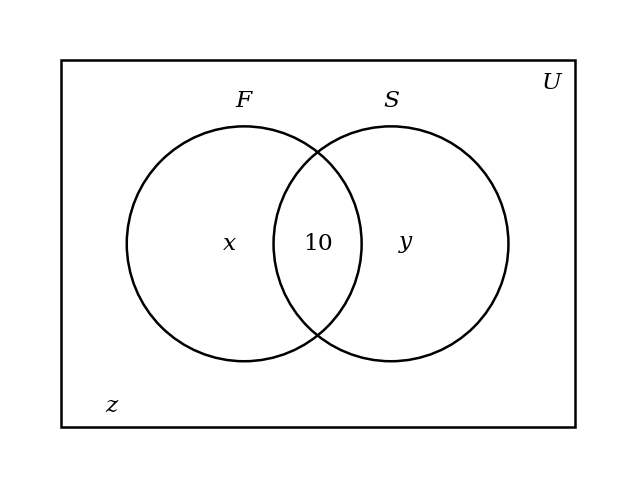
In a group of 60 students, 35 study French, 30 study Spanish, and 10 study both languages. Let represent the event "studies French" and represent the event "studies Spanish". The following Venn diagram shows these events, with , and representing numbers of students.
1.[4]
Find the values of , and .
2.[2]
Calculate the probability that a randomly selected student studies exactly one language.
3.[3]
Determine whether the events and are independent.