Practice SL 4.7—Discrete random variables with authentic IB Mathematics Analysis and Approaches (AA) exam questions for both SL and HL students. This question bank mirrors Paper 1, 2, 3 structure, covering key topics like functions and equations, calculus, complex numbers, sequences and series, and probability and statistics. Get instant solutions, detailed explanations, and build exam confidence with questions in the style of IB examiners.
Paper
Level
Question 1
HLPaper 2
1.[6]
A biased die is weighted such that the probability, , of obtaining a six is . The die is rolled repeatedly and independently until a six is obtained.
Let be the event "obtaining the first six on an even numbered roll".
Find .
Question 2
SLPaper 2
A discrete random variable models the number of customers arriving at a counter in a 10-minute period, with the probability distribution:
| 0 | 1 | 4 | |
|---|---|---|---|
| 0.2 |
(a) Find the value of and the probability distribution. (b) Find and sketch the probability distribution.
1.[3]
Find the value of and the probability distribution.
2.[3]
Find and sketch the probability distribution.
Question 3
HLPaper 1
Chloe and Selena play a game where each have four cards showing capital letters A, B, C and D.
Chloe lays her cards face up on the table in order A, B, C, D as shown in the following diagram.
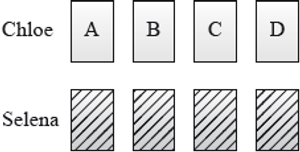
Selena shuffles her cards and lays them face down on the table. She then turns them over one by one to see if her card matches with Chloe’s card directly above.
Chloe wins if no matches occur; otherwise Selena wins.
Chloe and Selena repeat their game so that they play a total of 50 times.
Suppose the discrete random variable represents the number of times Chloe wins.
1.[6]
Show that the probability that Chloe wins the game is .
2.[3]
Determine the mean of .
3.[2]
Determine the variance of .
Question 4
HLPaper 2
A box contains two types of biased coins. One coin is drawn at random and tossed times.
- With probability , a Type A coin is drawn; for Type A, the probability of heads on any toss is .
- With probability , a Type B coin is drawn; for Type B, the probability of heads on any toss is .
Let be the total number of heads in the 8 tosses. Assume tosses are independent conditional on the coin type.
1.[4]
Write down the conditional distributions of and . Hence find .
2.[5]
Find and without expanding the full mixture PMF, by using the laws of total expectation and total variance.
3.[3]
The experiment resulted in exactly heads. Compute .
4.[2]
A game pays €. Decide whether to Play (before seeing any data).
5.[4]
After observing that the first two tosses are both heads, you are offered the option to play the game (where the payoff depends on the total number of heads in the 8 tosses). Compute and decide whether to play.
Question 5
SLPaper 1
A game involves rolling a fair six-sided die until a 6 appears. Let be the discrete random variable representing the number of rolls needed to get the first 6. The probability distribution is given by for .
1.[2]
Verify that and .
2.[3]
Show that the expected number of rolls, , is 6.
3.[3]
Find the probability that at least 4 rolls are needed to get the first 6.
Question 6
HLPaper 2
A store runs a promotion in which each customer plays one spin game. Before each spin, a wheel type is chosen at random: Wheel A with probability and Wheel B with probability . The payout (in euros) from a spin depends on the wheel type as follows (spins are independent between customers).
1.[3]
Find the unconditional probability distribution of (i.e., for ).
2.[4]
Hence compute and .
3.[4]
Define a “big win” as receiving at least . For independent customers, find the expected number of big wins, and use technology (or a normal approximation with continuity correction) to estimate the probability that at least 8 customers get a big win.
4.[3]
A randomly chosen customer received . Find the probability that their spin used Wheel B.
5.[2]
The store plans to charge an entry fee of euros per spin. Find the value of that makes the game fair on average for the store over many customers.
6.[4]
Suppose the store charges the fair price from Part 5. Let a customer’s net gain be and the store’s profit on that customer be . For independent customers, find and , where . Use a normal approximation to determine the probability that the store loses money (that is, ) on that day.
Question 7
SLPaper 1
A discrete random variable represents the number of successful attempts in a game, with the probability distribution given by the following table.
| 0 | 1 | 2 | 3 | |
|---|---|---|---|---|
Given that the expected value ,
1.[5]
Find the values of and .
2.[3]
Calculate the variance .
Question 8
SLPaper 1
A charity raffle sells tickets, where each ticket has a 5% chance of winning. Let be the random variable representing the number of tickets purchased to obtain two winning tickets.
1.[3]
Show that and find .
2.[4]
Find and the probability that at most 10 tickets are needed.
3.[5]
If the prize is not claimed, its value in week is dollars. Find the smallest such that the expected prize value for a ticket purchased in week exceeds 10 dollars.
4.[4]
Find the mode(s) of the probability distribution.
Question 9
SLPaper 1
A discrete random variable represents the number of defective items found in a quality control process. The probability distribution of is given in the following table:
| 0 | 1 | 2 | 3 | 4 | |
|---|---|---|---|---|---|
| 0.2 | 0.1 | 0.008 |
The value of is equal to the probability of observing exactly 4 defective items in a random sample of 5 items, assuming a binomial distribution where each item has a 0.1 probability of being defective.
1.[3]
Find the values of and .
2.[4]
Calculate and .
3.[2]
Find the probability that at least 2 defective items are found.
Question 10
SLPaper 1
A discrete random variable represents the number of correct answers in a 4-question quiz, where each question has a 25% chance of being answered correctly.
1.[3]
Write the probability distribution table for .
2.[2]
Calculate and .
3.[2]
Find the probability that at least 3 questions are answered correctly.