Probability Diagrams and Concepts in Math AA SL
Venn Diagrams
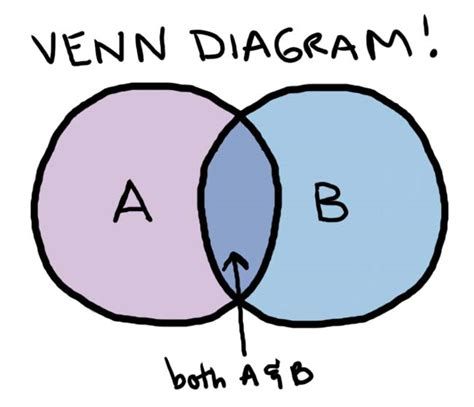
Venn diagrams represent relationships between sets and calculate probabilities. In probability theory, these diagrams illustrate events as circles within a sample space.
Consider a class where 65% of students play soccer, 45% play basketball, and 25% play both. A Venn diagram can visually represent this information:
- Circle A: Soccer players (65%)
- Circle B: Basketball players (45%)
- Intersection (A ∩ B): Students who play both (25%)
- Outside both circles: Students who play neither sport
Using this diagram, we can easily calculate that 85% of students play at least one of these sports: P(A ∪ B) = P(A) + P(B) - P(A ∩ B) = 65% + 45% - 25% = 85%
When using Venn Diagrams, start determining the number of objects with the most conditions (the inner most intersection) and work backwards. You avoid dealing with inclusion-exclusion principle and only have to work with the most basic cases,
Tree Diagrams
Tree diagrams are particularly useful for visualizing sequential events and calculating conditional probabilities. Each branch represents a possible outcome, and probabilities are multiplied along paths to find combined probabilities.
A bag contains 3 red balls and 2 blue balls. Two balls are drawn without replacement. The tree diagram would show:
1st draw:
- Red (3/5)
- Blue (2/5)
2nd draw (given Red first):
- Red (2/4)
- Blue (2/4)
2nd draw (given Blue first):
- Red (3/4)
- Blue (1/4)
To find the probability of drawing two red balls: P(Red and Red) = (3/5) × (2/4) = 3/10
Sample Space Diagrams
Sample space diagrams, often represented as grids or tables, show all possible outcomes of an experiment. They are particularly useful when dealing with two or more independent events.
Rolling two dice can be represented in a 6x6 grid. Each cell represents a possible outcome. To find the probability of rolling a sum of 7:
P(sum of 7) = Number of favorable outcomes / Total number of outcomes = 6 / 36 = 1/6
The favorable outcomes are (1,6), (2,5), (3,4), (4,3), (5,2), and (6,1).
Combined Events
The probability of the union of two events A and B is given by:
$P(A \cup B) = P(A) + P(B) - P(A \cap B)$
In the set of $A$, there are outcomes that are also in $A \cap B$, by there are also the same number of outcomes that satisfy $A \cap B$ which are also in $B$. Therefore, it is necessary to subtract $ P(A \cap B)$ from the overall probability to ensure that they are not over-counted.
The term P(A ∩ B) is subtracted because elements in the intersection would otherwise be counted twice in P(A) + P(B).
Mutually Exclusive Events
Events A and B are mutually exclusive if they cannot occur simultaneously. Mathematically:
$P(A \cap B) = 0$
For mutually exclusive events, the probability of either event occurring is simply the sum of their individual probabilities:
$P(A \cup B) = P(A) + P(B)$
When rolling a die, the events "rolling an even number" and "rolling an odd number" are mutually exclusive. P(Even ∪ Odd) = P(Even) + P(Odd) = 3/6 + 3/6 = 1
Conditional Probability
Conditional probability is the probability of an event occurring given that another event has already occurred. It is denoted as P(A|B) and calculated as:
$P(A|B) = \frac{P(A \cap B)}{P(B)}$
This can be rearranged to give:
$P(A \cap B) = P(B)P(A|B)$
In a deck of 52 cards, what is the probability of drawing a king given that the card is a face card?
P(King | Face Card) = P(King ∩ Face Card) / P(Face Card) = (4/52) / (12/52) = 1/3
Independent Events
Two events A and B are independent if the occurrence of one does not affect the probability of the other. For independent events:
$P(A \cap B) = P(A)P(B)$
When tossing a coin twice, the outcomes of each toss are independent. P(Heads on first AND Heads on second) = P(Heads) × P(Heads) = (1/2) × (1/2) = 1/4
Probabilities With and Without Replacement
In sampling problems, "with replacement" means that each draw is independent, while "without replacement" means that each draw affects the probability of subsequent draws.
A bag contains 3 red and 2 blue marbles. Two marbles are drawn.
With replacement: P(Red then Blue) = (3/5) × (2/5) = 6/25
Without replacement: P(Red then Blue) = (3/5) × (2/4) = 3/10
Students often forget to adjust probabilities for subsequent draws in "without replacement" scenarios. Always consider how each event affects the sample space for the next event.
When solving probability problems, start by clearly identifying the events and whether they are independent, mutually exclusive, or conditional. This will guide you in choosing the appropriate method or formula to solve the problem.