Practice E.3 Radioactive decay with authentic IB Physics exam questions for both SL and HL students. This question bank mirrors Paper 1A, 1B, 2 structure, covering key topics like mechanics, thermodynamics, and waves. Get instant solutions, detailed explanations, and build exam confidence with questions in the style of IB examiners.
Paper
Level
Question 1
HLPaper 2
In an experiment, a beam of neutrons is used to induce artificial transmutation of stable nuclei, producing radioactive , which undergoes decay with a half-life of 2.25 minutes.
1.[1]
Write an equation for the neutron-induced transmutation reaction.
2.[1]
Write an equation for the subsequent decay of .
3.[2]
Calculate the activity of a sample containing atoms of .
4.[2]
Determine the number of atoms remaining after 6.75 minutes.
5.[2]
Explain the role of neutron activation in nuclear physics and suggest a practical application.
Question 2
HLPaper 2
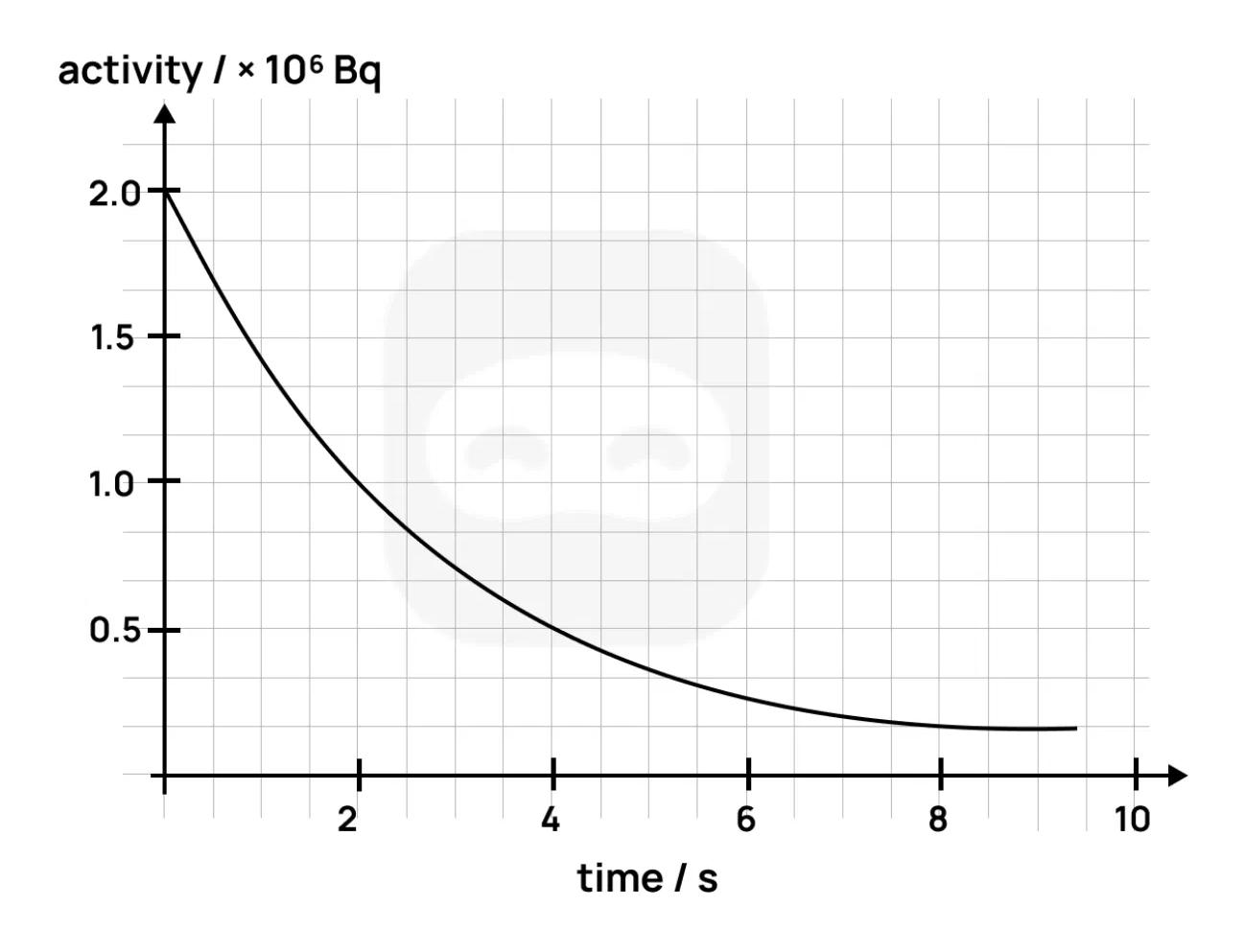
The graph shows the activity of a radioactive sample as a function of time.
1.[1]
Define the term activity as used in radioactive decay.
2.[2]
Use the graph to determine the half-life of the sample. Show your working.
3.[2]
Calculate the decay constant of the sample using your answer to Part 2.
4.[2]
The number of undecayed nuclei at time is given by . Deduce the expression for the half-life in terms of the decay constant.
5.[2]
A detector used to measure this sample's activity has a uncertainty in its readings. Discuss the effect of this uncertainty on the accuracy of your half-life determination.
6.[2]
Explain how this graph supports the probabilistic nature of radioactive decay.
Question 3
SLPaper 1A
Which of the following is true about mass-energy changes in nuclear decay?
Question 4
HLPaper 1A
An isotope of mass number has a binding energy per nucleon of . What is the total energy released if of this isotope is formed from separated nucleons?
Question 5
SLPaper 2
In the context of nuclear energy, the principle of mass-energy equivalence plays a crucial role in understanding how energy is released during radioactive decay. This principle is foundational in the development of sustainable energy sources.
1.[2]
Explain the concept of mass defect and its relation to binding energy.
2.[3]
Calculate the energy released if a total mass defect of is converted into energy, using the equation .
3.[3]
Discuss how the mass-energy equivalence principle is applied in the context of nuclear power generation and its implications for sustainable energy.
Question 6
HLPaper 1A
A pure sample of iodine-131 decays into xenon with a half-life of 8 days.
What is after 24 days?
Question 7
HLPaper 1A
When the nucleus is bombarded with alpha particles, the following nuclear reaction can occur.
The particle X is a
Question 8
SLPaper 1A
A graph of the variation of average binding energy per nucleon with nucleon number has a maximum. What is indicated by the region around the maximum?
Question 9
SLPaper 1A
In a neutral atom there are electrons, protons and neutrons. What is the mass number of the nuclide?
Question 10
SLPaper 1A
The initial number of atoms in a pure radioactive sample is . The radioactive half-life of the sample is defined as the