Practice A.4 Rigid body mechanics (HL only) with authentic IB Physics exam questions for both SL and HL students. This question bank mirrors Paper 1A, 1B, 2 structure, covering key topics like mechanics, thermodynamics, and waves. Get instant solutions, detailed explanations, and build exam confidence with questions in the style of IB examiners.
Paper
Level
Question 1
HLPaper 2
A rotating platform in a physics lab has a moment of inertia and is initially rotating at . A student drops a lump of clay of mass onto the platform at a distance of from the axis. The clay sticks to the platform.
1.[2]
Calculate the moment of inertia of the clay relative to the axis of rotation.
2.[2]
Determine the new angular speed of the platform-clay system.
3.[2]
Calculate the change in rotational kinetic energy.
4.[2]
Explain how this experiment demonstrates angular impulse and its relation to angular momentum.
Question 2
HLPaper 1A
A yo-yo of mass and radius is released from rest and allowed to fall vertically while unwinding. If its moment of inertia is , what is the linear acceleration of its center of mass?
Question 3
HLPaper 1A
A plank of mass and length rests horizontally on two supports placed from each end. A person of mass walks from the center toward one end. At what distance from the center will the plank begin to tip?
Question 4
HLPaper 1A
A disc of moment of inertia spinning at angular velocity is placed on a horizontal surface with friction and allowed to roll without slipping. After some time, it transitions into pure rolling motion. What happens to its final angular velocity?
Question 5
HLPaper 1A
A pulley system consists of a solid disc (mass , radius ) mounted horizontally and free to rotate. A mass is suspended and allowed to fall, causing the pulley to rotate. What is the angular acceleration of the disc?
Question 6
HLPaper 2
A flywheel rotates with an initial angular velocity of and comes to rest after 8.0 seconds due to a constant frictional torque. The moment of inertia of the flywheel is .
1.[2]
Calculate the angular acceleration of the flywheel.
2.[2]
Determine the frictional torque acting on the flywheel.
3.[2]
Calculate the total angle (in radians) through which the flywheel rotates before stopping.
4.[2]
Explain the relationship between the angular deceleration and the energy lost by the system.
Question 7
HLPaper 1B
A student investigates the torque produced by applying varying forces at different distances from the pivot of a rigid beam. The following data were recorded:
| Distance from Pivot | Force Applied | Torque |
|---|---|---|
| 0.2 | 3.6 | 0.72 |
| 0.4 | 3.6 | 1.44 |
| 0.6 | 3.6 | 2.16 |
| 0.8 | 3.6 | 2.88 |
| 1.0 | 3.6 | 3.60 |
The relationship between torque, force, and distance is given by:
where:
- is the torque,
- is the perpendicular distance from the pivot,
- is the applied force.
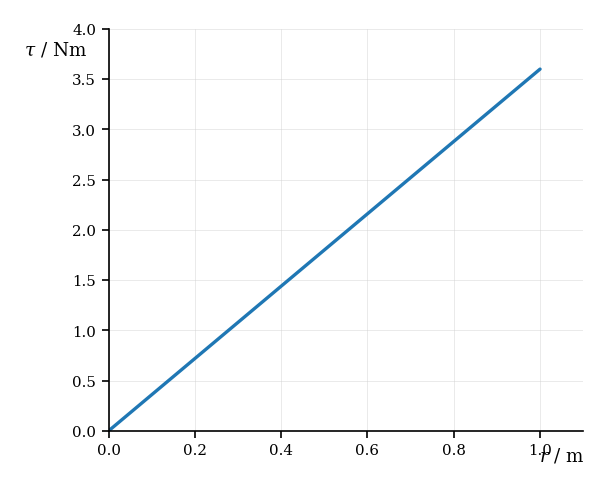
1.[4]
Identify two potential sources of error in the experiment and explain their impact on the measured torque.
2.[2]
Suggest two improvements to minimize these errors.
3.[2]
Using the graph provided, describe the trend in the data and explain how it supports the equation .
4.[1]
Suggest how the value of the applied force at a given distance could be determined graphically.
5.[2]
Using the data point , calculate the applied force . Show all your working.
6.[3]
If the uncertainty in is and the uncertainty in is , calculate the percentage uncertainty in for the same data point.
Question 8
HLPaper 2
A billiard ball of radius and mass is struck by a horizontal cue stick at a height above the billiard table. The moment of inertia for a sphere is given by . The cue stick strikes the ball with a force during an interval .
1.[2]
Find an expression for the velocity of the ball after the strike.
2.[3]
Find an expression for the angular velocity of the ball after the strike.
3.[3]
Find the value of for which the ball will roll without slipping. Express your answer in terms of .
Question 9
SLPaper 1A
An object of mass makes revolutions per second around a circle of radius at a constant speed. What is the kinetic energy of the object?
Question 10
HLPaper 2
A solid uniform rod of length and mass is pivoted at one end. The rod can rotate freely in a vertical plane about this pivot. A force of is applied perpendicular to the rod at its free end.
1.[2]
Determine the torque produced by the applied force at the free end of the rod.
2.[2]
The moment of inertia of a uniform rod about an axis through one end is given by . Calculate the moment of inertia of the rod about the pivot.
3.[2]
Using the result from Part 1 and Part 2, calculate the angular acceleration of the rod.