Practice SL 5.5—Introduction to integration with authentic IB Mathematics Applications & Interpretation (AI) exam questions for both SL and HL students. This question bank mirrors Paper 1, 2, 3 structure, covering key topics like core principles, advanced applications, and practical problem-solving. Get instant solutions, detailed explanations, and build exam confidence with questions in the style of IB examiners.
Paper
Level
Question 1
SLPaper 1
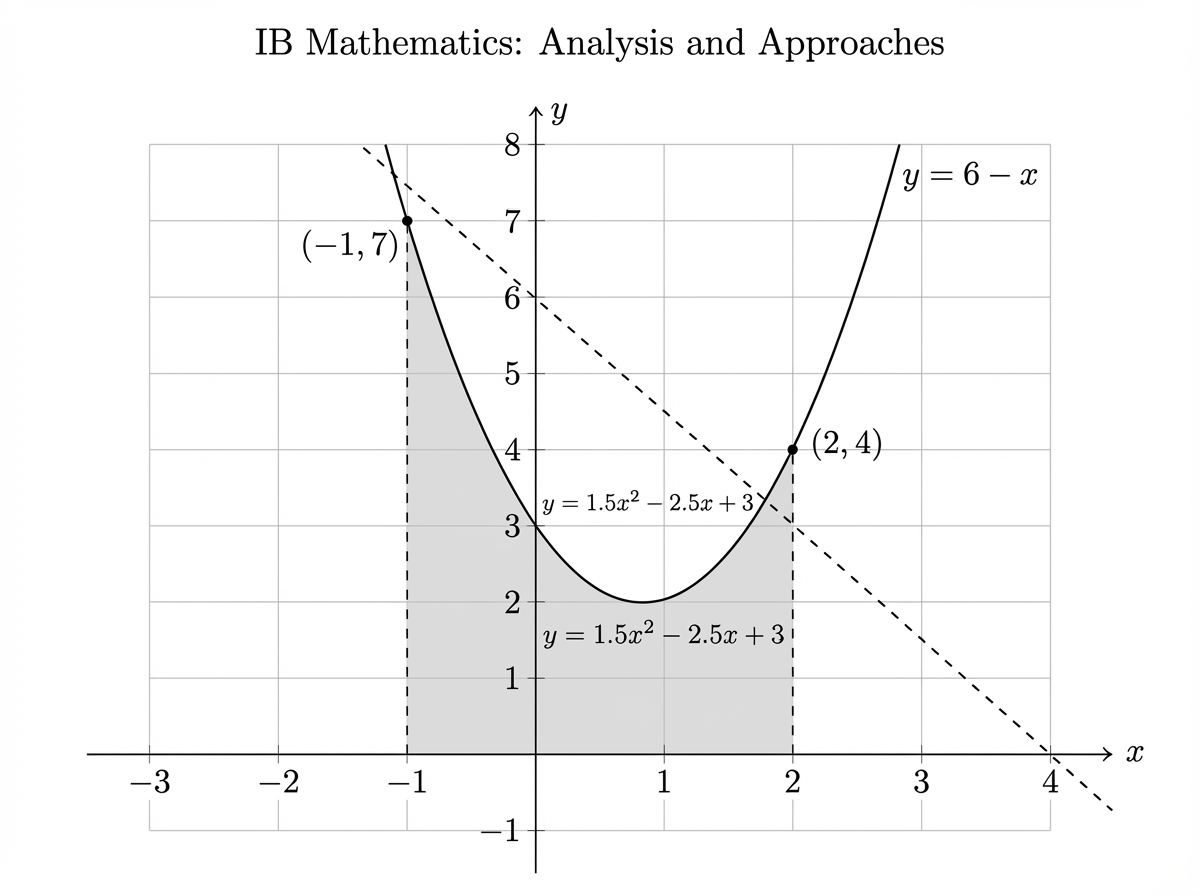
The graphs of and intersect at and , as shown in the following diagrams.
In Diagram 1, the region enclosed by the line , the vertical lines and , and the -axis has been shaded.
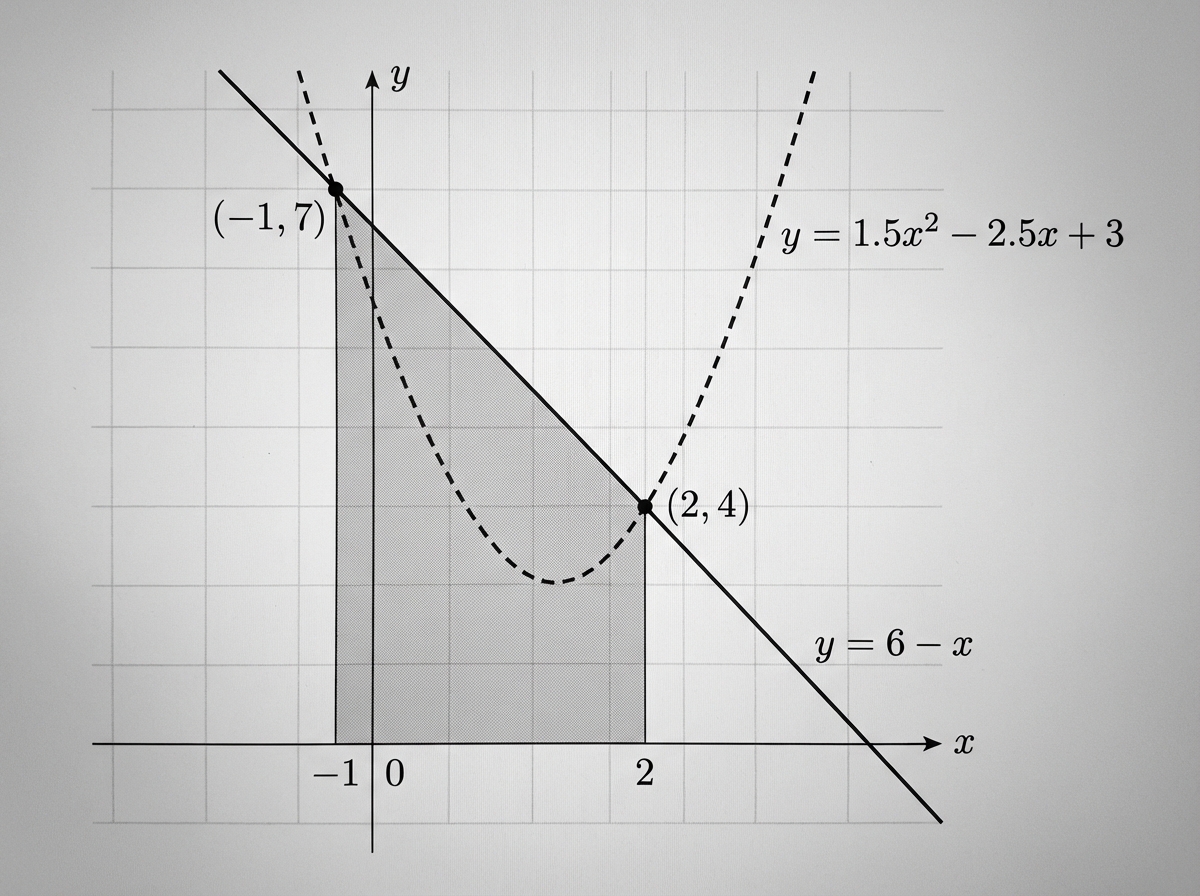
In Diagram 2, the region enclosed by the curve , the vertical lines and , and the -axis has been shaded.
1.[3]
Calculate the area of the shaded region in Diagram 1.
2.[1]
Write down an integral for the area of the shaded region in Diagram 2.
3.[3]
Calculate the area of the shaded region in Diagram 2.
4.[1]
Hence, determine the area enclosed between the line and the curve .
Question 2
HLPaper 2
A particle moves along the -axis. The velocity of is at time seconds, where for .
1.[2]
Find the times when is at instantaneous rest.
2.[3]
Find the magnitude of the particle's acceleration at 6 seconds.
3.[2]
Find the greatest speed of in the interval .
4.[4]
The particle starts from the origin . Find an expression for the displacement of from at time seconds.
5.[3]
Find the total distance travelled by in the interval .
Question 3
SLPaper 2
The function models the rate of growth of a plant species over time, where is measured in weeks.
1.[3]
Calculate the indefinite integral of .
2.[4]
Determine the definite integral of from to .
3.[3]
Interpret the result of the definite integral in the context of the plant's growth.
4.[4]
Determine if is increasing or decreasing on the interval [1, 3].
5.[4]
Verify your definite integral result using technology.
Question 4
SLPaper 1
1.[4]
Find .
2.[3]
Find , given that and .
Question 5
HLPaper 1
1.[3]
Let . Given that , find .
Question 6
SLPaper 1
1.[5]
Let . Find , given that .
Question 7
SLPaper 2
A fitness app calculates the energy expenditure of a user based on their running distance. The energy expenditure can be modeled by the integral , where represents a normalized distance covered by the user, constrained within the interval .
1.[4]
Find the indefinite integral of the energy expenditure function.
2.[3]
Calculate the definite integral of the energy expenditure function from to .
Question 8
SLPaper 2
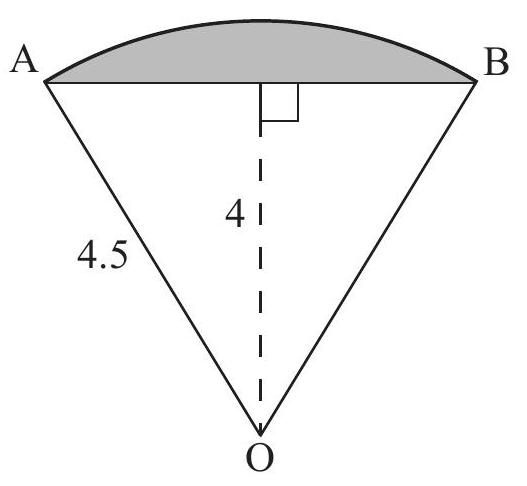
A sector of a circle, centre and radius , is shown in the following diagram.
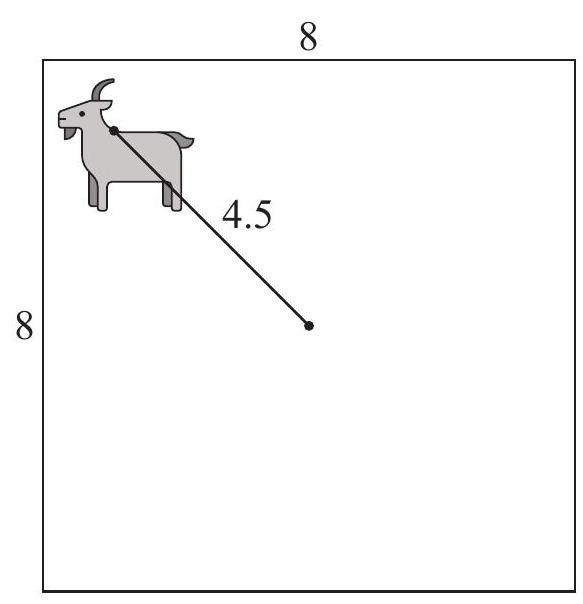
A square field with side has a goat tied to a post in the centre by a rope such that the goat can reach all parts of the field up to from the post.
Let be the volume of grass eaten by the goat, in cubic metres, and be the length of time, in hours, that the goat has been in the field. The goat eats grass at the rate of .
1.[3]
Find the angle .
2.[6]
Find the area of the shaded segment.
3.[2]
Find the area of a circle with radius .
4.[3]
Find the area of the field that can be reached by the goat.
5.[2]
Find the value of at which the goat is eating grass at the greatest rate.
Question 9
SLPaper 2
The function models the growth rate of a plant species in a greenhouse.
1.[2]
Calculate the indefinite integral of .
2.[2]
Using the boundary condition that , determine the constant of integration.
3.[2]
Find the definite integral of from to to determine the total growth over this period.
Question 10
SLPaper 1
A researcher is investigating the rate of decay of a certain radioactive substance, which can be modeled by the function for , where represents time in hours.
1.[2]
Find the indefinite integral of .
2.[2]
Determine the area under the curve of from to .