Practice SL 5.2—Increasing and decreasing functions with authentic IB Mathematics Analysis and Approaches (AA) exam questions for both SL and HL students. This question bank mirrors Paper 1, 2, 3 structure, covering key topics like functions and equations, calculus, complex numbers, sequences and series, and probability and statistics. Get instant solutions, detailed explanations, and build exam confidence with questions in the style of IB examiners.
Paper
Level
Question 1
SLPaper 1
1.[3]
Given the derivative of a function is , determine the intervals where the original function is increasing or decreasing.
Question 2
SLPaper 1
Daniela is planning to create a rectangular vegetable garden and wants to maximize her earnings from the produce. She has a fence of 200 meters to enclose the garden, with the length of the garden denoted by meters.
Daniela sells her produce for 2 USD per square meter, so maximizing the garden's area will maximize her revenue.
1.[4]
Express the area of the garden in terms of .
2.[2]
Determine the value of that maximizes the area of the garden.
3.[2]
Show that, with the maximum area, Daniela earns exactly 5000 USD from selling her produce.
Question 3
HLPaper 1
Given the function :
1.[5]
Find the derivative of from first principles.
2.[3]
Determine the intervals where is increasing or decreasing.
Question 4
SLPaper 1
The function models the signal loss (in decibels) along a transmission line, where represents the displacement in kilometers from a central reference point.
1.[3]
Find the rate of change in signal loss with respect to displacement .
2.[4]
Determine the interval(s) on which the signal loss is increasing.
Question 5
SLPaper 1
The derivative of a function is given by .
1.[3]
Determine the intervals where the original function is increasing or decreasing.
Question 6
SLPaper 1
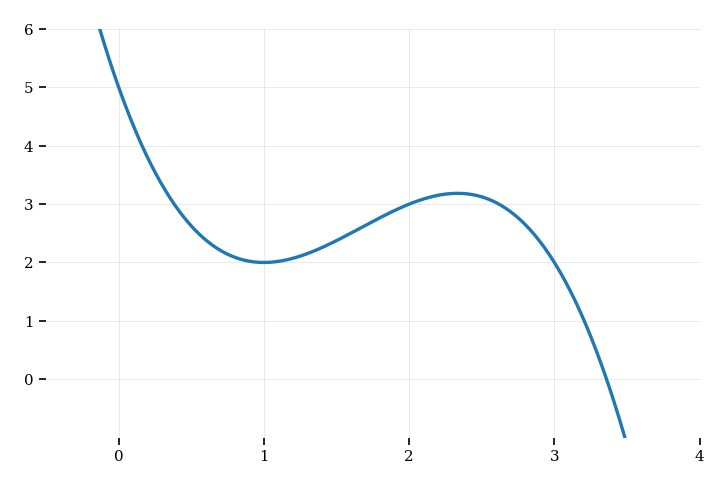
Consider the function . The graph of is shown below.
1.[1]
Write down the -intercept of the graph.
2.[2]
Expand the expression for .
3.[3]
Find .
4.[3]
Find the -coordinates of the points where the tangent is horizontal.
5.[2]
Determine the interval where the graph of is increasing.
6.[3]
Find the range of for .
Question 7
HLPaper 2
The function represents the elevation profile of a hiking trail, where is the distance in kilometers along the trail and is the elevation in meters to help understand the terrain.
1.[2]
Find the slope of the trail from the derivative
2.[2]
Identify the potential peaks or valleys along the trail
3.[3]
Determine the intervals on which the trail elevation is increasing or decreasing, showing where the trail ascends or descends.
Question 8
SLPaper 2
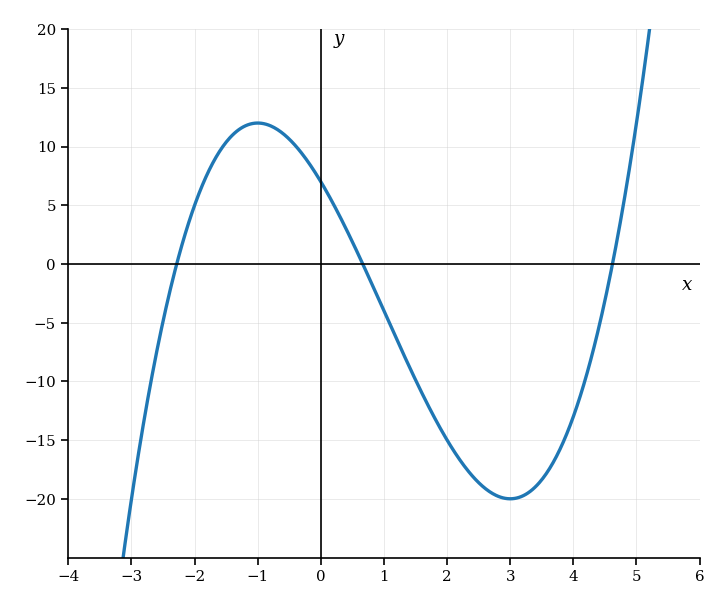
Consider the function . The graph of is shown below.
1.[1]
Write down the -intercept of the graph.
2.[2]
Find .
3.[3]
Find the -coordinates of the points where the tangent is horizontal.
4.[2]
Determine the interval where the graph of is decreasing.
5.[3]
Find the coordinates of the local minimum point.
6.[3]
Find the set of values of for which the equation has three distinct real roots.
Question 9
SLPaper 2
The function models the tilt of a robotic arm as it reaches out to different positions from its base, helping determine the arm's stability as it extends further from the center.
1.[4]
Find the derivative to determine the rate of change of the robotic arm's tilt as it extends.
2.[3]
Determine the intervals on which the tilt is increasing or decreasing, indicating when the arm moves in a stable direction.
Question 10
SLPaper 2
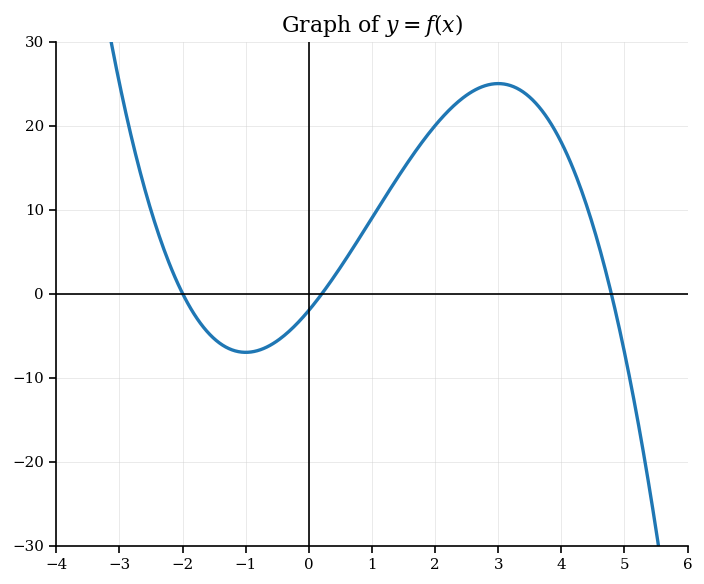
Consider the function . The graph of is shown below.
1.[1]
Write down the -intercept of the graph.
2.[2]
Find .
3.[3]
Find the -coordinates of the points where the tangent is horizontal.
4.[2]
Determine the intervals where the graph of is decreasing.
5.[3]
Find the coordinates of the local maximum point.
6.[2]
Find the number of solutions to in the interval .