Practice R3.2 Electron transfer reactions with authentic IB Chemistry exam questions for both SL and HL students. This question bank mirrors Paper 1A, 1B, 2 structure, covering key topics like atomic structure, chemical reactions, and organic chemistry. Get instant solutions, detailed explanations, and build exam confidence with questions in the style of IB examiners.
Paper
Level
Question 1
SL & HLPaper 1A
The apparatus for the electrolysis of molten sodium chloride is shown.
Which statement is correct?
Question 2
SL & HLPaper 1A
Given the standard electrode potentials:
Which statement is correct about the spontaneous direction of electron flow?
Question 3
SL & HLPaper 1A
Which of the following is always true in a redox reaction?
Question 4
SLPaper 1A
Which compound can be oxidised when heated with an acidified solution of potassium dichromate(VI)?
Question 5
HLPaper 1A
What are the products of electrolysis when concentrated calcium bromide solution is electrolysed using graphite electrodes?
| Product at cathode (negative electrode) | Product at anode (positive electrode) | |
|---|---|---|
| A. | hydrogen | bromine |
| B. | calcium | oxygen |
| C. | calcium | bromine |
| D. | hydrogen | oxygen |
Question 6
HLPaper 1A
Which compound contains sulfur with an oxidation state of +6?
Question 7
SLPaper 2
Voltaic cells convert chemical energy into electrical energy.
1.[1]
Identify the direction of electron flow in a zinc–copper voltaic cell.
2.[1]
State the species reduced at the cathode.
3.[2]
Explain why the flow of electrons occurs in that direction.
Question 8
SLPaper 1A
Which element undergoes reduction in the following reaction?
Question 9
SLPaper 1A
What is the change in the oxidation state of oxygen?
Question 10
SL & HLPaper 1A
The diagram below shows a voltaic cell.
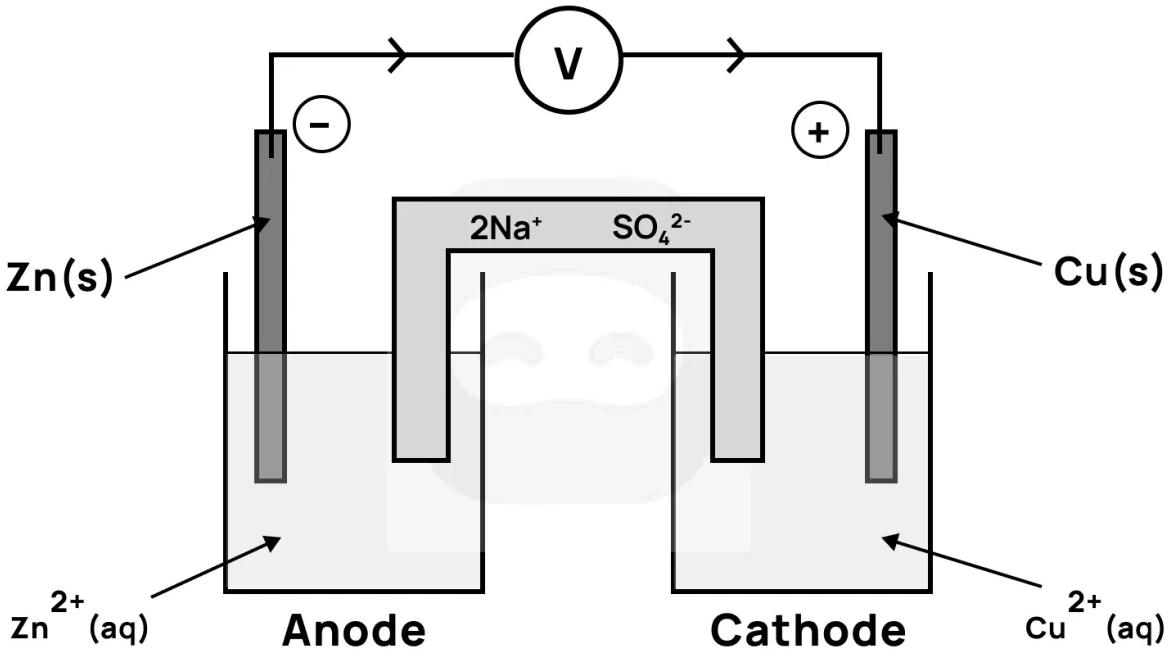
Which statement is correct?