Practice Unit 3: Financial Management - Accounting, Ratio evaluation, Core Financial Documents with authentic IB Business Management exam questions for both SL and HL students. This question bank mirrors Paper 1, 2, 3 structure, covering key topics like systems and structures, human behavior and interaction, and sustainability and ethics. Get instant solutions, detailed explanations, and build exam confidence with questions in the style of IB examiners.
Paper
Level
Question 1
HLPaper 3
LuminaCare
Resource 1 – Company profile and financial context
LuminaCare is a Ghana-based, for-profit social enterprise that manufactures solar-powered medical devices for rural clinics and maternal health centers across Sub-Saharan Africa. Its flagship product is a solar fetal heart monitor, which allows midwives to detect complications during pregnancy without relying on grid electricity. The company raised seed capital from impact investors but has now reached an inflection point: demand has grown by 300%, and LuminaCare must decide whether to pursue a $2.5M Series A equity round or take on $1.2M in concessional debt from a development bank.
Resource 2 – CFO’s internal memo (Finance)
“Our burn rate is steady, but we’ve reached our credit limit with suppliers. We operate on 90-day payment terms with clinics, so cash flow is always tight. Series A equity gives us the scale to meet demand and build a second facility—but would dilute founder control and introduce board-level oversight. The concessional loan is low-interest and non-dilutive but comes with covenants: quarterly EBITDA targets, strict capex limits, and donor-style reporting. Any miss could trigger loan restructuring or early repayment.”
Resource 3 – HR performance dashboard (Q1–Q2 2025)
| Metric | Value |
|---|---|
| Staff turnover (last 6 months) | 22% |
| Time to fill technical roles | 49 days (↑ 24%) |
| % of roles with formal job descriptions | 58% |
| Managerial span of control | Avg. 12 direct reports |
| Avg. team engagement score | 67/100 (↓ from 78) |
| The head of HR notes that burnout and unclear career paths are leading to attrition, especially among product engineers and field deployment staff. |
Resource 4 – Marketing team proposal
“Clinics love our mission—but most have no idea who we are until we show up at trade shows. We need to invest in inbound marketing, including a multilingual website, CRM tools, and a referral rewards program for midwives. More crucially, we’re perceived as a donor-funded nonprofit, not a serious tech company. To attract hospital procurement officers and larger buyers, we must reposition the brand to emphasize product quality, not just affordability and ethics.”
Resource 5 – Email thread: CEO to CFO and Marketing Lead
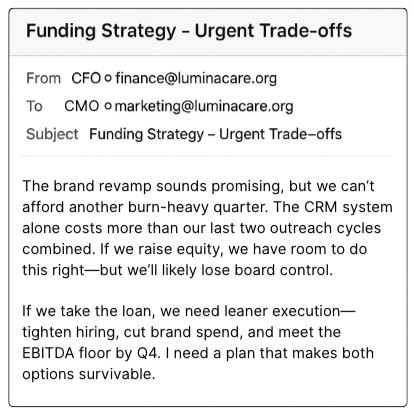
Resource 6 – Feedback from key field partners
“We rely on LuminaCare’s devices, but their response time for repairs has worsened.” “Sometimes we get different pricing from different reps. There’s no standard process.” “I love the mission—but our procurement officer wants a brand that feels serious. A logo change isn’t enough.”
1.[2]
With reference to Resource 3, describe one HR issue that may be impacting LuminaCare’s ability to scale sustainably.
2.[6]
Explain one financial challenge and one marketing challenge LuminaCare may face if it accepts the concessional loan.
3.[17]
Using all the resources provided and your knowledge of business management tools and theories, recommend a possible plan of action for LuminaCare over the next five years.
Question 2
HLPaper 2
GreenGadget Innovations
GreenGadget Innovations is a technology company that produces environmentally friendly electronic devices. The company has grown steadily over the past three years and is now planning a major investment to enhance its market share. Management is evaluating two projects: (1) launching a new product line of solar-powered smartwatches or (2) upgrading its manufacturing facilities to improve efficiency and reduce costs.
Both options require significant financial investment. To ensure the company manages its resources effectively, GreenGadget also plans to implement a more detailed budgeting system to control expenses and forecast revenues accurately.
The following financial data is provided:
1.[6]
Calculate the payback period and net present value (NPV) for both investment options (Solar Smartwatch and Facility Upgrade). Recommend which project GreenGadget should pursue based on your calculations.
2.[4]
Discuss the importance of budgeting for GreenGadget Innovations in managing its financial resources, especially when implementing a significant investment.
3.[4]
Analyze how GreenGadget can use capital budgeting techniques to prioritize between these two investment projects.
4.[10]
Evaluate the potential risks and rewards of launching the solar smartwatch compared to upgrading the manufacturing facilities.