Practice 3.5 Profitability and liquidity ratio analysis with authentic IB Business Management exam questions for both SL and HL students. This question bank mirrors Paper 1, 2, 3 structure, covering key topics like systems and structures, human behavior and interaction, and sustainability and ethics. Get instant solutions, detailed explanations, and build exam confidence with questions in the style of IB examiners.
Paper
Level
Question 1
HLPaper 3
LuminaCare
Resource 1 – Company profile and financial context
LuminaCare is a Ghana-based, for-profit social enterprise that manufactures solar-powered medical devices for rural clinics and maternal health centers across Sub-Saharan Africa. Its flagship product is a solar fetal heart monitor, which allows midwives to detect complications during pregnancy without relying on grid electricity. The company raised seed capital from impact investors but has now reached an inflection point: demand has grown by 300%, and LuminaCare must decide whether to pursue a $2.5M Series A equity round or take on $1.2M in concessional debt from a development bank.
Resource 2 – CFO’s internal memo (Finance)
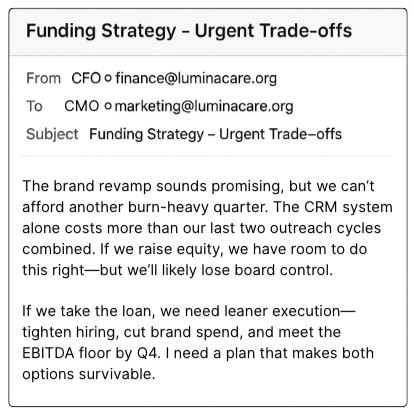
“Our burn rate is steady, but we’ve reached our credit limit with suppliers. We operate on 90-day payment terms with clinics, so cash flow is always tight. Series A equity gives us the scale to meet demand and build a second facility—but would dilute founder control and introduce board-level oversight. The concessional loan is low-interest and non-dilutive but comes with covenants: quarterly EBITDA targets, strict capex limits, and donor-style reporting. Any miss could trigger loan restructuring or early repayment.”
Resource 3 – HR performance dashboard (Q1–Q2 2025)
| Metric | Value |
|---|---|
| Staff turnover (last 6 months) | 22% |
| Time to fill technical roles | 49 days (↑ 24%) |
| % of roles with formal job descriptions | 58% |
| Managerial span of control | Avg. 12 direct reports |
| Avg. team engagement score | 67/100 (↓ from 78) |
| The head of HR notes that burnout and unclear career paths are leading to attrition, especially among product engineers and field deployment staff. |
Resource 4 – Marketing team proposal
“Clinics love our mission—but most have no idea who we are until we show up at trade shows. We need to invest in inbound marketing, including a multilingual website, CRM tools, and a referral rewards program for midwives. More crucially, we’re perceived as a donor-funded nonprofit, not a serious tech company. To attract hospital procurement officers and larger buyers, we must reposition the brand to emphasize product quality, not just affordability and ethics.”
Resource 5 – Email thread: CEO to CFO and Marketing Lead
Resource 6 – Feedback from key field partners
“We rely on LuminaCare’s devices, but their response time for repairs has worsened.” “Sometimes we get different pricing from different reps. There’s no standard process.” “I love the mission—but our procurement officer wants a brand that feels serious. A logo change isn’t enough.”
1.[2]
With reference to Resource 3, describe one HR issue that may be impacting LuminaCare’s ability to scale sustainably.
2.[6]
Explain one financial challenge and one marketing challenge LuminaCare may face if it accepts the concessional loan.
3.[17]
Using all the resources provided and your knowledge of business management tools and theories, recommend a possible plan of action for LuminaCare over the next five years.
Question 2
SLPaper 2
BeanBar Ltd.
BeanBar Ltd. is a medium-sized company that sells gourmet coffee beans online and in retail stores. The business recently launched a new premium coffee blend and carried out primary market research to better understand customer preferences before the launch. The findings helped inform the company’s updated marketing plan, which included promotional discounts and revised packaging.
Although initial sales were strong, the marketing manager is concerned that poor internal communication between the finance and sales teams may be affecting financial performance. The finance team has noted rising costs, while the operations team wants to reinvest in product development.
Table 1 shows selected financial data for the past two months.
Table 1: Selected financial data for BeanBar Ltd. for 2024
| Item | Month 1 ($) | Month 2 ($) |
|---|---|---|
| Revenue | 100,000 | 90,000 |
| Cost of goods sold | 40,000 | 42,000 |
| Expenses | 30,000 | 35,000 |
| Net profit | ? | ? |
| Current assets | 60,000 | 50,000 |
| Current liabilities | 30,000 | 40,000 |
1.[2]
Calculate the net profit for Month 1 and Month 2. Show all your working.
2.[2]
Calculate the current ratio for Month 2. Show all your working.
3.[2]
Explain one reason why a fall in net profit might concern the finance team.
4.[2]
Identify one method of primary market research used by businesses like BeanBar Ltd.
5.[2]
Outline one problem that may arise from poor internal communication between departments.
Question 3
SLPaper 2
BiteFresh Ltd.
BiteFresh Ltd. is a company that produces ready-made healthy meals for supermarkets and gyms. Due to growing demand, the business is planning to open a second production facility. Management is deciding between two locations: one in an urban area with higher rent but closer to suppliers and customers, and another in a rural area with lower operating costs but limited infrastructure.
The finance team has produced updated financial data to help evaluate the company’s performance and support the location decision.
Table 1: Financial data for BiteFresh Ltd.
| Item | Amount ($) |
|---|---|
| Revenue | 400,000 |
| Cost of goods sold | 220,000 |
| Expenses | 130,000 |
| Fixed costs (per month) | 12,000 |
| Selling price per unit | 10 |
| Variable cost per unit | 4 |
| Current assets | 70,000 |
| Current liabilities | 35,000 |
1.[2]
Calculate the net profit for the business.
Show all your working.
2.[2]
Calculate the net profit margin.
Show all your working.
3.[2]
Calculate the current ratio.
Show all your working.
4.[2]
Calculate the break-even output per month.
Show all your working.
5.[2]
Outline one factor that BiteFresh Ltd. should consider when choosing between the urban and rural location options.
Question 4
SLPaper 2
Solveta Ltd.
Solveta Ltd. is a private limited company that manufactures eco-friendly packaging materials for global e-commerce businesses. The company recently launched a major marketing campaign to enter three new export markets. This campaign involved substantial investment in promotion, pricing adjustments, and changes to distribution (place) to align with regional consumer expectations.
To fund this expansion, Solveta used a mix of retained profit, a medium-term loan, and newly issued share capital. While sales revenue has increased, rising logistics and distribution costs have impacted short-term liquidity. The finance department has released Solveta’s statement of financial position and asked the marketing and finance teams to assess its implications for profitability and cash flow.
Figure 1. Solveta Ltd. Statement of financial position as at 30 June 2024
| Item | $ |
|---|---|
| Assets | |
| Non-current assets | |
| Property, plant and equipment | 600,000 |
| Less: Accumulated depreciation | (150,000) |
| Net non-current assets | 450,000 |
| Current assets | |
| Cash | 60,000 |
| Debtors | 85,000 |
| Stock | 105,000 |
| Total current assets | 250,000 |
| Total assets | 700,000 |
| Liabilities | |
| Current liabilities | |
| Bank overdraft | 12,000 |
| Trade creditors | 48,000 |
| Short-term loan | 40,000 |
| Total current liabilities | 100,000 |
| Non-current liabilities | |
| Borrowings—medium term | 180,000 |
| Total liabilities | 280,000 |
| Net assets | 420,000 |
| Equity | |
| Share capital | 300,000 |
| Retained earnings | 120,000 |
| Total equity | 420,000 |
1.[2]
Explain one reason Solveta Ltd. may have chosen to use more than one source of finance for its international marketing campaign.
2.[2]
Suggest one element of the marketing mix Solveta adjusted to support its international expansion
3.[2]
Calculate the current ratio and acid test ratio for Solveta Ltd. Show all your working.
4.[2]
Outline what these liquidity ratios suggest about Solveta’s short-term financial position.
5.[2]
Comment on how Solveta’s cost and revenue structure may affect its profitability.
Question 5
SLPaper 2
PrintWise Ltd.
PrintWise Ltd. is a medium-sized business that offers custom printing services for schools and local businesses. The company uses a tall organizational structure with multiple layers of management. The managing director has an autocratic leadership style and prefers to give instructions rather than involve employees in decision-making.
Important updates are usually communicated through memos and notice boards. Recently, some employees complained that they were not informed about schedule changes, which affected their work performance.
Table 1 shows selected financial data from PrintWise Ltd.’s final accounts.
Table 1: Selected financial data for PrintWise Ltd. for 2024
| Item | Amount ($) |
|---|---|
| Revenue | 250,000 |
| Gross profit | 100,000 |
| Net profit | 40,000 |
| Current assets | 80,000 |
| Current liabilities | 40,000 |
1.[2]
Identify two features of a tall organizational structure.
2.[2]
State two characteristics of autocratic leadership
3.[2]
Calculate the net profit margin for PrintWise Ltd. Show all your working.
4.[2]
Calculate the current ratio for PrintWise Ltd. Show all your working.
Question 6
SLPaper 2
Global Beans Ltd. (GBL)
Global Beans Ltd. (GBL) is a multinational company (MNC) that sources, roasts, and sells premium coffee in over 30 countries. The company started as a family-run business and experienced rapid internal growth before expanding overseas through joint ventures and franchising.
GBL recently released its final accounts. Table 1 shows selected financial data.
Table 1: Selected financial data for GBL
| Item | Amount ($ million) |
|---|---|
| Revenue | 300 |
| Gross profit | 120 |
| Net profit | 30 |
| Current assets | 90 |
| Current liabilities | 60 |
GBL’s plans for further growth have sparked concerns from local stakeholders in some developing countries where it operates. Local farmers fear that expansion could shift sourcing to cheaper markets, reducing their income. Meanwhile, GBL’s investors are pressuring the company to boost profitability.
1.[2]
Identify two stakeholder groups affected by GBL’s growth.
2.[2]
Calculate GBL’s gross profit margin and net profit margin. Show all your working.
3.[2]
Outline one reason why GBL’s investors might be concerned about its net profit margin.
4.[2]
State one advantage and one disadvantage of using franchising as a method of growth for GBL.
5.[2]
Explain one ethical conflict that may arise when a multinational company like GBL tries to cut costs in developing countries.
Question 7
HLPaper 2
FreshEats Ltd (FE)
FreshEats Ltd (FE) is a rapidly expanding healthy fast-food chain based in Australia. The company has recently experienced significant growth, opening numerous outlets nationwide. This expansion has led to changes in organizational culture, shifting from a family-oriented culture to a more profit-driven environment. Some employees feel alienated, resulting in tensions and declining morale.
FE’s expansion required significant investment, financed through debt, affecting the company's profitability and liquidity ratios. Recent financial analysis indicates decreasing liquidity, causing concern among stakeholders about FE’s short-term financial health.
FE management is considering franchising as an alternative growth strategy, believing it could improve both liquidity and operational efficiency. However, employees are worried franchising could negatively impact their job security and working conditions, increasing risks of industrial action.
FE currently faces uncertainty regarding how many units they need to sell to break even at the new locations. Accurate break-even analysis is critical for financial planning during the ongoing expansion.
1.[2]
Define the term ‘franchising’.
2.[4]
Explain two ways rapid growth may negatively affect FE’s organizational culture.
3.[4]
Explain two reasons why profitability ratios might improve while liquidity ratios worsen.
4.[4]
Calculate the break-even quantity for FE if fixed costs are USD 120,000, average selling price per unit is USD 8, and average variable cost per unit is USD 5. Show all working.
5.[10]
Recommend whether FE should pursue franchising as a growth strategy, considering industrial relations and financial factors.
Question 8
HLPaper 3
GreenTech Innovations
Resource 1 - Company Overview
GreenTech Innovations is a renewable energy firm founded in 2018, focusing on developing and deploying solar and wind energy solutions for both residential and commercial clients. With a mission to combat climate change and promote sustainable energy consumption, the company has seen significant growth due to increasing demand for green technologies.
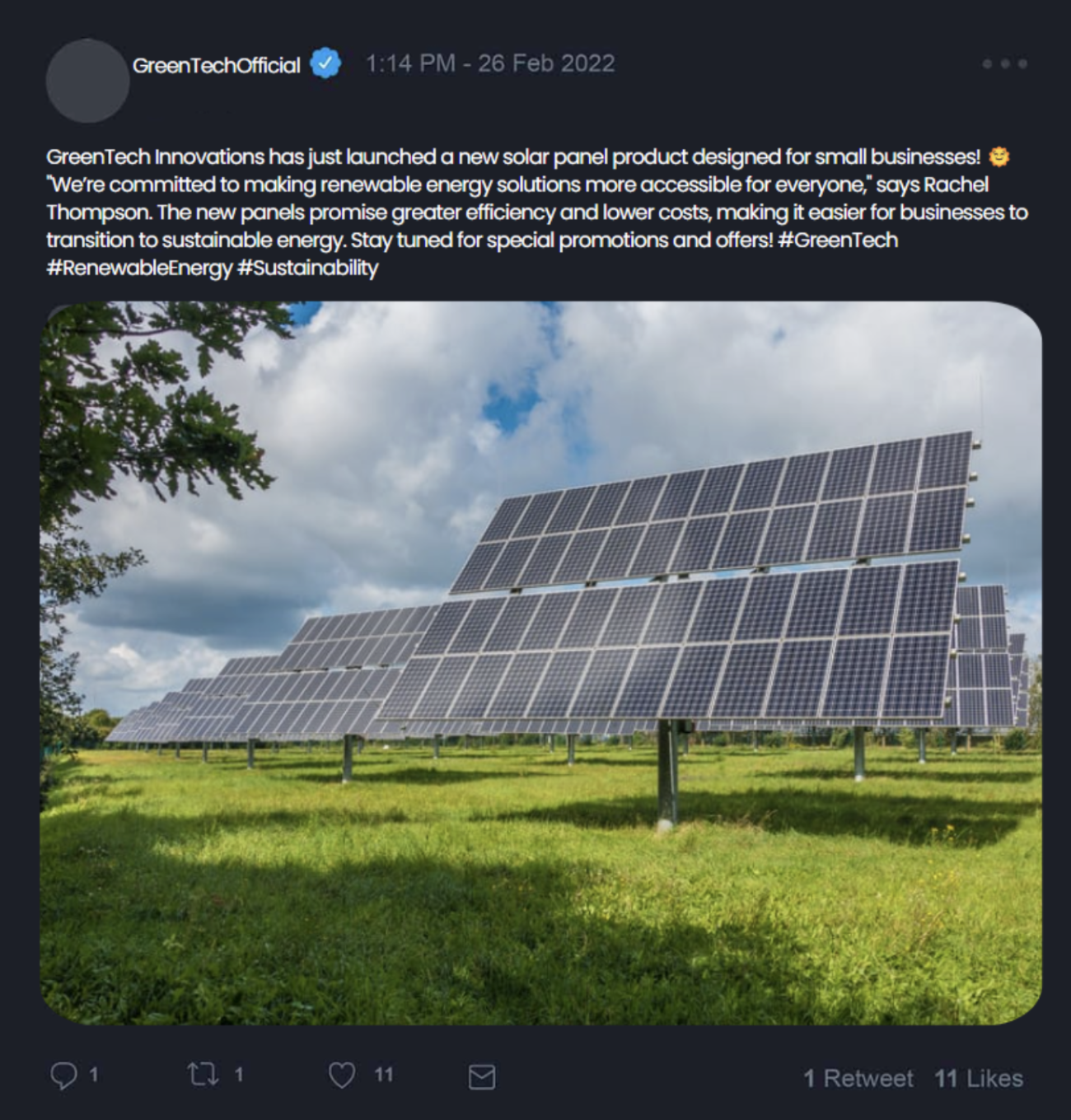
CEO Rachel Thompson emphasizes, "Our goal is to make renewable energy accessible and affordable for everyone, but we face challenges in maintaining profitability while expanding our operations." Despite positive market reception, rising operational costs and competition in the renewable energy sector are pressing issues for GreenTech.
Resource 2 - Financial Performance Report (2023)
GreenTech Innovations
Financial Performance Summary for 2023
| Metric | Amount |
|---|---|
| Revenue | £5,000,000 |
| Gross Profit | £2,000,000 |
| Operating Expenses | £1,200,000 |
| Net Profit | £800,000 |
| Total Assets | £3,500,000 |
| Total Liabilities | £1,500,000 |
| Equity | £2,000,000 |
The company's revenue has increased by 25% from the previous year, but operating expenses have also risen due to investments in new technology and increased staffing costs, raising concerns about long-term profitability.
Resource 3 - Letter from the CFO
Subject: Financial Strategy Update
Dear Rachel,
As we analyze our current financials, it’s essential to develop strategies that balance our growth with profitability.
Here are my suggestions:
Streamline Operations: Assess areas where we can reduce costs without compromising service quality.
Explore New Markets: Consider expanding into regions with lower competition for renewable energy.
Invest in Technology: Leverage automation to enhance operational efficiency and reduce labor costs.
Looking forward to discussing this at our next meeting.
Best,
John Miller, CFO
Resource 4 - Interview with the CEO
In an interview with Eco Business News, CEO Rachel Thompson discussed GreenTech's vision and challenges. "The renewable energy sector is rapidly evolving, and while we are excited about our growth, we must remain vigilant about our operational efficiency.
Our commitment to sustainability and customer satisfaction drives our decisions, but profitability is critical for our long-term success. We're considering partnerships with other tech firms to innovate further."
Resource 5 - Social Media Announcement
1.[2]
Using an appropriate business management theory, identify a human need that GreenTech Innovations products satisfy for their target consumers.
2.[6]
Outline two challenges GreenTech Innovations faces in maintaining profitability. Support your answer with evidence from the resources.
3.[17]
Based on the resources and your business knowledge, recommend a comprehensive strategy to enhance GreenTech Innovations profitability and sustainability over the next five years. Your strategy should consider cost management, market expansion, technological innovations, and consumer engagement initiatives.
Question 9
SLPaper 2
FreshStart Organic
FreshStart Organic is a small business specializing in locally sourced organic produce. Established in 2018, the business prides itself on sustainability and community engagement. FreshStart Organic supplies its products to local markets and runs a subscription box service for home delivery.
Recently, FreshStart has seen increased competition from larger retailers entering the organic market. To remain competitive, the company is considering two options: (1) launching a new marketing campaign to raise awareness of its unique value, or (2) expanding its subscription box service to neighboring towns. However, these strategies require significant investment.
Below is selected financial data for the year ending December 31, 2023:
| Financial Metric | Value (USD) |
|---|---|
| Revenue | 200,000 |
| Cost of Goods Sold (COGS) | 80,000 |
| Operating Expenses | 90,000 |
| Net Profit | 30,000 |
| Total Assets | 150,000 |
| Total Liabilities | 50,000 |
| Current Assets | 60,000 |
| Current Liabilities | 40,000 |
1.[3]
Calculate the Return on Capital Employed (ROCE) for FreshStart Organic using the provided data. Show your workings.
2.[4]
Using the data provided, calculate the Acid Test Ratio for FreshStart Organic and comment on its short-term liquidity position.
3.[4]
Analyze the potential impact of launching a new marketing campaign on FreshStart Organic’s profitability and competitive position.
4.[6]
Explain whether expanding the subscription box service is a better strategic option than launching a marketing campaign.
Question 10
SLPaper 2
NaturFresh Cooperative (NFC)
NaturFresh Cooperative (NFC) is an agricultural cooperative based in Spain, jointly owned by local farmers. NFC markets fresh organic produce across Europe, experiencing significant recent market growth due to rising consumer demand for healthy foods.
To maintain its competitiveness, NFC emphasizes its unique selling proposition (USP) of providing fresh, sustainably grown, locally sourced produce. NFC regularly conducts primary market research to better understand customer preferences and refine its product offerings.
NFC’s financial team highlighted concerns about low liquidity ratios, which management plans to address urgently. They also recognize that the cooperative’s strong reputation and brand name are critical intangible assets essential to sustaining growth.
To further enhance its competitive position, NFC is considering implementing a comprehensive customer loyalty program, encouraging repeat purchases and strengthening customer relationships across its European markets.
1.[2]
Define the term ‘primary market research’.
2.[4]
Explain two advantages of NFC operating as a cooperative.
3.[4]
Explain two reasons why intangible assets are important for NFC’s continued growth.
4.[4]
Explain two benefits to NFC of implementing a customer loyalty program.
5.[10]
Recommend two strategies NFC could use to improve its liquidity ratios without compromising its USP or market growth.