Practice B1.1 Carbohydrates and lipids with authentic IB Biology exam questions for both SL and HL students. This question bank mirrors Paper 1A, 1B, 2 structure, covering key topics like cell biology, genetics, and ecology. Get instant solutions, detailed explanations, and build exam confidence with questions in the style of IB examiners.
Paper
Level
Question 1
SLPaper 1A
During digestion, how is a water molecule used to break down polymers into monomers?
Question 2
SLPaper 1A
What feature of cellulose allows it to form rigid plant cell walls?
Question 3
SLPaper 1A
What characteristic of glucose makes it suitable for transport in the bloodstream?
Question 4
SLPaper 1A
Which of the following is an organic compound?
Question 5
HLPaper 1A
The diagrams show how monosaccharide molecules are joined to form chains in two polysaccharides.
Using the diagram and the table, which diagram and monosaccharide represent glycogen?
| Diagram | Monosaccharide that makes up the chain | |
|---|---|---|
| A. | A | glucose |
| B. | A | maltose |
| C. | B | glucose |
| D. | B | maltose |
Question 6
SL & HLPaper 1A
The diagram shows an image of a plant cell, which type of carbohydrate provides structural support in plant cell walls?
Question 7
SLPaper 1A
How is carbon able to form a wide variety of stable organic molecules?
Question 8
SLPaper 1A
What makes starch suitable for energy storage in plant cells?
| Property | Contribution to Storage Function | |
|---|---|---|
| I | Insolubility in water | Prevents osmotic imbalance |
| II | Helical structure | Enables compact packing |
| III | Easily hydrolyzed | Allows rapid energy release |
Question 9
SLPaper 1A
What is a reason glycogen offers a metabolic advantage over unbranched polysaccharides?
Question 10
SLPaper 1A
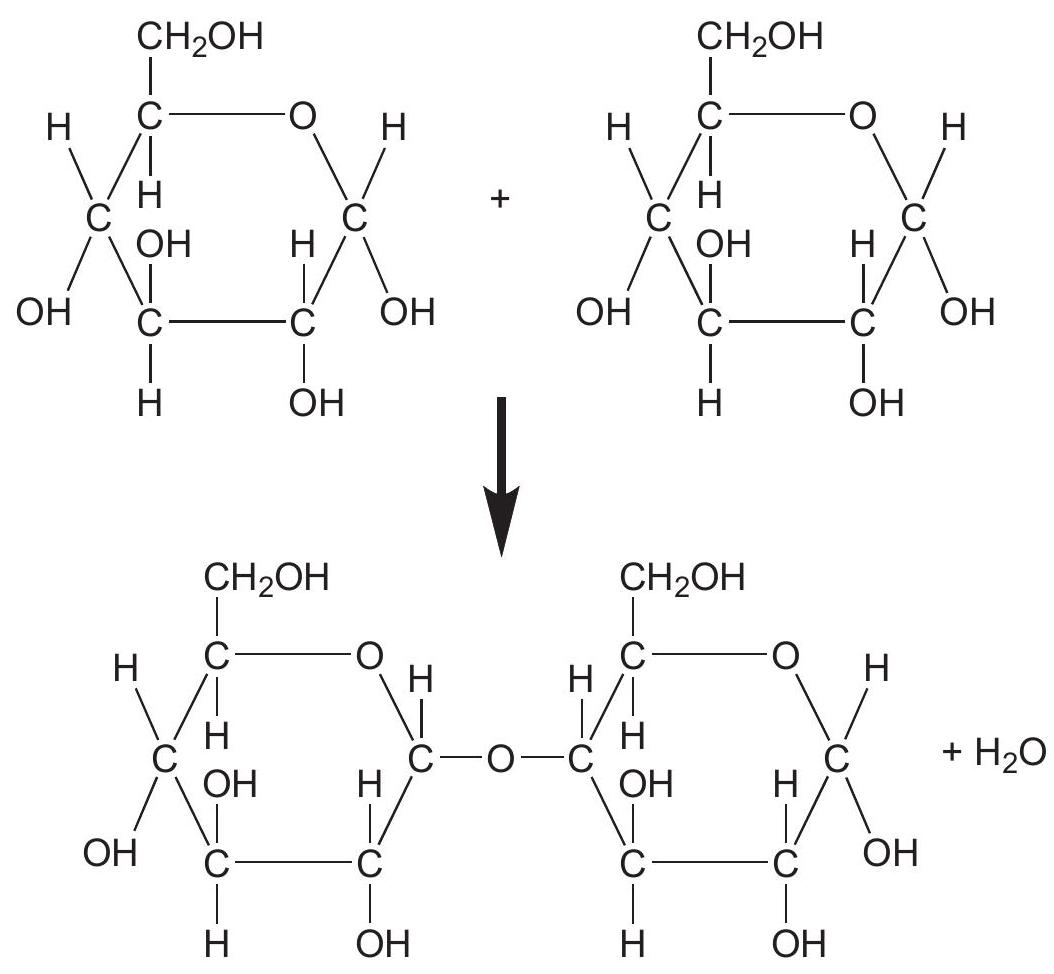
What type of molecule is formed by the chemical reaction shown in the diagram?