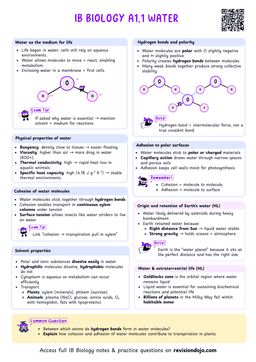
A1.2.6 DNA as a double helix linked by hydrogen bonding between complementary base pairs
A1.2.6 DNA as a double helix linked by hydrogen bonding between complementary base pairs Notes
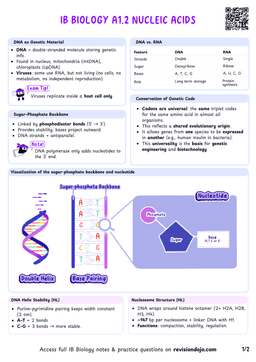
DNA Consists Of Two Polynucleotide Strands
Each strand has a sugar–phosphate backbone with nitrogenous bases projecting inward.
The strands align side by side, forming a double-stranded structure.
DNA as a double helix
The Antiparallel Arrangement of DNA Strands
The two DNA strands run in opposite directions.
One strand runs 5′ to 3′, while the other runs 3′ to 5′.
This arrangement is called antiparallel.
Drawing the Structure of DNA
Unlock the rest of this chapter with aFreeaccount
Nice try, unfortunately this paywall isn't as easy to bypass as you think. Want to help devleop the site? Join the team at https://revisiondojo.com/join-us. exercitation voluptate cillum ullamco excepteur sint officia do tempor Lorem irure minim Lorem elit id voluptate reprehenderit voluptate laboris in nostrud qui non Lorem nostrud laborum culpa sit occaecat reprehenderit
Definition
Paywall
(on a website) an arrangement whereby access is restricted to users who have paid to subscribe to the site.
anim nostrud sit dolore minim proident quis fugiat velit et eiusmod nulla quis nulla mollit dolor sunt culpa aliqua
Lorem ipsum dolor sit amet, consectetur adipiscing elit. Sed do eiusmod tempor incididunt ut labore et dolore magna aliqua. Ut enim ad minim veniam, quis nostrud exercitation ullamco laboris nisi ut aliquip ex ea commodo consequat.
Duis aute irure dolor in reprehenderit
Duis aute irure dolor in reprehenderit in voluptate velit esse cillum dolore eu fugiat nulla pariatur. Excepteur sint occaecat cupidatat non proident, sunt in culpa qui officia deserunt mollit anim id est laborum.
Note
Lorem ipsum dolor sit amet, consectetur adipiscing elit, sed do eiusmod tempor incididunt ut labore et dolore magna aliqua. Ut enim ad minim veniam quis nostrud exercitation.
Excepteur sint occaecat cupidatat non proident
Nemo enim ipsam voluptatem quia voluptas sit aspernatur aut odit aut fugit, sed quia consequuntur magni dolores eos qui ratione voluptatem sequi nesciunt. Neque porro quisquam est, qui dolorem ipsum quia dolor sit amet, consectetur, adipisci velit.
Tip
Lorem ipsum dolor sit amet, consectetur adipiscing elit, sed do eiusmod tempor incididunt ut labore et dolore magna aliqua. Ut enim ad minim veniam, quis nostrud exercitation ullamco laboris nisi ut aliquip ex ea commodo consequat.
Lorem ipsum dolor sit amet, consectetur adipiscing elit.
Sed do eiusmod tempor incididunt ut labore et dolore magna aliqua.
Ut enim ad minim veniam, quis nostrud exercitation ullamco laboris.
Duis aute irure dolor in reprehenderit in voluptate velit esse cillum.
Questions
Recap questions
1 of 5
Question 1
Recap question
Which type of interaction between complementary bases provides both sufficient stability in the double helix and the ability to separate strands during replication?
End of article
Want a cheatsheet?
View a summary cheatsheet for A1.2 Nucleic acids
Lesson
Recap your knowledge with an interactive lesson
10 minute activity
Note
DNA as a Double Helix
DNA is a double helix, meaning it consists of two intertwined strands that form a spiral structure.
The two strands are held together by hydrogen bonds between specific pairs of nitrogenous bases.
This structure was first discovered by Watson and Crick in 1953.
AnalogyThink of the DNA double helix like a twisted ladder, where the sugar-phosphate backbones are the sides of the ladder and the base pairs are the rungs.