RNA (Ribonucleic Acid)
Definition
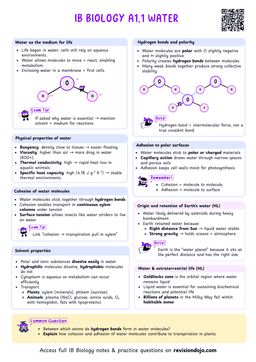
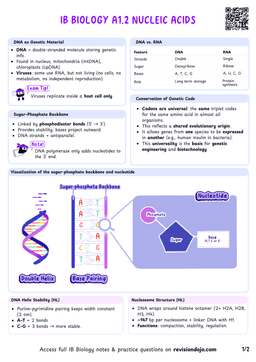
RNA (Ribonucleic Acid)
RNA is a single-stranded nucleic acid that plays a key role in coding, decoding, regulation, and expression of genetic information.
- RNA is a single-stranded nucleic acid that plays a key role in coding, decoding, regulation, and expression of genetic information.
- RNA is a single, unbranched polymer of nucleotides.
Note
Ribose differs from deoxyribose (in DNA) by having an –OH group on the 2′ carbon, instead of just a hydrogen atom.
Structure of RNA Nucleotides
- Each nucleotide consists of:
- A ribose sugar (pentose)
- A phosphate group
- A nitrogenous base (adenine, uracil, cytosine, or guanine)
Hint
Remember “U is Unique to RNA.”
Key Structural Features
- Ribose differs from deoxyribose (in DNA) by having an –OH group on the 2' carbon, instead of just a hydrogen atom.
- Uracil (U) replaces thymine (T) in RNA.
- Nucleotides are linked by phosphodiester bonds between the 3' carbon of one ribose and the 5' phosphate of the next nucleotide.
Exam technique
- You should be able to draw and recognize diagrams of:
- The structure of single nucleotides (showing ribose, phosphate, and base)
- RNA polymers (showing multiple nucleotides linked by phosphodiester bonds)
Self review
- How does ribose differ from deoxyribose in structure?
- Which sugar is present in RNA nucleotides, and how does it differ from the sugar in DNA?
- Which base in RNA replaces thymine, and what does it pair with during transcription?
- What type of reaction links nucleotide monomers into RNA polymers, and what molecule is released?