Nuclear Fission: Spontaneous Fission, Induced Fission, Chain Reactions, and Energy Release
Spontaneous Fission: When Nuclei Split on Their Own
Spontaneous fission
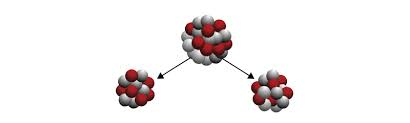
Spontaneous fission occurs when a heavy nucleus splits into smaller nuclei without any external influence.
This process is rare because most heavy nuclei are stable enough to resist splitting on their own.
Some isotopes, such as uranium-238 and californium-252, can undergo spontaneous fission under the right conditions.
Why Does Spontaneous Fission Happen?
- The nucleus of an atom is held together by the strong nuclear force, which binds protons and neutrons tightly.
- However, in very heavy nuclei, the repulsive electromagnetic force between the positively charged protons becomes significant.
- If the nucleus is large enough, this repulsion can overcome the strong nuclear force, causing the nucleus to split into smaller fragments.
Spontaneous fission is much less common than other forms of radioactive decay, such as alpha or beta decay, because the strong nuclear force typically stabilizes the nucleus.
Induced Fission: Splitting Nuclei with Neutrons
Induced fission
Induced fission occurs when a nucleus splits after absorbing a neutron.
Unlike spontaneous fission, this process requires an external trigger.
When a uranium-235 nucleus absorbs a neutron, it becomes uranium-236, an unstable isotope.
This instability leads to the nucleus splitting into smaller nuclei, releasing energy and additional neutrons.
A Typical Induced Fission Reaction
- Consider this common induced fission reaction involving uranium-235: $$
^{1}_{0}n + ^{235}_{92}U \rightarrow ^{236}_{92}U \rightarrow ^{144}_{56}Ba + ^{89}_{36}Kr + 3 ^{1}_{0}n
$$ - Here’s what happens step by step:
- A neutron is absorbed by a uranium-235 nucleus, forming uranium-236.
- The uranium-236 nucleus becomes unstable and quickly splits into two smaller nuclei (barium-144 and krypton-89 in this example).
- Three free neutrons are released, along with a significant amount of energy.
- Consider you’re observing a uranium-235 reaction.
- The three neutrons released can collide with other uranium-235 nuclei, potentially causing more fission reactions.
- This cascading effect forms the basis of a chain reaction.
- Don’t confuse induced fission with spontaneous fission.
- Induced fission requires an external neutron to trigger the process, while spontaneous fission occurs without any external influence.
Chain Reactions: The Self-Sustaining Cascade
The neutrons released during fission can collide with other fissile nuclei, such as uranium-235 or plutonium-239, causing them to undergo fission as well.
$\implies$ This creates a chain reaction.
If each fission event produces enough neutrons to sustain further reactions, the process becomes self-sustaining.
Critical Mass and Chain Reactions
- For a chain reaction to occur, there must be a minimum amount of fissile material, known as the critical mass.
- If the mass is too small, neutrons escape without triggering additional fission reactions, and the chain reaction stops.
- If the mass is large enough, the reaction continues, releasing a steady stream of energy.
- The critical mass depends on factors such as the material's shape, density, and composition.
- Spherical shapes are ideal because they minimize neutron escape, making the chain reaction more efficient.
Energy Release: The Source of Nuclear Power
- When a nucleus undergoes fission, the total mass of the resulting products is slightly less than the mass of the original nucleus.
- This “missing” mass is converted into energy, as described by Einstein’s famous equation: $$
E = \Delta m c^2
$$ Here:- $E$ is the energy released,
- $\Delta m$ is the mass defect (the difference in mass between the reactants and products),
- $c$ is the speed of light ($3.00 \times 10^8 \, \text{m s}^{-1}$).
Calculate the energy released in the fission of uranium-235. The reaction is:
$$
^{1}_{0}n + ^{235}_{92}U \rightarrow ^{236}_{92}U \rightarrow ^{144}_{56}Ba + ^{89}_{36}Kr + 3 ^{1}_{0}n
$$
Solution
- The masses involved are:
- Total mass of reactants: $235.0439299 + 1.008665 = 236.0525949 \, \text{u}$,
- Total mass of products: $143.92292 + 88.91781 + 3 \times 1.008665 = 235.866724 \, \text{u}$.
- The mass defect is: $$
\Delta m = 236.0525949 - 235.866724 = 0.18587 \, \text{u}.
$$ - Converting to energy: $$
E = \Delta m c^2 = 0.18587 \, \text{u} \times 931.5 \, \text{MeV u}^{-1} = 173 \, \text{MeV}.
$$ - This energy is released as the kinetic energy of the fission fragments and neutrons.
Why Does Fission Release Energy?
- The energy release in fission can also be understood using the binding energy per nucleon curve.
- This curve shows that nuclei with intermediate mass numbers (like krypton and barium) have higher binding energy per nucleon than very heavy nuclei (like uranium).
When uranium splits, the resulting nuclei are more tightly bound, and the difference in binding energy is released as energy.
Applications of Fission Energy
The energy released in fission can be harnessed for various purposes, such as:
- Nuclear Power Plants: Controlled chain reactions produce heat, which is used to generate electricity.
- Nuclear Weapons: Uncontrolled chain reactions release energy explosively.
While nuclear power offers high energy output and reduces reliance on fossil fuels, it also presents challenges, including radioactive waste and the risk of accidents.