Practice C.1 Simple harmonic motion with authentic IB Physics exam questions for both SL and HL students. This question bank mirrors Paper 1A, 1B, 2 structure, covering key topics like mechanics, thermodynamics, and waves. Get instant solutions, detailed explanations, and build exam confidence with questions in the style of IB examiners.
Paper
Level
Question 1
SLPaper 2
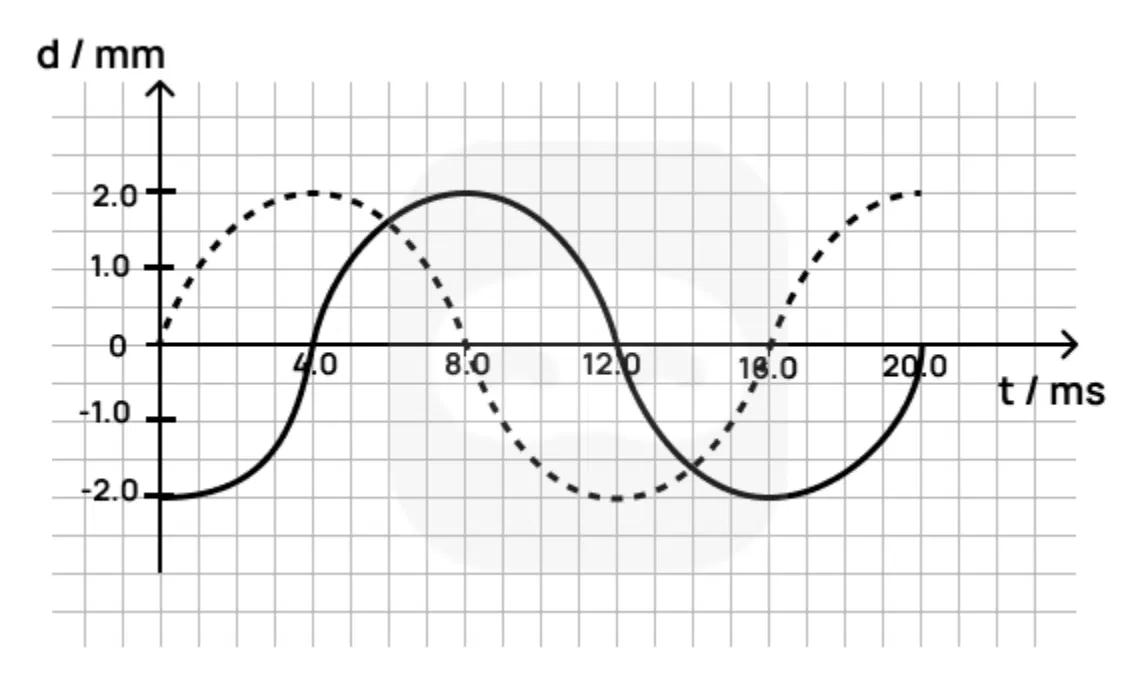
The graph shows the displacement-time representation of two transverse waves (solid and dashed) travelling through the same medium. Both waves have the same amplitude and frequency.
1.[1]
State the amplitude of either wave.
2.[2]
Determine the period of the waves.
3.[2]
Determine the phase difference between the two waves.
4.[1]
Outline one difference between the two waves other than phase.
5.[2]
Explain how the principle of superposition is used to determine the resultant displacement of these waves at any time .
Question 2
SLPaper 2
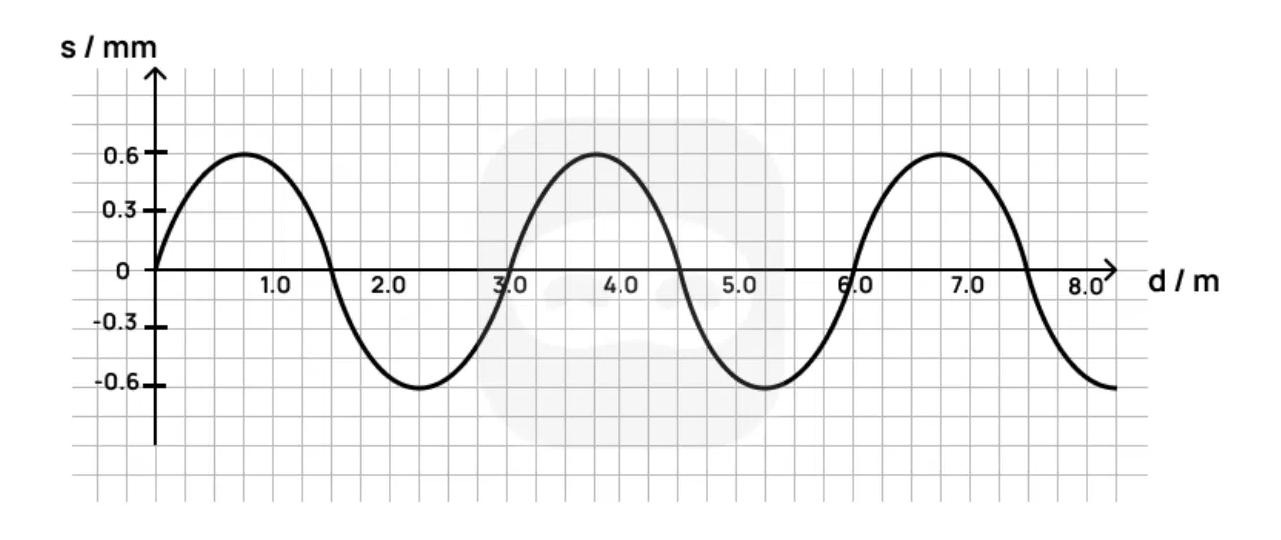
The graph shows the transverse displacement in millimetres of points on a stretched string as a function of distance in metres along the string at a fixed instant in time.
1.[1]
State the amplitude of the wave.
2.[1]
State the wavelength of the wave.
3.[2]
The wave has a frequency of . Calculate the speed of the wave.
4.[2]
Identify whether this is a transverse or longitudinal wave. Justify your answer.
Question 3
SLPaper 2
A student investigates a mass-spring system undergoing vertical simple harmonic motion. The system has a spring constant and supports a mass of . The system oscillates with an amplitude of .
1.[2]
Calculate the natural frequency of the oscillation.
2.[2]
Calculate the total mechanical energy of the system.
3.[2]
Determine the displacement of the mass when the speed is .
4.[2]
Explain how damping would affect the amplitude and energy of this system over time.
Question 4
HLPaper 1A
A body moves in simple harmonic motion (SHM). At time , the displacement is zero and the body is moving in the positive direction.
Which graph correctly shows the variation of the body's kinetic energy with time?
Question 5
SLPaper 2
A mass is attached to a spring and performs simple harmonic motion with an amplitude of and a maximum speed of .
1.[1]
State the relationship between maximum speed, amplitude, and angular frequency.
2.[2]
Calculate the angular frequency of the motion.
3.[2]
Determine the period of the oscillation.
Question 6
SLPaper 1A
A mass on a spring oscillates with frequency . What is the period of oscillation?
Question 7
SLPaper 1A
What is the phase difference between velocity and acceleration in simple harmonic motion?
Question 8
HLPaper 1B
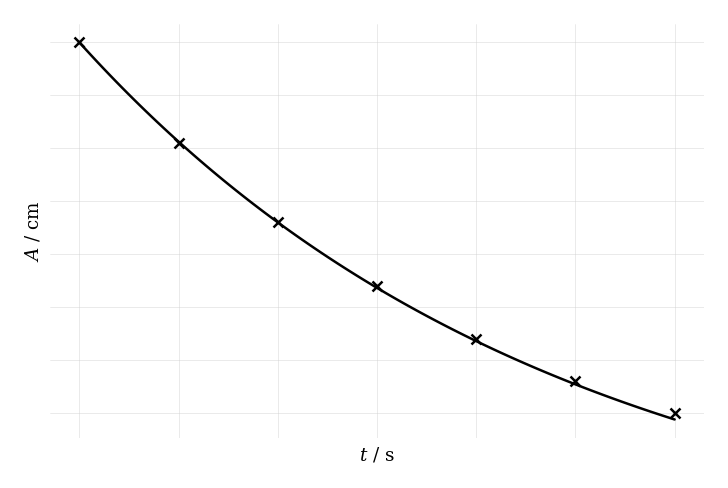
A student investigates the damping of a pendulum's amplitude over time . The amplitude is measured at regular time intervals as the pendulum oscillates in air. The following data were recorded:
| Time / s | Amplitude / cm |
|---|---|
| 0 | 10.0 |
| 5 | 8.1 |
| 10 | 6.6 |
| 15 | 5.4 |
| 20 | 4.4 |
| 25 | 3.6 |
| 30 | 3.0 |
The amplitude of a damped oscillation follows the equation:
where:
- is the initial amplitude ,
- is the damping coefficient,
- is the mass of the pendulum bob,
- is the time,
- is the base of the natural logarithm.
1.[2]
Describe the trend in the graph and explain how it relates to the equation .
2.[4]
Identify two potential sources of error in the experiment and explain their impact on the measured amplitude.
3.[2]
Suggest two improvements to minimize these errors.
4.[2]
Suggest how to linearize the data to determine the damping coefficient .
5.[3]
Using the data point , calculate the value of . Show all your working.
6.[3]
If the uncertainty in is and the uncertainty in is , calculate the percentage uncertainty in for the same data point.
Question 9
HLPaper 1A
A particle undergoes simple harmonic motion. Which quantities of the motion can be simultaneously zero?
Question 10
HLPaper 2
A particle moves according to the equation , where displacement is in metres and time is in seconds.
1.[3]
Determine the displacement and velocity of the particle at .
2.[1]
Calculate the maximum speed of the particle.
3.[2]
Determine the total energy of the system if the mass of the particle is .
4.[2]
Calculate the potential energy of the particle at .
5.[1]
Explain the meaning of negative velocity in this context.