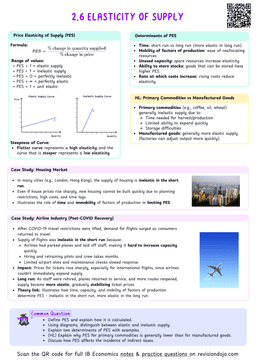
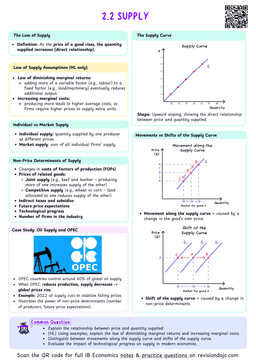
The Supply Curve showcases the positive relationship referred to by the law of supply (2.2.1) in a graph. Hence, higher prices lead to more quantity supplied, ceteris paribus.
The figure above showcases a supply curve ($S$) that is upward-sloping due to the law of supply:
- For a price of $2$, the firm is willing and able to supply an output of $20$ units
- As the price rises to $3,4$ and $5$, the quantity supplied by the firm also rises to $30, 40$ and $50$ respectively.
Drawing the supply curve
Three important points to make sure of when drawing the supply diagram.
- Make sure to label the axis (holds for any diagram). In this case, prices $P$ will be on the $y$-axis (add the currency being used too) and quantity $Q$ will be on the $x$-axis
- The graph should show an upward-sloping curve (positive relationship) such that a rise in price leads to a rise in the quantity supplied
- If you're showcasing a specific point on the curve, make sure to label the price and quantity associated with it clearly. For example label the price $P_1$ and quantity as $Q_{s1}$
- It is important to note that the supply curve doesn't indicate anything about the actual quantity the firm will supply and the price it will receive.
- The curve indicates what the firm is ready to and can potentially supply in the market.
The vertical supply curve
In some scenarios, the supply curve may be vertical. A vertical supply curve indicates that:
Even when prices change, the quantity supplied stays the same as seen in the figure below.
The vertical supply curve occurs when there is:
- Limited time and therefore it is not possible to produce more of a certain good or service within that period. For example seats at a cinema cannot easily be added quickly, their supply is fixed (the number of seats in the cinema).
- No possibility of new production of that good or service ever. For example, original paintings and antiques can only be replicated but not reproduced.
These two conditions lead to the supply curve being fixed at a given quantity despite the changes in price.
Marginal Cost Curve and Supply Curve (HL Only)
The above figure shows a marginal cost curve representing the cost required to produce one more unit of the good or service.
The supply curve showcases all the quantities that a firm is able and willing to produce for a given price.
Hence, a section of the marginal cost curve is the firm's supply curve. (The exact part of the marginal cost curve will be discussed in 2.11)
- Because the firm is only willing to produce one more unit of the good if it can cover the marginal cost
- Hence, the marginal cost curve tells us the cost needed for the firm to be able to produce one more unit
- It also showcases the minimum price the firm will charge for it to be willing to produce one more unit as it needs to cover the marginal costs
The section of the marginal cost curve where the firm would not benefit from shutting down is the supply curve.
Consider goods or services with limited supply, like rare artwork or land. How do these exceptions challenge the universality of the law of supply?
Can you explain why the supply curve slopes upward? Try drawing a supply curve and annotating it with reasons for the positive relationship between price and quantity supplied.