Absolute Advantage
Absolute Advantage
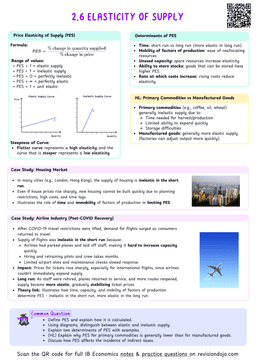
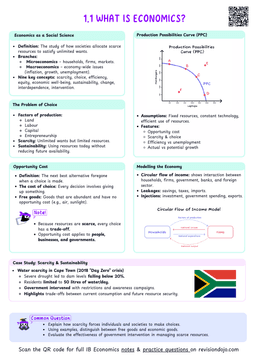
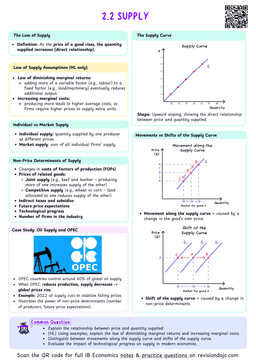
The ability to produce the same quantity of a good or service using fewer resources per unit of time.
The theory of absolute advantage by Adam Smith indicates a country is more efficient in production if it uses fewer resources to produce a good.
- In other words, the country uses the same resources as another and yet, produces more goods.
Assume there are two countries, $A$ and $B$, who produce either only beef or only leather.
The table below shows how much each country produces per one worker in one day if the worker produced either only beef or only leather.
- Therefore if a worker in country A produces 8 kilos of beef then they produce 0 metres of leather
- Or they do 2 meters of leather so 0 kilos of beef.
| Country | Kilos of beef | Metres of leather |
|---|---|---|
| A | 8 | 2 |
| B | 5 | 4 |
Country $A$ has an absolute advantage in producing beef because with the same number of resources (one worker), it produces more beef.
However, country $B$ has an absolute advantage in producing leather because with the same number of resources, it produces more leather.
The example above showcases the scenario where reciprocal absolute advantage exists.
- However, this is not always the case as sometimes, a country could have absolute advantage in producing all the goods.
We can use the information in the example above to construct the PPCs of each country.
- For simplicity, we use a straight-line PPC implying constant opportunity costs.
The figure above shows the PPCs for each country which we can construct by noticing the quantity produced per worker (assuming there is only one worker in each country).
- Hence for country $A$, if it producers 8 units of beef then it produces 0 units of leather showcasing its intercept on the vertical axis at $(0,8)$
- If it produces 2 units of leather, then it producers 0 units of beef indicating its intercept on the horizontal axis at $(2,0)$
- By drawing a straight line across the two points, we create the PPC for country $A$ assuming constant opportunity costs.
We can repeat the process to get the PPC of country $B$.
As observed in the diagram:
- The PPC of country $A$ extends (intercepts) further up the vertical axis than the PPC of country $B$ indicating the absolute advantage of $A$ in beef production.
- Similarly, the PPC of country $B$ extends (intercepts) further right the horizontal axis than the PPC of country $A$ indicating the absolute advantage of $B$ in leather production.
There can be cases where a countries PPC sits entirely above on both axis indicating absolute advantage in both goods.
Hence, if a country specialises in the good they have absolute advantage in, then:
- Country $A$ can produce only beef while country $B$ produces only leather.
- Therefore, country $A$ can export its beef to country $B$ which exports its leather to country $A$.
Hence absolute advantage encourages production of goods to those who are more efficient, which leads to more production for the same resources worldwide (efficient production throughout the world).
Further:
- Even though countries produce within their PPC, due to the trade caused by absolute advantage, it is possible to consume outside of the PPC.
- This is because by importing goods from a more efficient country, you can consume more than you could have alone (seen in the figure).
This is the reallocation of resources such that production takes place in countries with lower costs.
Comparative Advantage
Comparative Advantage
A country having lower opportunity costs in the production of a good compared to another country.
The concept of absolute advantage only explains a small section of gains from trade and specialising in production.
Economist David Ricardo with his theory of comparative advantage showed that countries can benefit from trade even if one has absolute advantage in all goods as long as they have different opportunity costs.
Assume again there are two countries, $A$ and $B$, who produce either only beef or only leather.
The table below shows how much each country produces per one worker in one day if the worker produced either only beef or only leather.
- Therefore if a worker in country A produces 20 kilos of beef then they produce 0 metres of leather
- Or they do 10 meters of leather and so 0 kilos of beef.
| Country | Kilos of beef | Metres of leather |
|---|---|---|
| A | 20 | 10 |
| B | 10 | 2 |
Hence, it can be seen country $A$ has an absolute advantage in both goods since it can produce more beef and more leather using the same resources in the same time.
Using the example above, we can draw the PPCs for country $A$ and $B$.
This time, country $A$ has absolute advantage in both goods because its PPC lies entirely above country $B$.
Intersection on the graph indicates absolute advantage to each country, but no intersection implies one country has absolute advantage in both.
Hence, it is important to determine if there is a comparative advantage by comparing opportunity costs, to understand which good each country should specialise in.
Opportunity cost
The value of the next best option that must be forgone or sacrificed in order to acquire something else.
As it's the cost of the alternative, in other words, it can be thought of as:
- How much of good 'D' do I sacrifice per unit of good 'E" that I am producing now?
Since we have a straight-line PPC (assuming opportunity costs are constant), we can simply use the final values to calculate the opportunity costs by:
$$ \text{Opportunity Costs} = \frac{\text{Good Sacrificed}}{\text{Good Produced}} $$
For the example above, if country $A$ would like to produce $20$ kilos of beef, it needs to sacrifice $10$ meters of leather, meaning the opportunity cost is:
$$ OC = \frac{10}{20} = \frac{1}{2}$$
Hence, to produce one additional kilo of beef, it sacrifices a half meter of leather.
Similarly, if they produced $10$ meters of leather instead of $20$ kilos of beef, then:
$$ OC = \frac{20}{10} = 2 $$
Hence, to produce one additional meter of leather, they need to sacrifice 2 kilos of beef.
The example above works only because the opportunity cost is constant. Therefore, we can compare the total values like we did above.
Otherwise we would need to use the rate of change to calculate incremental values which is not part of this course.
Hence, using the method in the example above, we can add extra columns to the table indicating the opportunity costs calculated in a similar way.
Using the formula and example above, we get:
| Country | Kilos of beef | Metres of leather | Opportunity Cost of making Beef | Opportunity Cost of making Leather |
|---|---|---|---|---|
| A | 20 | 10 | 1/2 | 2 |
| B | 10 | 2 | 1/5 | 5 |
- Therefore, country $A$ has lower opportunity costs to produce leather compared to country $B$ indicating it has a comparative advantage.
- However, country $A$ has higher opportunity costs to produce beef compared to $B$ indicating it has comparative disadvantage.
- Even though $A$ has lower absolute costs for producing beef, it has higher comparative costs.
Therefore, country $A$ has comparative advantage in producing leather while country $B$ has comparative advantage in producing beef.
This can also be observed on the graph, as:
- The country with the steeper PPC will have comparative advantage on the good listed on the vertical axis (y-axis).
- Hence, in this case, $B$ has comparative advantage in beef.
- The country with the flatter PPC will have comparative advantage on the good listed on the horizontal axis (x-axis).
- Hence, $A$ has comparative advantage in leather.
The theory of comparative advantage states that:
- If countries specialise and trade by their according their comparative advantage, then resource allocation, production and consumption can increase worldwide.
- Even with any case of absolute advantage, different opportunity costs determine countries as more efficient.
- Further, while countries produce within their PPC, they can consume outside the PPC as shown in the figure.
If you have parallel PPC curves as shown above, this means countries face equal opportunity costs and one has absolute advantage in both.
This is very unrealistic in real life, but according to the model, it implies there is no reason for trade in a world of constant opportunity cost.
However, in real life opportunity cost varies and other reasons arise to trade (not part of the course).
- Absolute advantage is a weaker argument than comparative advantage as it does not consider the possible gains from opportunity costs.
- It is also a special case of comparative advantage (notice in the first example on this page, the conclusions of absolute advantage don't effect those of comparative advantage).
Hence, now we understand how the free trade diagram incorporates who imports and exports.
- In the first diagram, the domestic country has a higher price $P_d$ than the world price $P_w$ due to it being inefficient in production.
- This indicates the domestic country has comparative disadvantage and thus will accept lower world prices and import the goods.
- The second diagram indicates the domestic country having a lower price $P_d$ than world price $P_w$ due to its more efficient production.
- Thus it will accept the higher price, producing more and exporting its goods to inefficient foreign countries.
Sources of comparative advantage
Countries gain comparative advantages due to differences in resources, technology, and labor productivity.
- This enables countries to produce certain goods at lower opportunity costs than others.
- Sometimes, factor endowments (the factors of production available to a country) make the production of certain goods easier for some countries.
A country with more mountains may not be suitable for the production of crops, but might be more suitable for creating more tourism services (such as to do hiking or skiing).
- Explain how absolute advantage works using a valid example and a diagram.
- Explain how comparative advantage works using a valid example and diagram.
- Discuss the difference in outcomes between the two concepts.
Does the acknowledgement of inefficiencies in production harm our reputation and increase our reliance on other countries? Is this a good argument against trade?