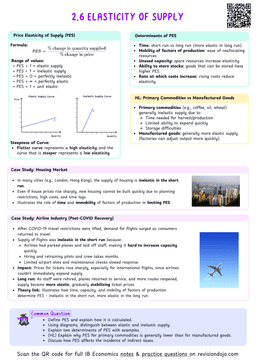
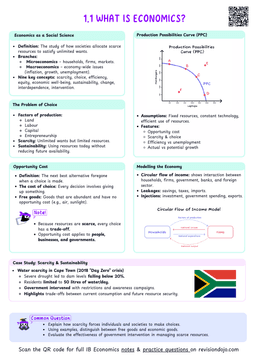
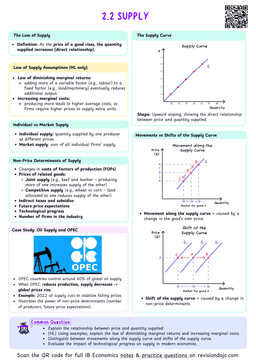
The term per capita originates from Latin and translates to "per person". A per capita measure:
- Calculates the average value of a metric (such as GDP, GNI, income, or expenditure) for each individual in a country.
- Allows to make comparison accounting for different population sizes across countries.
- Allows accurate comparisons over time that account for population growth.
GDP per capita is calculated as:
$$\text{GDP per capita} = \frac{\text{Total GDP}}{\text{Population}}$$
Similarly, GNI per capita is calculated as:
$$\text{GNI per capita} = \frac{\text{Total GNI}}{\text{Population}}$$
Utilising per capita values to make comparison across countries
Total GDP alone does not give a complete picture of economic performance or living standards when populations vary. For example:
- Country A:
- GDP = €10 billion,
- Population = 1 million,
- GDP per capita = €10,000
- Country B:
- GDP = €10 billion,
- Population = 2 million,
- GDP per capita = €5,000
While total GDP is the same, Country A’s per capita GDP is double that of Country B, highlighting the significant difference in individual economic resources.
Real GDP/GNI per person (per capita) at purchasing power parity (PPP)
Purchasing power
The ability of a given amount of money to buy goods and services, which depends on the prices of those goods and services. A fixed amount of money with higher purchasing power can buy more goods and services than the same amount with lower purchasing power.
- Countries' economies have varying purchasing powers because the prices of goods and services differ across nations due to factors like local production costs, wages, and market conditions.
- For example, $10 USD might buy a full meal in one country but only a coffee in another.
- Therefore, a higher real GDP per capita in one country might not reflect better living standards if its cost of living is very high.
- To make meaningful comparisons of GDP per capita across countries, real GDP must be adjusted for purchasing power differences.
- This adjustment of purchasing power is done through the Purchasing Power Parities (PPP) exchange rates.
- Using PPPs ensures that GDP and GNI reflect the real value of goods and services that people in each country can afford, regardless of local prices.
Purchasing Power Parity (PPP) exchange rates
Special exchange rates designed that equal the purchasing power of different currencies to that of 1 US dollar.
Real GDP/GNI per capita at PPP formula
$$\text{Real GDP/GNI Per Capita at PPP} = \frac{\text{Real GDP or GNI at PPP}}{\text{Population}}$$
Calculating the real GDP per capita at PPP of an economy
Suppose an economy, Econland, has:
- A nominal GDP of $2 trillion,
- A population of 500 million,
- A PPP adjustment which doubles ($\times 2$) the purchasing power of its GDP.
To calculate its real GDP per capita at PPP to the US Dollar, we:
- Adjust nominal GDP using the PPP exchange rate:
$$\text{Adjusted GDP at PPP} = 2 \, \text{trillion USD} \times 2 = 4 \, \text{trillion USD}$$
- Divide by population to calculate per capita GDP at PPP:
$$\text{GDP per capita at PPP} = \frac{4 \, \text{trillion USD}}{500 \, \text{million people}} = 8,000 \, \text{USD per person}$$
This $8,000 reflects the real purchasing power per person in Econland, considering local price levels.
Calculations of real GDP/GNI at PPP are beyond the scope of the IB Economics syllabus. Only an understanding of the concept of PPPs is needed.