Price Elasticity of Supply
A measure of the responsiveness of quantity supplied when there is a change in price.
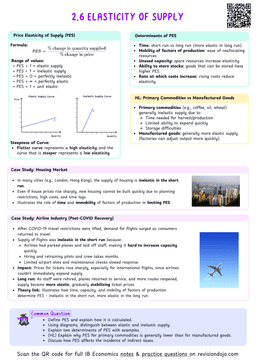
Price elasticity of supply is defined as the percentage change in quantity supplied divided by the percentage change in price:
$$ \mathrm{PES} = \frac{\%\Delta Q_s}{\%\Delta P}$$
Where:
- $\%\Delta Q_s$ = Percentage change in quantity supplied
- $\%\Delta P$ = Percentage change in price
Therefore, using the above formulas, PES can be written as:
$$ \mathrm{PES} = \frac{\frac{Q_{new}-Q_{old}}{Q_{old}}\times 100}{\frac{P_{new}-P_{old}}{P_{old}}\times 100} = \frac{\frac{Q_{new}-Q_{old}}{Q_{old}}}{\frac{P_{new}-P_{old}}{P_{old}}}=\frac{\frac{\Delta Q}{Q_{old}}}{\frac{\Delta P}{P_{old}}} $$
The expanded format of writing PES is provided here as in exam papers, they might ask you to calculate the percentage change in quantity supplied and price to figure out the PES!
As observed above, it is almost identical to $PED$ but rather focuses on the quantity supplied.
If we know that:
- At a price $P_1 = \$ 50$ producers supply $Q_1=15$ bars of chocolate
- At a price $P_2 = \$ 100$ producers supply $Q_2 = 25$ bars of chocolate.
Then we can calculate the $PES$ at $P=50$ by using the formula above.
- $\%\Delta P = \frac{100-50}{50}\times 100 = 100\%$ since the price doubled
- $\%\Delta Q = \frac{25 - 15}{15}\times 100 \approx 66.66\%$
Hence the price elasticity of supply would be:
$$ PES = \frac{\%\Delta Q_s}{\%\Delta P} = \frac{66.66..}{100} = \frac{2}{3}$$
For the example above, we would get a different $PES$ if we used $P_2,Q_2$ as our initial values and $P_1,Q_1$ as the new one (you can try this yourself)
Hence make sure to write "PES at P = initial price".
As we can see, the price elasticity of supply is positive.
- This is due to the law of supply, where the percentage change of quantity supplied will be in the same direction as that of price.
- Therefore PES is mathematically always positive.
Degrees of PES: Theoretical Range of Values
PES values help classify supply into different categories.
Relative PES cases
Price Inelastic
- When $0 < PES < 1$, the supply is called price inelastic.
- Here, the percentage change in quantity supplied is less than the percentage change in price
- Therefore $PES$ is smaller than 1 and the quantity supplied is greatly unresponsive
Now think of seasonal fruits
- If prices rises, even by a lot, it is almost impossible to increase the quantity supplied of seasonal fruits in a certain period of time.
- Because seasonal fruits only grow at specific times of the year and take time to grow.
- Producers cannot easily increase the quantity and thus quantity supplied doesn't rise by much.
Price Elastic
- When $1 < PES < \infty$, the supply is called price elastic.
- Here, the percentage change in quantity supplied is more than the percentage change in price.
- Therefore $PES$ is greater than 1 and the quantity supplied is greatly responsive.
Think of taxis
- Relatively easy to work as a taxi driver, whether it is part-time of full time alongside ease of access with online apps.
- Even if prices rise by a bit, by offering drivers a higher commission, a lot more drivers are likely willing to accept commission due to competition.
- Or new drivers can easily join to get a portion of the cut.
- Hence the quantity supplied of taxis will increase.
Example Diagrams
The figure above shows the supply curve of a good that has a high PES or in other words, is elastic.
- There is a higher increase in quantity supplied compared to the change in price.
- The curve is relatively flatter and starts from the y axis.
The figure above shows the supply curve of a good that has a low PES or in other words, is inelastic.
- There is a lower increase in quantity supplied compared to the change in price.
- The curve is relatively steeper and starts from the x axis.
Usually, the flatter curve represents a high elasticity and the curve that is steeper represents a low elasticity (inelasticity).
As stated before, you can only compare flatter with steeper if two curves intersect on the same set of axes/graph, otherwise, you can't due to scaling differences!
Special Cases where PES is constant
Unit Elastic
- When $PES = 1$, the supply is called unit price elastic (Unitary PES).
- Here, the percentage change in quantity supplied is equal to the percentage change in price.
- Therefore the quantity supplied is exactly as responsive to the price.
Perfectly Inelastic
- When $PES = 0$, the supply is called perfectly price inelastic.
- Here, the percentage change in quantity supplied is always 0 regardless of what happens to the price.
- Therefore the quantity supplied is perfectly unresponsive to the price.
A good example of this is the supply of cinema tickets for a single screening. Whether the price changes or not, the supply for one movie showing is going to be constant.
Perfectly Elastic
- When $PES = \infty$, the supply is called perfectly price elastic.
- Here, the percentage change in quantity supplied can be of any magnitude even if the price doesn't change.
- A small price increase causes producers to produce an infinite amount, and a small price fall causes producers to produce nothing as the point of production will not be at the line of production (elastic line).
- Therefore $PES$ is infinity and the quantity supplied is perfectly responsive.
Unitary PES holds for all straight-line supply curves that go through the origin as the percentage change between any two points is the same in both axes (variables).
Determinants of PES
Many goods and services can have ranges of different values of PES.
Time
The length of time available to producers makes them more responsive to price changes.
- If they have limited time, it may be difficult for firms to change their inputs to produce more or less goods, hence the supply is price inelastic.
- However, with more time, they can adjust their inputs and (factors of) production much easier, making them more responsive and thus supply more elastic.
Cinema tickets for one showing of a movie will have an inelastic supply, in fact, perfectly inelastic supply $PES = 0$, because seats can't just be made or removed.
However, if you consider a longer length of time, then this allows for the cinema to create new seats or remove ones that aren't needed.
Mobility of Factors of Production
The easier it is to move factors of production from one area of production to another, the more elastic the supply.
- If factors are easy to move, then firms can easily move factors to the production of goods where prices increase (more responsive)
- If factors are more fixed, then firms can't easily respond to price changes.
Unused Capacity
Sometimes firms have unused capacity of certain factors of production as they may not exhaust all factors at all times.
- If the firm has used a lot of its capacity, then even with a price increase it would be difficult for the producers to respond as they have no spare available
- However, if the firm has spare capacity available, then it can easily allocate this capacity for the production of the good whose price increased, making them more responsive.
Ability to store stocks
Firms that can store a larger capacity of produced goods likely have a higher elasticity in supply.
- A higher storage capacity means producing extra is possible as there are more storage options and hence are more responsive.
- However, a lack of storage means the producers need to be careful and not overproduce and thus are less responsive.
Rate of Cost Increase
If the cost of producing an extra unit rises faster, then expanding production would be difficult.
- If costs increase at a fast rate, then even with increases in the price of the goods, the producers may not increase production by much, thus having inelastic supply.
- If costs increase relatively slow then it would be easy for producers to take advantage of higher prices and thus have elastic supply.
Consider how ethical or cultural factors might influence decisions about increasing supply, particularly for goods like luxury items or essential medicines.
- Explain how PES applies for different types of goods.
- Show the different PES ranges on a diagram.
- Explain why certain goods have a PES that varies over time.