The Mole: A Gateway to Quantifying the Atomic World
You are holding a single grain of sand in your hand. Now imagine trying to count every grain of sand on a beach. The task seems impossible, doesn’t it?
Similarly, when dealing with atoms, molecules, or ions, particles so small that billions of them fit into a single drop of water, counting them individually is impractical.
The Mole: The Chemist’s Counting Unit
Mole
The mole (mol) is the SI unit for the amount of substance, defined as $6.02 \times 10^{23}$ particles (atoms, molecules, or ions).
Think of it as the "chemist's dozen," but instead of 12, one mole contains 6.02 × 10²³ elementary entities. This number is known as the Avogadro constant ($N_A$).
Why 6.02 × 10²³?
- The Avogadro constant wasn’t chosen randomly.
- It was specifically defined to connect the microscopic world of atoms and molecules to measurable quantities in the macroscopic world.
- One mole of carbon-12 atoms has a mass of exactly 12 grams.
- This precise relationship between the number of particles and their mass makes the mole an invaluable tool in chemistry.
- Consider that you’re buying apples by weight at a market.
- The mole is like the scale that tells you how many apples you’re getting without counting each one individuall.
- It bridges the gap between quantity and weight.
Elementary Entities: What Are We Counting?
- When using the mole, it’s essential to specify what you’re counting.
- The term elementary entities refers to the type of particle involved, which could include:
- Atoms (e.g., one mole of helium atoms)
- Molecules (e.g., one mole of water molecules)
- Ions (e.g., one mole of sodium ions)
- Electrons (e.g., one mole of electrons)
- Other specified groups of particles (e.g., formula units in ionic compounds like NaCl)
- Always clarify the type of elementary entity in a calculation.
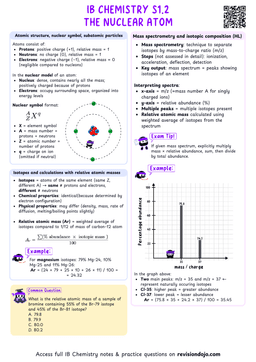
- For example, one mole of water (H₂O) contains one mole of molecules, but it also contains two moles of hydrogen atoms and one mole of oxygen atoms.
Using the Avogadro Constant for Conversions
- The Avogadro constant ($N_A$) serves as a bridge between the amount of substance (n) in moles and the number of entities (N) in a sample.
- The relationship is expressed mathematically as: $$N = n \times N_A $$ where:
- $N$ = number of entities
- $n$ = amount of substance in moles
- $N_A = 6.022 \times 10^{23} \, \text{mol}^{-1}$
Rearranging the Formula
To calculate the amount of substance ($n$) when the number of entities ($N$) is known, rearrange the equation:
$$
n = \frac{N}{N_A}
$$
How many atoms are in 2.5 moles of copper (Cu)?
Solution
- Identify the formula to use: $$N = n \times N_A$$
- Substitute the given values: $n = 2.5 \, \text{mol}$, $N_A = 6.02 \times 10^{23} \, \text{mol}^{-1}$
- Perform the calculation: $$
N = 2.5 \, \text{mol} \times 6.02 \times 10^{23} \, \text{mol}^{-1} = 1.51 \times 10^{24} \, \text{atoms}.
$$
- Always check your significant figures!
- Match the precision of your answer to the least precise value in the data.
A sample contains $4.5 \times 10^{22}$ water molecules. How many moles of water does the sample contain?
Solution
- Identify the formula to use: $n = \frac{N}{N_A}$.
- Substitute the given values: $N = 4.5 \times 10^{22}$ , $N_A = 6.02 \times 10^{23} \, \text{mol}^{-1}$.
- Perform the calculation: $$
n = \frac{4.5 \times 10^{22}}{6.02 \times 10^{23}} = 0.075 \, \text{mol}
$$
- One of the common mistakes is forgetting to divide by the Avogadro constant when converting from entities to moles is a common mistake.
- Always double-check your formula!
How many molecules are in a 10.0 g sample of carbon dioxide $(CO_2)$?
Solution
Step 1: Convert mass to moles using the formula:
$$n = \frac{m}{M}$$
where: $m = 10.0 \, \text{g}$ and $M = (12.01) + (2 \times 16.00) = 44.01 \, \text{g mol}^{-1}$.
Calculation: $$n = \frac{10.0}{44.01} = 0.227 \, \text{mol}$$
Step 2: Convert moles to number of molecules using Avogadro's constant:
$$N = n \times N_A$$
where $N_A = 6.02 \times 10^{23} \, \text{mol}^{-1}$.
Calculation:
$$N = 0.227 \times 6.02 \times 10^{23} = 1.37 \times 10^{23} \, \text{molecules}$$
- How would you calculate the number of molecules in 0.15 moles of oxygen gas (O₂)?
- What about the number of oxygen atoms?