Using Box-and-Whisker Plots to Visualize Continuous Data
box-and-whisker
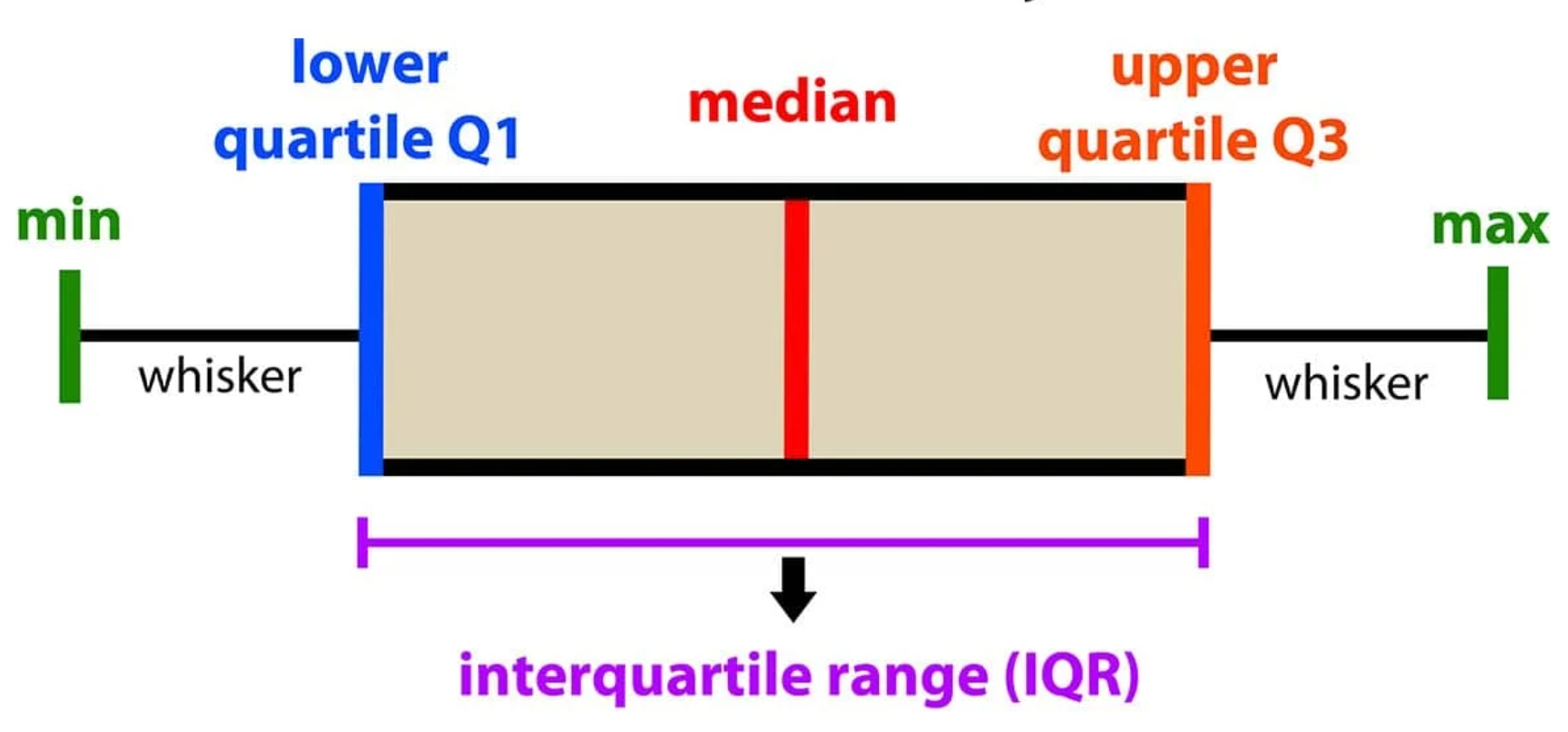
A box-and-whisker plot is a graphical representation that summarizes a dataset by showing its spread and central tendency.
- It uses five key statistics, along with the identification of outliers:
- Minimum: The smallest data value, excluding outliers.
- First Quartile (Q1): The median of the lower half of the data.
- Median (Q2): The middle value of the dataset.
- Third Quartile (Q3): The median of the upper half of the data.
- Maximum: The largest data value, excluding outliers.
- Outliers: Data points that fall significantly outside the typical range, calculated as more than 1.5 × IQR above Q3 or below Q1.
- Outliers are data points that fall far outside the typical range.
- They are identified using the interquartile range (IQR), which is the difference between the third and first quartiles ($$\text{IQR} = Q3 - Q1$$).
Why Are Box-and-Whisker Plots Useful?
- Box-and-whisker plots provide a clear, concise way to:
- Summarize Data: Visualize the range, spread, and central tendency of the dataset.
- Identify Outliers: Spot unusual data points that lie far from the majority.
- Compare Datasets: Use multiple box plots side by side to compare distributions across groups.
How to Create a Box-and-Whisker Plot
Step 1: Organize the Data
Arrange your data values in ascending order.
Step 2: Calculate Key Statistics
- Find the Median (Q2): Divide the dataset into two equal halves.
- Find Q1 and Q3: Identify the medians of the lower and upper halves.
- Calculate the Interquartile Range (IQR): Subtract Q1 from Q3: IQR=Q3−Q1IQR = Q3 - Q1IQR=Q3−Q1
Step 3: Identify Outliers
- Multiply the IQR by 1.5: 1.5×IQR1.5 \times IQR1.5×IQR
- Add this value to Q3 to find the upper bound for outliers.
- Subtract this value from Q1 to find the lower bound for outliers.
Step 4: Draw the Plot
- Box: Draw a rectangle from Q1 to Q3.
- Median: Add a line inside the box at Q2.
- Whiskers: Extend lines from the box to the minimum and maximum values within the non-outlier range.
- Outliers: Plot outliers as individual points beyond the whiskers.
Example: Heights of Students in a Class
Consider this dataset of student heights (in cm):
193, 183, 176, 163, 193, 152, 160, 175, 184, 180, 173, 186, 153, 172, 180, 195, 176, 201, 177.
Solution
- Organize Data: Arrange in ascending order:
- 152, 153, 160, 163, 172, 173, 175, 176, 176, 177, 180, 180, 183, 184, 186, 193, 193, 195, 201.
- Calculate Q1, Q2 (Median), and Q3:
- Q1 = 172
- Median (Q2) = 176
- Q3 = 184
- Find IQR: IQR=Q3−Q1=184−172=12IQR = Q3 - Q1 = 184 - 172 = 12 IQR=Q3−Q1=184−172=12
- Identify Outliers:
- Upper bound = Q3+1.5×IQR=184+18=202Q3 + 1.5 \times IQR = 184 + 18 = 202Q3+1.5×IQR=184+18=202
- Lower bound = Q1−1.5×IQR=172−18=154Q1 - 1.5 \times IQR = 172 - 18 = 154Q1−1.5×IQR=172−18=154
- Any value above 202 or below 154 is an outlier.
- Draw the Plot:
- Box: From Q1 (172) to Q3 (184).
- Median: Line at 176.
- Whiskers: Extend to 153 (minimum) and 201 (maximum).
- Outliers: None in this dataset.
The IQR is the middle 50% of the data, while the range includes all data points.
Tips for Analyzing Box-and-Whisker Plots
- Check the Spread: The length of the whiskers and box indicates variability.
- A longer box suggests greater spread within the quartiles.
- Look for Symmetry: If the median is centered within the box, the data is evenly distributed. Otherwise, it’s skewed.
- Compare Multiple Plots: When analyzing datasets from different groups, compare the boxes for medians, spread, and outliers.
Step 1: Organize the Data
- Arrange the data in ascending order.
Outliers are marked as individual points on the plot, while the whiskers extend only to the minimum and maximum values within the non-outlier range.
Step 4: Draw the Plot
- Box: Draw a box from $$Q1$$ to $$Q3$$.
- Median: Draw a line inside the box at the median ($$Q2$$).
- Whiskers: Extend lines from the box to the minimum and maximum values (excluding outliers).
- Outliers: Plot any outliers as individual points.
Why Use Box-and-Whisker Plots?
- Summarize Data: Quickly visualize the spread and central tendency of the data.
- Identify Outliers: Easily spot unusual data points.
- Compare Datasets: Multiple box plots can be used side by side to compare different groups.
Suppose you're comparing the heights of students in two different classes. Box-and-whisker plots can show which class has a greater range of heights, a higher median, or more outliers.
Practical Applications
- Biology: Analyzing traits like plant height or enzyme activity.
- Medicine: Comparing patient data, such as blood pressure or cholesterol levels.
- Education: Evaluating test scores to identify trends or outliers.
How does the choice of statistical tools, such as box-and-whisker plots, influence the conclusions we draw from data? Consider the role of visual representation in shaping our understanding of complex biological phenomena.
Box-and-whisker plots are a powerful tool for summarizing and interpreting data. By highlighting key statistics and outliers, they provide valuable insights into the variability and distribution of a dataset.