Water Moves from Less Concentrated to More Concentrated Solutions
- In a room full of people, if everyone crowds into one corner, it becomes cramped, while the rest of the room is spacious.
- Now, think of water molecules behaving similarly they move from areas where they are more "crowded" to areas where they are more "spread out"
- This movement is driven by differences in solute concentration.
Solute concentration
Solute concentration refers to the amount of solute (a substance dissolved) present in a given quantity of solvent (a liquid in which the solute is dissolved) or solution.
Osmosis is The Movement of Water
Osmosis
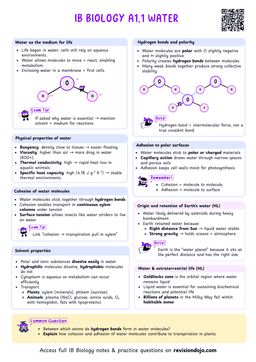
Osmosis is the net movement of water molecules across a semi-permeable membrane from a region of lower solute concentration to a region of higher solute concentration.
The membrane allows water to pass through but restricts larger solute molecules or ions.
- Water moves because of:
- Intermolecular Attractions: Water molecules form hydrogen bonds with solute molecules, creating a "pull" that draws water toward the solute.
- Net Movement: Although water moves in both directions across the membrane, more water moves toward the higher solute concentration, resulting in a net movement.
Always describe osmosis in terms of solute concentration, not water concentration.
Key Terms: Hypotonic, Hypertonic, and Isotonic
To describe the relative concentrations of solutions, we use three terms:
Hypotonic
A solution with a lower solute concentration compared to another solution.
Hypertonic
A solution with a higher solute concentration compared to another solution.
Isotonic
Two solutions with equal solute concentrations, resulting in no net movement of water.