Reflex Arcs Enable Rapid, Automatic Responses by Bypassing the Brain
Reflex arc
A pathway followed by nerve impulses during a reflex action, including the sensory and motor neurons and sometimes an interneuron.
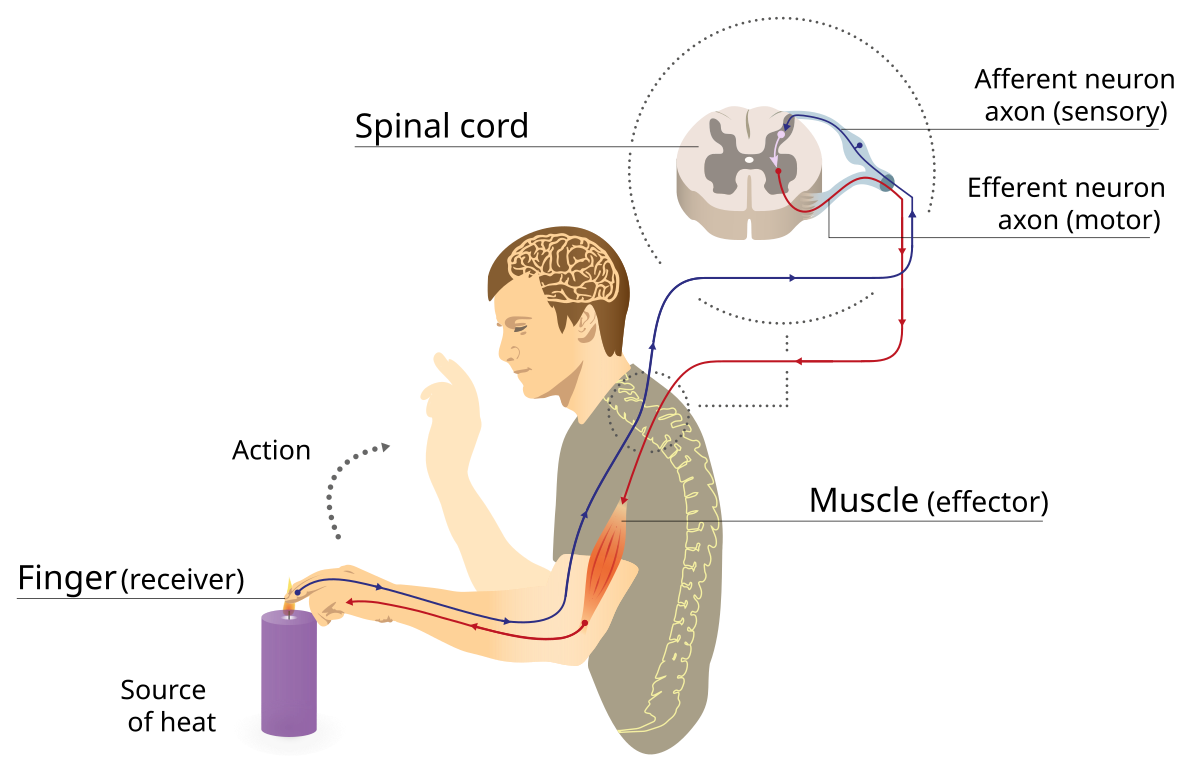
- A reflex arc involves a series of interconnected neurons that transmit signals from a sensory receptor to an effector, bypassing the brain for faster response.
- Reflexes bypass conscious control by directly involving the spinal cord rather than the brain, making them fast and automatic.
- Imagine touching a hot stove.
- Before you even think about it, your hand jerks away.
- This automatic reaction is a reflex, a rapid response designed to protect you from harm.
Components of a Reflex Arc
Reflex arcs are the simplest form of neural coordination, involving just a few key components:
- Receptor: Detects the stimulus (e.g., pain, heat).
- Sensory Neuron: Transmits the signal to the central nervous system (CNS).
- Interneuron: Processes the signal in the spinal cord.
- Motor Neuron: Carries the response signal to the effector.
- Effector: Executes the response (e.g., muscle contraction).
Pain Reflex Arc in Action: A Step-by-Step Breakdown
1. Receptor: Detecting the Stimulus
- Free Sensory Nerve Endings: Specialized nerve endings in the skin act as pain receptors.
- Stimulus Detection: When you touch something harmful, these receptors generate an electrical signal called a nerve impulse.
Pain receptors are nociceptors, designed to detect potentially damaging stimuli like extreme heat or pressure.
2. Sensory Neuron: Transmitting the Signal
- Pathway to the CNS: The sensory neuron carries the nerve impulse from the receptor to the spinal cord.
- Structure: Sensory neurons have long axons that enable them to transmit signals over significant distances.
The sensory neuron enters the spinal cord through the dorsal root, a bundle of nerve fibers that connects peripheral nerves to the CNS.
3. Interneuron: Processing in the Spinal Cord
- Location: Interneurons are located in the grey matter of the spinal cord.
- Role: They act as a bridge, relaying the signal from the sensory neuron to the motor neuron.
- Decision-Making: The interneuron processes the signal and determines the appropriate response such as contracting a muscle to withdraw your hand.
- Don’t confuse interneurons with sensory or motor neurons.
- Interneurons are entirely within the CNS and do not extend to the body’s periphery.
4. Motor Neuron: Delivering the Response
- Signal Transmission: The motor neuron carries the processed signal from the spinal cord to the effector (e.g., a muscle).
- Effector Activation: When the signal reaches the muscle, it triggers a contraction, causing your hand to move away from the harmful stimulus.
Think of the motor neuron as a delivery driver, transporting instructions from the CNS to the muscles, telling them exactly what to do.
5. Effector: Executing the Response
- Role of Skeletal Muscles: In this reflex arc, the effector is a skeletal muscle, which responds by contracting.
- Involuntary Action: The muscle contraction is automatic and does not require conscious thought, ensuring a rapid response.
When you touch a hot surface, the muscles in your arm contract to pull your hand away, minimizing potential injury.
Think of the pain reflex arc like a fire alarm system:
- The fire sensor detects the heat (sensory receptor).
- It sends a signal to the control panel (spinal cord).
- The control panel sends a signal to the sprinkler system (motor neuron), causing an immediate response.
You don’t have to think about it—the system works automatically to protect you from the heat.
Why Reflex Arcs Are So Fast
- Reflex arcs are designed for speed, bypassing the brain to save time.
- Instead of traveling to the brain for processing, the signal is handled directly by the spinal cord.
- This shortcut reduces response time, which can be critical in preventing injury.
While the reflex action occurs, a separate signal is sent to the brain, allowing you to become aware of the pain after your hand has already moved away.
Reflex Arcs and System Integration
Reflex arcs demonstrate how different body systems work together seamlessly:
- Nervous System: Transmits and processes signals.
- Muscular System: Executes the response through muscle contraction.
- Skeletal System: Provides the framework for muscle movement.
- How do reflex arcs illustrate the concept of emergent properties in biology?
- Consider how the integration of neurons and muscles creates a response that is greater than the sum of its parts.
- What is the function of the interneuron in a reflex arc?
- How does a sensory neuron differ from a motor neuron in a reflex arc?
- What are the five key components of a reflex arc?
- How does the spinal cord’s involvement make reflexes faster than voluntary actions?