Transmembrane Receptors for Neurotransmitters and Changes to Membrane Potential
- Transmembrane receptors for neurotransmitters play a critical role in cellular communication by converting chemical signals into electrical responses.
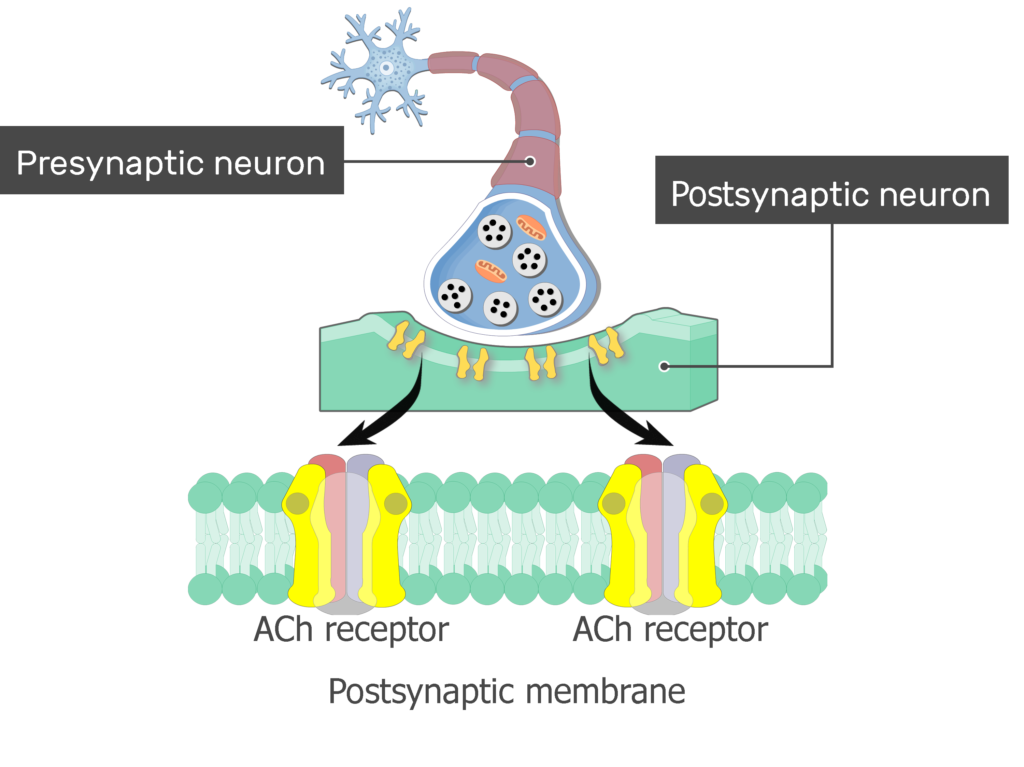
- One classic example is the acetylcholine receptor (AChR), a type of ligand-gated ion channel.
- The binding of acetylcholine (a neurotransmitter) to its receptor triggers a series of events that alter the membrane potential, leading to downstream cellular responses.
- Imagine flipping a light switch.
- The action is small, but it triggers a cascade of events that illuminate a room.
- In biology, neurotransmitters act like this switch, initiating changes in a cell by binding to transmembrane receptors.
- These receptors are essential for communication between neurons and other cells, such as muscle fibers.
Membrane potential
Membrane potential is the difference in electrical charge between the inside and outside of a cell.
- Transmembrane receptors are proteins that span the plasma membrane, with one part exposed to the extracellular environment and another facing the cytoplasm.
- They act as gatekeepers, receiving signals from the outside and transmitting them into the cell.
- These receptors are highly specific, binding only to particular molecules, called ligands.
- A ligand is a molecule that binds to a specific site on a receptor, much like a key that fits into a lock.
The Acetylcholine Receptor: A Classic Example
- Acetylcholine is a neurotransmitter that plays a crucial role in transmitting signals across synapses, particularly at the junctions between neurons and muscle fibers.
- The acetylcholine receptor is a transmembrane protein that acts as both a receptor and an ion channel.
How It Works
- Binding of Acetylcholine: When acetylcholine is released into the synaptic gap, it diffuses across and binds to the receptor on the postsynaptic membrane.
- Conformational Change: This binding causes the receptor to change shape, opening an ion channel within the protein.
- Ion Flow: Positively charged ions, such as sodium ($\text{Na}^+$), flow into the cell through the open channel.
- Depolarization: The influx of $\text{Na}^+$ ions reduces the negative charge inside the cell, causing a change in membrane potential. This local depolarization can trigger an action potential or muscle contraction.
Depolarization
A change in the membrane potential of the presynaptic neuron, making it more positive.
The acetylcholine receptor is a ligand-gated ion channel, meaning it opens in response to the binding of a specific ligand (acetylcholine).
Quick review of the steps to remember the action of acetylcholine receptor
- Step 1: Acetylcholine (ACh) is released from the presynaptic neuron.
- Step 2: Acetylcholine binds to the acetylcholine receptor on the postsynaptic membrane.
- Step 3: The binding of ACh causes the receptor ion channel to open.
- Step 4: Positively charged ions (Na⁺ or Ca²⁺) flow into the postsynaptic cell.
- Step 5: This influx of positive ions leads to depolarization of the membrane.
- Step 6: The signal can be propagated if the depolarization reaches a threshold, causing an action potential.
Changes in Membrane Potential
- At rest, the inside of a cell is more negative compared to the outside.
- When ions flow through the receptor, this balance shifts, creating a depolarization.
- If the depolarization is strong enough, it can trigger an action potential, a rapid electrical signal that travels along the neuron or muscle fiber.
Depolarization occurs when the membrane potential becomes less negative (or more positive) due to the influx of positively charged ions.
Why Is This Important?
The ability of neurotransmitters to change membrane potential is critical for:
- Neural Communication: Transmitting signals between neurons.
- Muscle Contraction: Initiating the contraction of muscle fibers.
- Reflexes and Responses: Enabling rapid responses to stimuli.
- When you touch a hot surface, sensory neurons release neurotransmitters that bind to receptors in motor neurons.
- This triggers a rapid response, causing your muscles to contract and pull your hand away.
Broader Implications
Transmembrane receptors are not limited to neurotransmitters. They play roles in:
- Hormonal Signaling: Receptors for hormones like insulin regulate glucose uptake.
- Immune Responses: Cytokine receptors help coordinate immune activity.
- Cell Growth and Division: Growth factor receptors control cell proliferation.
How do the structural differences between transmembrane and intracellular receptors reflect their roles in cell signaling? Consider how these differences might influence the speed and specificity of the signals they transmit.
- What are transmembrane receptors, and how do they work?
- How does the acetylcholine receptor change membrane potential?
- Why is the ability to change membrane potential important for cells?