Interdependence of the Light-Dependent and Light-Independent Reactions
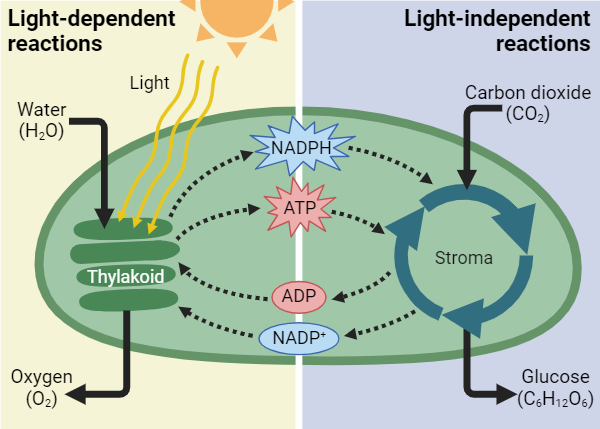
- Photosynthesis is a two-part process:
- Light-dependent reactions: These occur in the thylakoid membranes of the chloroplast and convert light energy into chemical energy (ATP and reduced NADP).
- Light-independent reactions: Also known as the Calvin cycle, these occur in the stroma and use ATP and reduced NADP to fix carbon dioxide into glucose.
- These stages are interdependent, neither can function alone for long.
Note
- These reactions require light.
- Without it, ATP and NADPH production halts.
Analogy
- Think of the light-dependent reactions as the power plant, which generates electricity (ATP and NADPH).
- The Calvin cycle is like the grid that uses this electricity to power different systems (carbon fixation and glucose production).
- If there is no CO2 (fuel) or no light (energy source), the power plant (LDR) cannot generate electricity, and the grid (Calvin cycle) goes offline.
How Light-Independent Reactions Build Glucose
- Location: Stroma of chloroplasts.
- Key Processes:
- Carbon Fixation: $CO_2$ combines with RuBP, catalyzed by Rubisco.
- Reduction: ATP and NADPH convert glycerate 3-phosphate into triose phosphate.
- Regeneration of RuBP: ATP regenerates RuBP, allowing the cycle to continue.
Note
These reactions don’t need light directly but rely on ATP and NADPH from the light-dependent stage.
Why the Two Stages Depend on Each Other
1. Light-Dependent Reactions Need NADP
- NADP acts as an electron carrier, accepting electrons to form NADPH.
- Without NADP, electrons have nowhere to go, and the electron transport chain stops.
Common Mistake
- A common misconception is that the light-independent reactions can continue indefinitely in the dark.
- In reality, they stop once ATP and NADPH are depleted.
2. Light-Independent Reactions Need ATP and NADPH
- ATP provides energy, and NADPH supplies electrons for reducing $CO_2$.
- Without these molecules, the Calvin cycle cannot produce glucose.
Hint
The light-independent reactions are sometimes called the "dark reactions," but they don’t work without the products of the light-dependent reactions.
What Happens When Conditions Change?
1. Lack of Light
- Stops the Light-Dependent Reactions:
- No ATP or NADPH production.
- The Calvin cycle halts once existing ATP and NADPH are used up.
2. Lack of CO₂
- Disrupts the Calvin Cycle:
- RuBP cannot be converted into glycerate 3-phosphate.
- NADP is not regenerated, slowing the light-dependent reactions.
Example
- In a greenhouse, if CO₂ levels drop, photosynthesis slows even if light is abundant.
- This is why CO₂ enrichment is used to boost plant growth.
Balancing the Two Stages
- Photosynthesis is a finely tuned process.
- If one stage slows down, the other is affected.
- This balance ensures that resources like ATP and NADPH are used efficiently.
Theory of Knowledge
- How does the interdependence of photosynthesis reflect broader themes of interconnectedness in biology?
- Can you think of other systems where different parts rely on each other?