The Electron Transport Chain: A Series of Carriers
Definition
Electron transport chain (ETC)
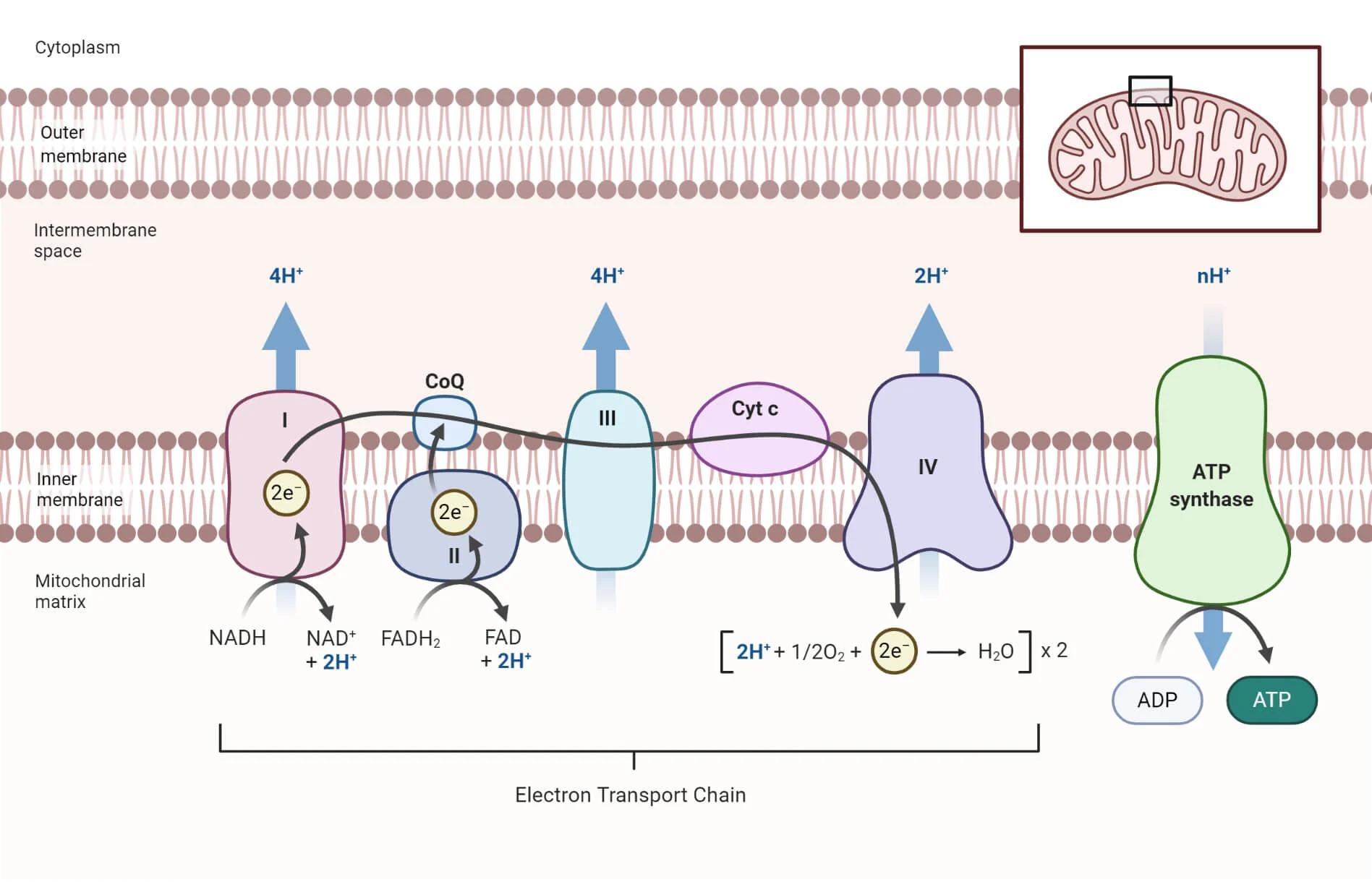
A series of protein complexes embedded in the inner mitochondrial membrane.
After NADH and FADH₂ donate electrons to the ETC (covered in C1.2.13), those electrons flow through these carriers in sequence.
Hint
- Electrons don't release all their energy at once.
- The stepwise transfer through multiple carriers allows the cell to capture energy efficiently at each stage, rather than losing it all as heat.
Step-by-Step: How Electron Flow Generates The Proton Gradient
The electron transport chain doesn't works as a sequence of controlled transfers that efficiently extracts energy from electrons.
Step 1: Electrons Enter the Chain
- NADH donates electrons to the first carrier protein in the ETC.
- FADH₂ donates electrons to a carrier further down the chain.
Hint
- FADH₂ enters later in the chain than NADH, so it releases less energy overall.
- This is why FADH₂ results in fewer protons being pumped and less ATP produced compared to NADH.
Step 2: Electrons Move Through Carriers
- Electrons pass from one protein complex to the next.
- Each transfer involves a redox reaction, one carrier is reduced (gains electrons), then oxidized (passes electrons to the next carrier).
- As electrons pass from carrier to carrier, they move to lower energy levels.
Step 3: Energy is Released
- Energy is released at each transfer step as electrons drop to lower energy levels.
- This energy is captured by the protein complexes, it's not lost as heat.
Hint
- Electrons don't release all their energy at once.
- The stepwise transfer through multiple carriers allows the cell to capture energy efficiently at each stage, rather than losing it all as heat.
Step 4: Released Energy Drives Proton Pumping
- The protein complexes in the ETC use the captured energy to actively pump protons (H⁺) from the mitochondrial matrix into the intermembrane space.
- Protons are pumped against their concentration gradient (from low H⁺ to high H⁺).
- This is active transport, requiring energy input.
Common Mistake
- Don't confuse where the energy comes from.
- The energy for pumping protons doesn't come from ATP, it comes from the electrons moving down the chain.
- The ETC creates the conditions for ATP synthesis; it doesn't use ATP.
Step 5: The Proton Gradient Forms
- Continuous proton pumping creates:
- High H⁺ concentration in the intermembrane space.
- Low H⁺ concentration in the matrix.
- This difference is the proton gradient (also called the electrochemical gradient).The gradient stores potential energy.
Hint
The gradient exists across the inner mitochondrial membrane, between the intermembrane space and the matrix.
Self review
- What happens to energy as electrons move through carriers in the ETC?
- How is the energy released during electron transfer used?
- In which direction are protons pumped? From matrix to intermembrane space, or vice versa?
- Where exactly is the proton gradient located in the mitochondrion?