Leaves Are Adapted to Maximize Gas Exchange For Photosynthesis And Respiration
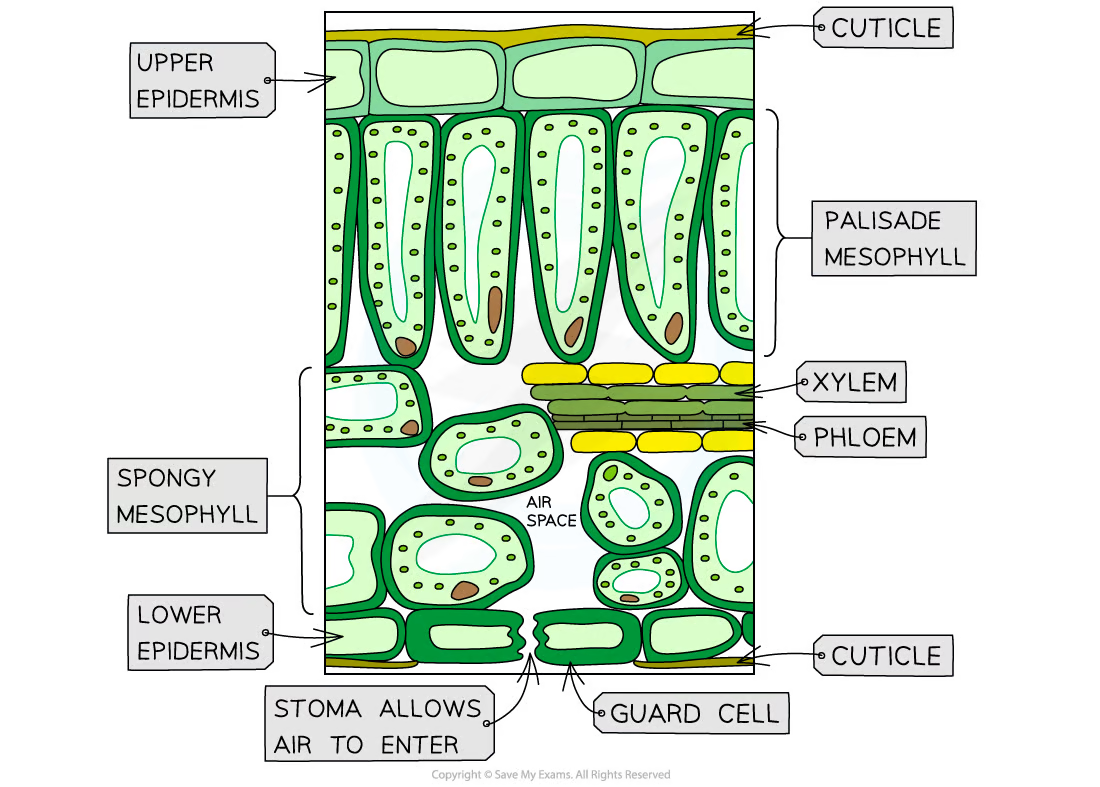
The Waxy Cuticle
- Acts as a waterproof barrier to reduce water loss by evaporation.
- Its low gas permeability is balanced by specialized structures like stomata.
The thickness of the waxy cuticle varies among plants. For example, desert plants (xerophytes) have a thicker cuticle to reduce water loss, while plants in humid environments have a thinner cuticle.
The Epidermis
- A transparent layer that protects the leaf and allows sunlight to pass through to photosynthetic tissues.
- Houses stomata, which are crucial for gas exchange.
Remember, the transparency of the epidermis is crucial for allowing maximum sunlight to reach the chloroplast-rich cells below, ensuring efficient photosynthesis.
Stomata and Guard Cells
- Stomata are tiny pores (mainly on the leaf underside) that allow gases like CO2 in and O2 out.
- Guard cells control the opening and closing of stomata, adapting to environmental conditions to minimize water loss.
- Imagine a sunny day when photosynthesis is active. The plant opens its stomata to absorb $CO_2$ for photosynthesis.
- However, if the soil dries out, the stomata close to prevent dehydration, even if it means slowing down photosynthesis.
- Many students assume stomata are always open during the day and closed at night.
- While this is generally true, stomatal behavior can vary based on environmental factors like humidity, temperature, and $CO_2$ levels.
Spongy Mesophyll
- A loosely packed layer with air spaces to increase the surface area for gas diffusion.
- Moist cell walls allow gases to dissolve, aiding efficient diffusion.
Think of the air spaces in the spongy mesophyll as an interconnected network of highways, allowing gases to move freely between the stomata and the photosynthetic cells.
Leaf Veins: Transporting Water and Nutrients
- Veins in a leaf are composed of vascular tissues:xylem and phloem.
- These structures play an indirect but vital role in gas exchange:
- Xylem: transports water from the roots to the mesophyll cells, maintaining the moist surface required for efficient gas diffusion.
- Phloem: carries away the sugars produced during photosynthesis, ensuring the plant has the energy to sustain its metabolic processes.
Leaf veins are also structurally important, providing support to the leaf and preventing it from collapsing under its own weight.
How All These Adaptations Work Together
- Each of the adaptations discussed above contributes to the leaf's ability to exchange gases efficiently while minimizing water loss.
- To summarize:
- Waxy Cuticle:Reduces water loss but restricts gas diffusion.
- Epidermis:Protects internal tissues while allowing light to pass through.
- Stomata and Guard Cells:Regulate the entry and exit of gases and water vapor.
- Spongy Mesophyll: Provides a large, moist surface area for gas exchange.
- Veins:Supply water and nutrients while transporting sugars away.
Think of a leaf as a factory. The stomata are the doors controlling the flow of raw materials ($CO_2$) and finished products ($O_2$). The spongy mesophyll is the production floor where photosynthesis occurs, and the veins are the conveyor belts transporting supplies and products to and from the factory.
The Challenge of Balancing Gas Exchange and Water Conservation
- While leaves are highly efficient at gas exchange, they face a constant trade-off: opening stomata for gas exchange increases the risk of water loss.
- Plants have evolved several strategies to address this challenge:
- Closing Stomata at Night:Since photosynthesis does not occur in the absence of light, stomata are closed at night to conserve water.
- Thicker Cuticle in Dry Environments:Plants in arid regions often have a thicker waxy cuticle to minimize water loss.
- Sunken Stomata and Hairy Leaves:Some plants have stomata recessed in pits or surrounded by hairs, which trap moisture and reduce water loss.
- What role do guard cells play in regulating gas exchange?
- Why is the spongy mesophyll important for gas exchange?
- How does the waxy cuticle help plants survive in dry environments?