Lipid Bilayers Are The Basis of Cell Membranes
- The lipid bilayer forms the foundation of all cell membranes, defining the boundary between a cell and its environment.
- This versatile structure controls the passage of substances into and out of the cell while maintaining compartmentalization within eukaryotic cells.
The Essential Structure of the Lipid Bilayer
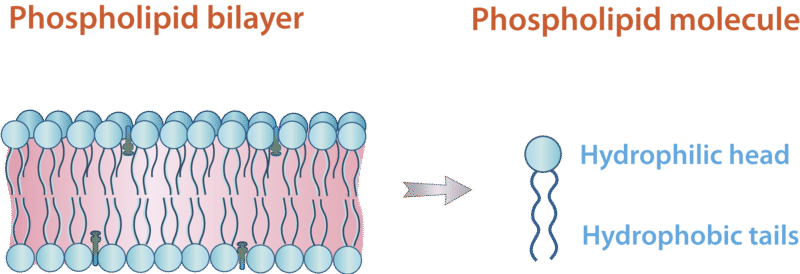
- The lipid bilayer consists of two layers of phospholipids and other amphipathic molecules.
- These specialized molecules self-assemble into a bilayer due to their unique chemical properties:
- Hydrophilic heads (polar regions) face outward toward water.
- Hydrophobic tails (non-polar regions) cluster inward, away from water.
Structure of a Phospholipid
- Hydrophilic Head: The polar phosphate group forms the head, which readily interacts with water.
- Hydrophobic Tails: The nonpolar hydrocarbon chains make up the tails which avoid water.
- This amphipathic nature is key to the behavior of phospholipids in water.
- When introduced into an aqueous environment, they spontaneously arrange themselves to shield their hydrophobic tails while exposing their hydrophilic heads to water.
Definition
Amphipathic
Amphipathic: A molecule that has both hydrophilic (water-attracting) and hydrophobic (water-repelling) regions.
Formation of the Lipid Bilayer
How Does This Work?
- Hydrophobic Interactions: The hydrophobic tails cluster together, avoiding contact with water and reducing the system's free energy.
- Hydrophilic Interactions: The hydrophilic heads form hydrogen bonds with water molecules, stabilizing the bilayer structure.
- The result is a stable, self-sealing bilayer.
- If disrupted, the bilayer will spontaneously reassemble, a property critical for maintaining the integrity of cell membranes.
Why Lipid Bilayers Are Perfect Barriers
1. Selective Permeability
- The bilayer’s hydrophobic core makes it selectively permeable:
- Small Nonpolar Molecules: These can diffuse freely through the bilayer (e.g., oxygen and carbon dioxide).
- Large or Polar Molecules: These are blocked by the hydrophobic core and require specialized transport proteins to cross.
2. Fluidity and Flexibility
- The lipid bilayer is fluid, allowing phospholipids to move laterally within the layer.
- This fluidity enables the membrane to adapt its shape, repair itself when damaged, and facilitate processes like cell division and vesicle formation.
The Role of Other Amphipathic Lipids
- While phospholipids are the primary components of the bilayer, other amphipathic lipids contribute to its function:
- Cholesterol: Found in animal cell membranes, cholesterol fits between phospholipids, modulating membrane fluidity and stability.
- Glycolipids: These lipids, with attached carbohydrate groups, play roles in cell recognition and signaling.
Exam technique
A very high yield exam tip is to know the function of cholesterol and what cells contain cholesterol