Water As A Solvent
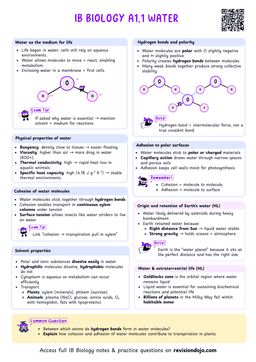
- Water is often called the "universal solvent" because it dissolves a wide variety of substances, due to its polarity.
- When polar or charged substances enter water, water molecules surround them, forming hydration shells.
- The δ− oxygen attracts positive charges; the δ+ hydrogens attract negative charges.
- This separates and suspends the particles, keeping them dissolved.
Hint
This interaction explains why water dissolves most ionic and polar substances efficiently, making it essential for cellular processes.
What Dissolves In Water
- Hydrophilic ("water-loving") dissolve:
- Polar molecules and charged ions are hydrophilic.
- Dissolves easily in water.
- Eg. Glucose, amino acids, sodium ions (Na⁺), chloride ions (Cl⁻).
- Hydrophobic ("water-fearing") don't dissolve:
- Non-polar molecules are hydrophobic.
- Do not dissolve in water.
- Dissolves in non-polar solvents instead.
- Eg. Fats, oils, cholesterol.
Example
- Hydrophilic substances: Eg. Glucose, amino acids, sodium ions (Na⁺), chloride ions (Cl⁻).
- Hydrophobic substances: Fats, oils, cholesterols
Hint
- "Like dissolves like."
- Polar solvents (water) dissolve polar solutes, but not non-polar solutes.
Water's Solvent Properties Make It the Ideal Medium for Metabolism
Definition
Metabolism
The sum of all chemical reactions occurring in an organism to maintain life, including reactions that break down molecules for energy (catabolism) and reactions that build molecules for growth and repair (anabolism).
- The cytoplasm and the interior of organelles are aqueous solutions, water containing dissolved substances.
- Because water dissolves both enzymes and substrates (reactants), metabolic reactions can occur efficiently.
- In other words, the fact that water dissolves so many substances makes it the perfect environment for the thousands of chemical reactions that sustain life.
Water's Solvent Properties Enable Transport in Plants
Plants rely on water as a transport medium in two vascular systems:
- Xylem sap:
- Transports mineral ions (e.g., nitrate NO₃⁻, phosphate PO₄³⁻, potassium K⁺) from roots to leaves.
- These ions are charged, so they dissolve readily in water.
- Dissolved ions can be absorbed by root cells and transported upward in the xylem's aqueous sap.
- Phloem sap:
- Transports sucrose (a polar sugar) and amino acids from photosynthetic leaves to other parts of the plant.
- Both are hydrophilic, dissolving in the aqueous phloem sap.
- This allows energy and building blocks to be distributed throughout the plant.
Hint
Because water dissolves these essential nutrients, plants can move them from where they're produced (or absorbed) to where they're needed.
Water's Solvent Properties Enable Transport in Animals
- In animals, blood plasma (which is ~90% water) serves as the primary transport medium.
- Water's ability to dissolve ions, glucose, and amino acids makes blood plasma an effective transport system.
Example
- Substances dissolved in plasma:
- Ions (Na⁺, Cl⁻): Dissolve completely; essential for nerve impulses, muscle contraction, and osmotic balance.
- Glucose and amino acids: Polar molecules that dissolve fully; transported to cells for cellular respiration and protein synthesis.
- Oxygen (special case): Non-polar with very low solubility in water; transported by binding to hemoglobin in red blood cells instead of dissolving in plasma.
Self review
- Why is water called a "universal solvent"?
- What types of substances dissolve in water?
- What types of substances do not dissolve in water?
- Why do most metabolic reactions occur in aqueous solution?
- How does water's ability to dissolve substances help enzymes function?