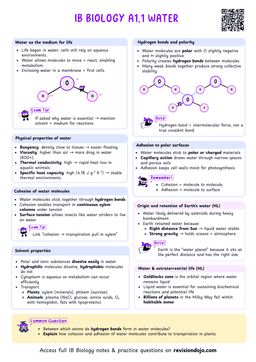
The Structure of a Water Molecule
- A water molecule consists of one oxygen atom and two hydrogen atoms bonded together by covalent bonds.
- Covalent bonds form when atoms share electrons.
- However, in water, the sharing is unequal because oxygen is more electronegative than hydrogen.
Definition
Electronegativity
Electronegativity is an atom's ability to attract electrons in a bond.
Polarity: Unequal Charge Distribution
- Because oxygen pulls electrons closer:
- The oxygen atom develops a partial negative charge (δ−).
- The hydrogen atoms develop partial positive charges (δ+).
- This uneven charge distribution makes water a polar molecule, it has a positive end (hydrogen side) and a negative end (oxygen side).
Polarity Enables Hydrogen Bonding
- This polarity is what allows hydrogen bonds to form between water molecules:
- The δ+ hydrogen of one molecule is electrostatically attracted to the δ− oxygen of a neighboring molecules.
- Because opposite charges attract, these polar regions create weak intermolecular attractions.
- These attractions are hydrogen bonds.
Note
Although a single hydrogen bond is weak, water molecules are small and numerous, allowing for a dense network of these bonds.
Hint
Polarity from unequal electron sharing → partial charges → electrostatic attraction between molecules → hydrogen bonding.
Analogy
- Think of a game of tug-of-war between two players of unequal strength.
- The stronger player pulls the rope closer to their side.
How to Draw a Water Molecule
To show the structure and polarity of water:
- Draw the Atoms:
- Place one oxygen atom (O) in the center.
- Add two hydrogen atoms (H) on either side, positioned at an angle of approximately 104.5° to each other, reflecting the molecule's bent shape.
- Show the Bonds:
- Draw a single covalent bond (-) between each hydrogen atom and the oxygen atom. These represent shared electrons.
- Indicate Partial Charges:
- Label the oxygen atom with a partial negative charge (δ⁻) because it is more electronegative and pulls shared electrons closer.
- Label each hydrogen atom with a partial positive charge (δ⁺) because electrons are drawn away from them.
Exam technique
Always include partial charges (δ+ and δ−) when drawing water molecules to show polarity.
Self review
- What is the chemical formula for water?
- What type of bond connects hydrogen and oxygen within a water molecule?
- What is electronegativity?
- Why does oxygen have a partial negative charge in water?
- Why do hydrogen atoms have partial positive charges in water?
- What does it mean for a molecule to be polar?
- How does polarity lead to hydrogen bonding between water molecules?
- Draw a water molecule showing its bent shape and partial charges.
- What is a hydrogen bond?
- Between which atoms does a hydrogen bond form in water?