Macroeconomic objectives
Key goals of governments in achieving economic stability include sustainable growth, low inflation, low unemployment, balanced trade, and income equality.
- Governments aim to achieve multiple macroeconomic objectives simultaneously, including price stability, full employment, economic growth, and balance of payments stability.
- However, pursuing one objective often requires trade-offs with others, creating complex policy dilemmas.
Low Unemployment and Low Inflation
Defining Low Unemployment
- The lowest sustainable unemployment rate an economy can achieve without triggering accelerating inflation is called the natural rate of unemployment (typically 4–6%).
- Frictional, structural, and cyclical unemployment all contribute to the natural rate. When these types remain low, the natural rate is also low.
Students often think 0% unemployment is ideal and achievable. However, some unemployment is natural and even necessary for a healthy economy!
Defining low inflation
Low inflation is typically defined by central banks as a stable price level with inflation around 2%.
- The European Central Bank (ECB) aims for inflation “below, but close to 2%.”
- When inflation surged to 10.6% in 2022, the ECB took dramatic action by raising interest rates.
- Many students think zero inflation is best.
- Actually, a small positive inflation rate helps the economy adjust to shocks and prevents deflation!
- In an ideal world, we would want both low inflation and low unemployment.
- Low unemployment drives economic growth and higher GDP, while also reducing government spending on welfare.
- Low inflation ensures price stability and economic certainty, which are vital for planning.
- Low inflation also boosts international competitiveness, as exports become cheaper, leading to greater demand.
- However, these objectives are not fully independent. They are interconnected through wage pressures and aggregate demand, meaning there is often a trade-off.
- During the 1960s, Australia maintained unemployment below 2% while experiencing strong economic growth.
- This “golden age” demonstrated how low unemployment can boost an economy’s overall performance.
- How do we determine the “optimal” balance between unemployment and inflation?
- This raises questions about measuring social welfare and making economic trade-offs.
Trade-off between unemployment and inflation (HL only)
- The relationship between unemployment and inflation was first identified by A.W. Phillips in the 1950s, based on observations of wage rates and unemployment data.
- This discovery led economists to develop several theoretical explanations for why this trade-off occurs:
- Wage-Price Spiral
- Labour Market Dynamics
- Aggregate Demand Effects
Wage–Price Spiral
- Lower unemployment leads to higher wage demands.
- Higher wages increase production costs.
- Businesses raise prices to protect profits.
- Workers then demand higher wages to maintain purchasing power.
Labour Market Dynamics
- Low unemployment gives workers stronger bargaining power.
- Employers compete for scarce labour by offering higher wages.
- Higher wages boost consumer spending.
Aggregate Demand Effects
- Increased employment raises disposable income.
- Higher income drives up aggregate demand.
- Rising demand puts upward pressure on prices.
This is how the link between employment and inflation operates through changes in overall spending power in the economy.
Students often miss that the wage–price spiral is a continuous cycle as each round of wage increases can trigger further price increases!
These theoretical relationships can be demonstrated using the AD/AS framework shown below in Figure 1 below.
- The AD/AS diagram is a powerful tool for understanding the relationship between unemployment and inflation.
- When different levels of aggregate demand (AD) are plotted against a given short-run aggregate supply (SRAS) curve, each intersection point shows a unique combination of inflation and unemployment.
- Moving from AD1 to AD2: the price level rises (inflation), real GDP increases (unemployment falls), and a point appears on the Phillips curve.
- As further rightward shifts in AD occur, we can map out the Phillips curve, where each new intersection point represents another possible combination of inflation and unemployment.
- During the 2008 financial crisis, many countries experienced a sharp fall in aggregate demand (AD1 to AD2), moving along their Phillips curves toward higher unemployment but lower inflation.
- However, unprecedented monetary policy responses disrupted this traditional relationship.
- This illustrates how modern economic conditions can challenge the simple AD/AS framework.
Short-run and long-run Phillips curve
Modern economic understanding differentiates between short-run and long-run relationships.
Short-run Phillips Curve
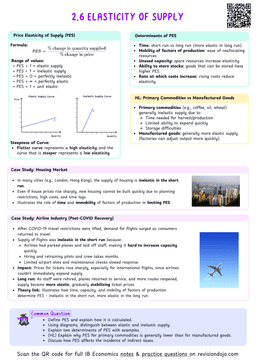
The short-run Phillips curve shows a downward-sloping relationship, where lower unemployment is associated with higher inflation.
The short-run Phillips curve assumes workers and firms have not yet adjusted their inflation expectations, which is a crucial point for understanding why the trade-off eventually breaks down.
Figure 2 shows both the short-run Phillips curve (SRPC) and the long-run Phillips curve (LRPC), with the unemployment rate on the X-axis and the inflation rate on the Y-axis.
- The SRPC is downward sloping and represents a temporary trade-off.
- Changes in aggregate demand cause movements along the curve.
- Shifts of the curve occur due to expectations or supply shocks.
- The LRPC is vertical, consistent with the natural rate hypothesis:
- The economy gravitates toward a natural rate of unemployment.
- In the long run, there is no permanent trade-off between inflation and unemployment.
- Historical evidence shows that while the short-run Phillips curve (SRPC) may hold temporarily, economies do not remain at points on the long-run Phillips curve (LRPC) indefinitely.
- The 2008 financial crisis and the COVID-19 pandemic further complicated our understanding of this relationship.
- Recognition that unemployment cannot be permanently lowered through inflation highlights the need for structural solutions rather than purely monetary policies to address unemployment.
- The long-run Phillips curve (LRPC) does not mean monetary policy is ineffective.
- Rather, it simply highlights its limitations in influencing real variables like unemployment over the long term.